Mechanical Engineering Capstone Design Experience – Information for Students
Welcome to the Mechanical Engineering Capstone Design webpage for students. This page provides an overview of the capstone design course sequence, prerequisite courses, the registration process, the types of projects offered, and general purchasing logistics. We hope the information provided helps you prepare for your capstone experience and make the most of the available opportunities.To see details about the registration process and prerequisite courses click the button below.
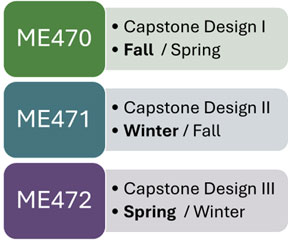 The Capstone design sequence in the mechanical engineering curriculum is a culminating experience in which students are expected to integrate the knowledge and skills they have acquired throughout the curriculum. Students work in teams of four on a design project for three consecutive terms. It is the first time students have worked on a project of this magnitude spanning over three quarters with the same instructor, client, and team. Each student typically spends 12 hours per week on the project over 28 weeks. Sometimes projects end early, or things change, and we handle it similarly to how we would in an industry setting. Our goal is to simulate a real-world experience while still providing you with guidance and support. We encourage students to come prepared with an open mind to make the best use of their time and build on their skills.
The objective in the capstone is to solve a complex engineering problem while demonstrating your ability to communicate, work in a team, plan projects, apply engineering ethics, explore design ideas, make decisions, and engage in self-directed learning. A sample syllabus can be found here.
Capstone prepares you to launch your career as a mechanical engineer. The capstone course is unique; unlike other courses, we don’t have a solution to the problem. You develop the solution, and the instructor serves as a mentor who oversees the direction you take and steers you only as necessary. The team regularly communicates with the client, and we recommend meeting every other week. In these meetings, you share the progress you have made so far and ask any clarifying questions to your client.
Things to do before you get started as a rising senior….
- Attend the Capstone info session meeting and/or the multi-disciplinary (MDS) Capstone info session.
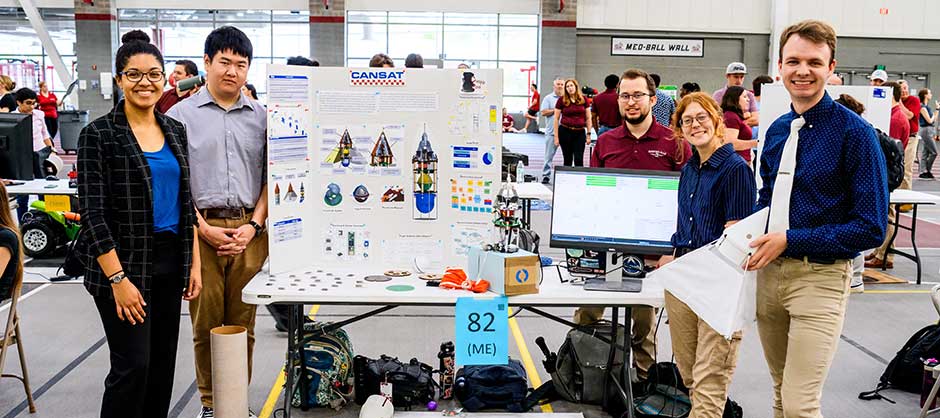
- Attend the Rose Show and talk to the students who are presenting their work, and get to know the variety of the projects that we offer
- Take BIC/KIC shop training classes in the spring quarter
- Your training is valid for next year, and you only need to take a one-hour refresher course.
- Schedule for the upcoming month comes out at Noon on the last Friday of each month
- Register for ME470 Capstone Design I class
- Let us know if you have any project ideas (see below for more details)
Types of Projects in Capstone
The ME capstone design course offers a diverse range of project types, each with distinct characteristics.
- Industry Sponsored Projects: Projects sponsored and guided by industry partners, often reflecting real-world industry challenges. Students are encouraged to suggest potential capstone project opportunities with the companies they are working with during their internships or co-ops.
- Entrepreneurial Projects: Projects that involve developing new products or business ventures. We welcome our recent grads and current students to propose entrepreneurial projects.
- Community-Based Service Projects: Projects aimed to support positive change by creating innovations that build on existing strengths within our community. Additionally, projects that focus on sustainability or work with people with disabilities.
- Course Development Projects: Projects focused on developing educational content or resources for courses at Rose-Hulman. In the past year, we created a printmaking press for an arts professor and a wind-tunnel traverse for the fluids lab.
- Competition Team Projects: Projects geared towards participating in engineering design competitions. Competition team projects are better suited for Spring Forward Capstone, as they align more closely with the competition timelines.
The project list will be available at the start of the academic year. For examples of past projects, see the Rose Show project lists below.