Impacting Communities: Rose-Hulman Capstone Projects
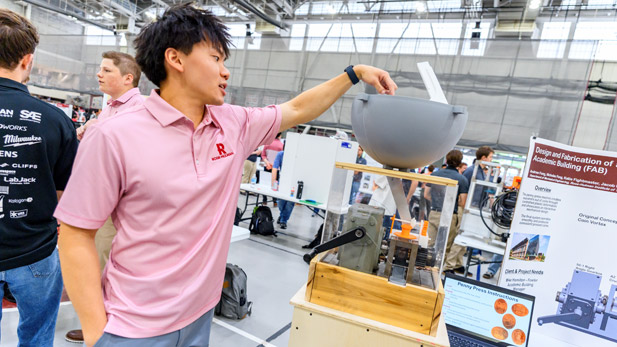
Throughout the 2026 Rose Show, students created innovations to make their communities better places to live, work, and play, including projects exploring games, athletics, and pressing global health concerns.
At their core, engineers, scientists, and mathematicians are dreamers. They see the world as a window of innovations to be unlocked, and throughout each academic year, seek the avenues where their interests can make the biggest impact. Through capstone, studio, and design projects, they hone their skills to fill unsolved needs in their communities and around the world, and display the differences they make at the annual Rose Show.
Artificial Pacer
Multidisciplinary Design
Alexander Spitzer, Andrew Cowlin, Abigail Leul
Maintaining consistent pacing is essential for effective run training, yet many athletes struggle to regulate speed without external feedback. This project presents the design and development of an artificial pacing robot intended for use on a standard running track. The robot travels at a user-defined speed, providing runners with a reliable visual reference to help maintain optimal training intensity. The system integrates precise motor control, a user communication interface, and autonomous navigation to ensure consistent performance along the track. By reducing pacing variability, this robot aims to improve training efficiency and support athletes in achieving more targeted and repeatable workout outcomes.
Hydroelectric Emergency Light
Engineering Design
Ethan Moen, Aidan Truby
In Tanzania, Ethiopia, and similar markets, power outages force families to spend limited income on kerosene, candles, and batteries, while students, small businesses, and health clinics lose critical hours of productivity. The Hydroelectric Emergency Light (HEEL) is a faucet that harnesses existing water flow to generate hands-free, omnidirectional light without a power grid, fuel, or batteries. One installation means that as long as water runs, light follows. The product enables individuals to perform everyday tasks with the hands-free light the faucet provides.
PneumaNode
Biology & Biomedical Engineering
Tommaso Calviello, Alyssa McGauley, Connor O'Connell, Katie Choi
Patients admitted to an intensive care unit (ICU) require continual monitoring, including regular checks of blood pressure, heartrate, respiratory rate, and lung function, and frequent assessments require nurses to spend much of their shifts performing routine monitoring tasks. Tommaso Calviello, Alyssa McGauley, Connor O'Connell, and Katie Choi developed a device to continuously monitor patients with the same level of accuracy as bedside nurses, with a particular focus on babies in the neonatal intensive care unit (NICU). PneumaNode is a small, stick-on sensor patch that continuously monitors a baby's vital signs, reducing clinician workload and improving diagnostic consistency.
"What impressed me most was not only the quality of the solution they developed with ResperCare LLC, but the way they worked together as a team, listening to one another, embracing feedback, and consistently putting the success of the project ahead of individual recognition," said Adel Alhalawani, PhD, faculty advisor to the project and assistant professor of biology and biomedical engineering.
Read more about the PneumaNode NICU monitoring system.
Visa Mapper
Computer Science & Software Engineering
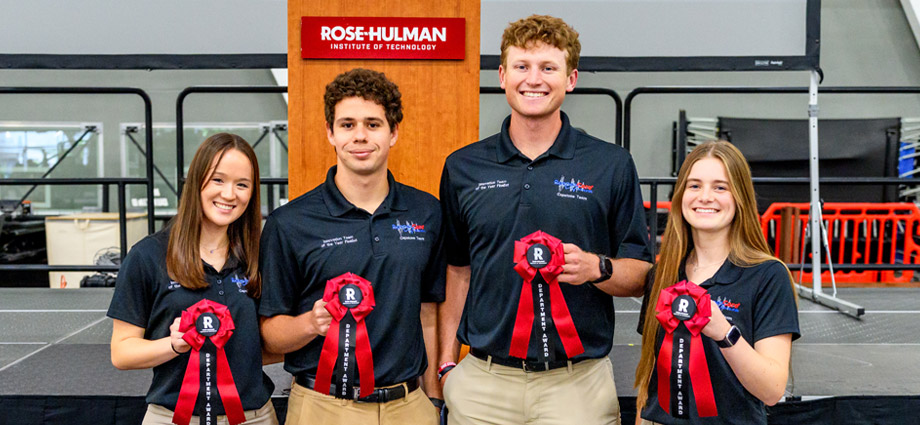
John Dickinson, Ethan Hutton, Ryan Jin, Wesley Schuh
Visa Mapper simplifies global travel by analyzing complex visa rules using a traveler's full profile, including passports, visas, and transit conditions. It uncovers hidden exemptions, including visa waivers based on third-party visas, that are often buried in fine print. The system extracts and structures data from semi-structured sources using AI that is fine-tuned to optimize accuracy and consistency. An intuitive interface lets users explore entry options, filter destinations, and view eligibility instantly, turning complicated regulations into clear, actionable, travel insights.
Design and Fabrication of a Penny Press Machine for the Fowler Academic Building (FAB)
Mechanical Engineering
Nicholas Fong, Andrew Fong, Jacob Ulewicz, Katie Fightmaster
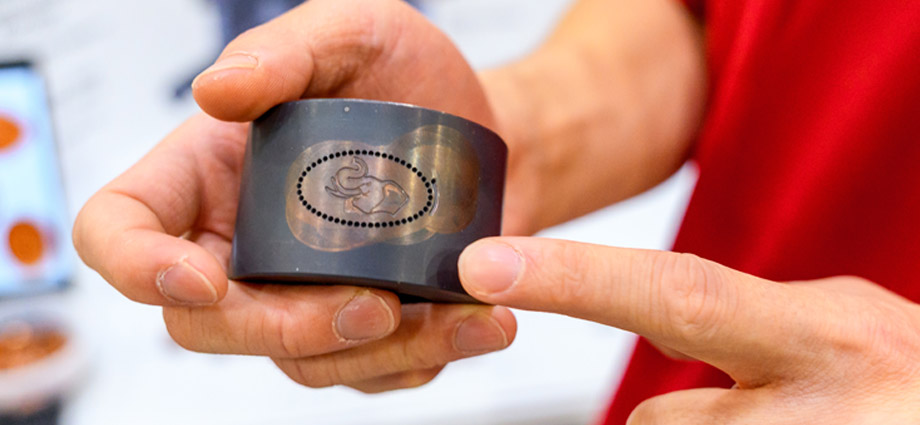
This project presents the design and fabrication of a rolling penny press for installation in the Fowler Academic Building (FAB), allowing users to create engraved souvenirs through controlled plastic deformation. The machine showcases engineering design through a visible, interactive mechanism. The completed system operates smoothly and produces consistent engraved coins, providing an engaging, hands-on experience for the Rose-Hulman community. The penny press machine provides a souvenir to campus visitors as unique and memorable as a Rose-Hulman education.
"It's kind of cool to have a lasting impact on Rose when I leave," said Jacob Ulewicz, a 2026 mechanical engineering graduate.
Project Bsafe
Electrical & Computer Engineering
Nikki Bonilla, Jiuzhou Lin, Ellis Gibbons, Nicola Ruiz
The Damien Center provides care to groups who have been historically stigmatized and marginalized, providing comprehensive and innovative HIV and AIDS care and prevention. The Damien Center offers services including medical care, case management, a harm reduction program, and a food pantry. In an area with a high rate of drug overdoses, bathrooms become common locations for overdoses, delaying medical response times. This project seeks to implement a cost-effective, privacy-respecting bathroom monitoring system to prevent fatal overdoses and other medical emergencies by enabling rapid staff intervention. The team developed two devices: a bathroom motion sensor to detect when patrons and visitors become unresponsive and a receiver to alert staff when an emergency occurs.
Wabash Valley Crew Rowing Shell Transportation Device
Mechanical Engineering
Alex Moeder, Benjamin Essex, Evan Miller
The Wabash Valley recently launched a crew team, providing youth the opportunity to learn to row on the Wabash River. This project is to assist younger kids with physical limitations to transport a heavy rowing shell up and down a hill.
Solving Social Deduction Games
Mathematics
Daniel Leverett
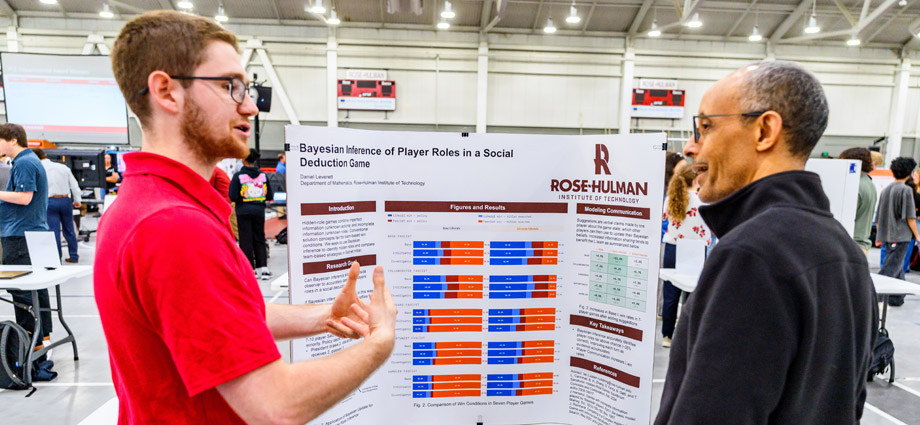
In the field of game theory, games of interest sometimes involve asymmetric player information. Daniel Leverett, a 2026 mathematics graduate, analyzed social deduction board games. In such games, each player is assigned a role and placed on one of two teams, but other players' are unaware of the roles of others. Leverett developed a Bayesian inference model for an outside observer trying to determine players' roles. Computational experiments for a restricted set of available player and team strategies demonstrate an outside observer can often learn most players' roles before the end of the game.
Wabash Valley emergency Response Facility
Civil & Environmental Engineering
Alexis Willour, Aslan Henderson, Carter Schutte, Garrett Stegenga
The 181st Intelligence Wing of the Indiana Air National Guard worked with this capstone team to design a combined facility housing multiple Air National Guard entities under the same roof. Currently, the Vigo County Emergency Management Agency (EMA), the Civil Air Patrol Wing, and the Air Guard are housed in separate facilities. Leaders requested that the updated design include an Emergency Operations Center, administrative areas for Vigo County EMA and Civil Air Patrol, a classroom space that could be converted into an operations floor, a climate-controlled storage space, and a small aircraft hangar. The aircraft hangar is designed in conjunction with runway updates, including aircraft apron improvements and modifications to the parking area.
The Air Guard Base lot is approximately 69 acres, and this design utilizes about three acres of space.
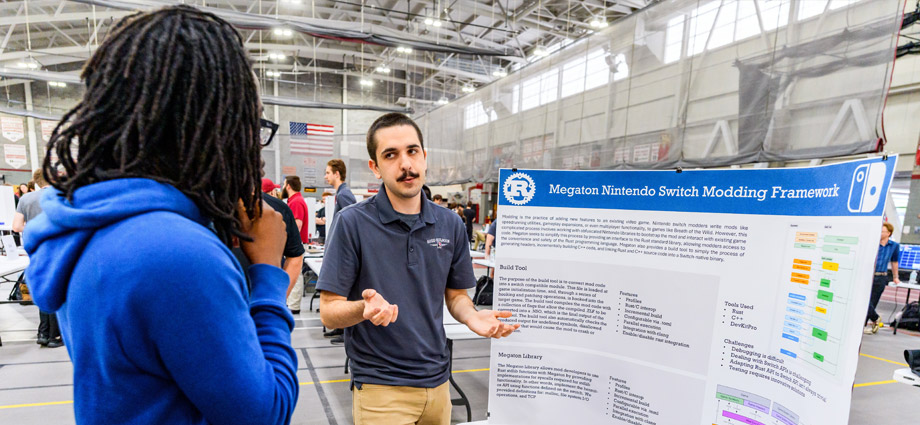
Megaton: Nintendo Switch Modding Framework for Rust
Computer Science & Software Engineering
Luke Buchanan, Michael Chalupiak, Andrew Petersen, Bryan Pfeifer
Megaton aims to simplify the process of creating modifications (mods) for the Nintendo Switch. The framework consists of a build tool and support library, which allow mod developers to embed Rust code into Switch-native binaries (NSOs). The build tool uses parallelization and incremental compilation to greatly reduce build times and simplifies the process of generating FFI code and linking Rust and C++ into a single binary. The library provides low-level implementations for the Switch platform, enabling the use of many features from the Rust Standard Library.
Horizon Health Hospital HVAC Improvement
Mechanical Engineering
Aidan Kriek, Ian Powers, Matthew Schwartz, Wil Bell
Horizon Health is a critical-access hospital in Paris, Illinois, with an outdated HVAC system in the patient wing. This project evaluates current HVAC performance against American Society of Heating, Refrigerating, and Air-Conditioning Engineers (ASHRAE) standards, including temperature, humidity, particulate matter, and air changes per hour (ACH). This team developed a solution that provides daily updates to hospital administrators, summarizing patient room conditions and identifying any deviations from ASHRAE guidelines to support informed decisions on system improvements and patient safety.
Fold-A-Bed
Engineering Design
Madilyn Steiger, Logan Fiorito-Zendejas
Fold-A-Bed strives to minimize the effects of anti-homeless infrastructure by providing an alternative sleeping and storage option for people who do not currently have access to a living space or shelter. The design consists of an elevated platform for sleeping and resting, which can be folded into a mobile storage space for transporting belongings. Fold-A-Bed facilitates an increased sense of comfort and security by preventing people experiencing homelessness from having to sleep on the ground. The device also provides a reliable way to protect and transport necessities.
Learn more about the Rose Show and past projects here.