Improving Everyday Lives
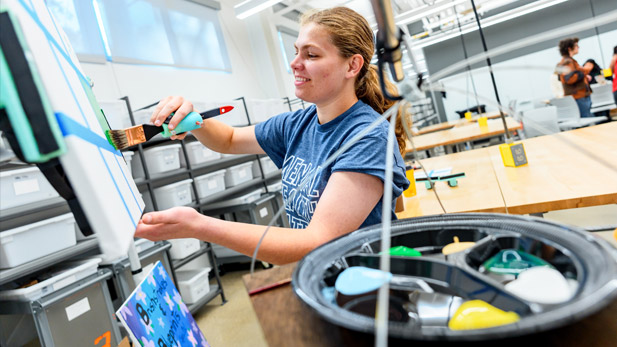
Rose-Hulman students and their 2026 design projects solved everyday problems to improve the lives of people around them, through projects including an adaptive game controller, an adjustable easel, and a device to aid in moving trash cans.
Changing the world begins with changing one corner of the world and creating solutions to alleviate the stresses, pains, or challenges of everyday life. Over the past academic year, several Rose-Hulman design teams worked directly with individual clients, crafting projects designed to meet their specific needs and make a positive impact in their daily lives.
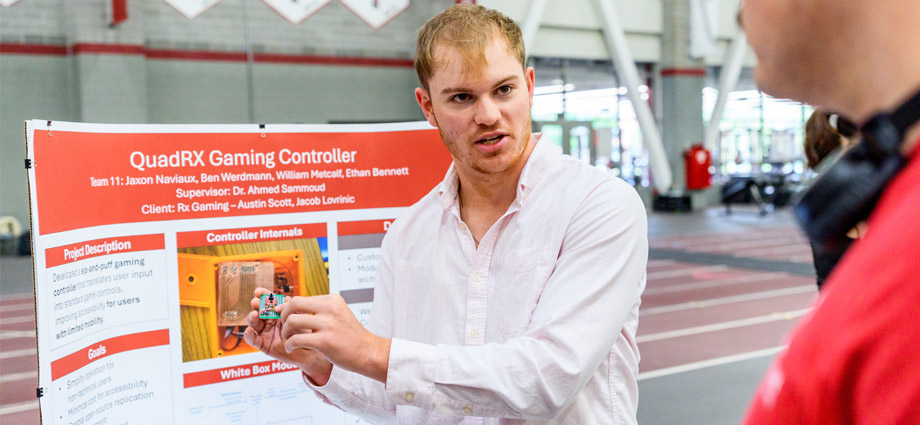
Quad-RX Adaptive GAming Controller
Electrical & Computer Engineering
Ethan Bennett, William Metcalf, Ben Werdmann, Jaxon Naviaux
Gaming has become a greater and grander part of popular culture over the past 50 years. However, the vast majority of gaming peripherals, including controllers, are designed to be operated by individuals who are physically capable of using two hands. Individuals with physical disabilities often have to settle for sub-optimal setups or pay exorbitant prices for handmade controllers. Ethan Bennett, William Metcalf, Ben Werdmann, and Jaxon Naviaux believed that gaming culture should not be limited to able-bodied individuals and aimed to provide a more affordable alternative to two-handed controllers than what is currently available on the market.
Brushstrokes and Blueprints: Flexible Easel
Biology & Biomedical Engineering
Elizabeth Johnson, Marina Cadilli
For their senior design project, Elizabeth Johnson and Marina Cadilli worked with a professional artist who lives with fibromyalgia and chronic pain. Her pain impacts her work, preventing her from raising her arm above her shoulder for long periods or working without experiencing muscle fatigue. Johnson and Cadilli designed an easel that allows the client to easily rotate her painting and shift her canvas up, down, left, or right without damaging the artwork. The team also created a custom paintbrush grip for her use. Designed to be interchangeable with her art materials, the grip helps relieve carpal tunnel symptoms she experiences when her thumb depresses into her palm.
User feedback is often one of the most valuable parts of the engineering design process, and Cadilli was able to validate her product herself, testing the flexible easel for her final project in a Rose-Hulman art class. She noticed that the initial prototype caused smaller canvases to spin uncontrollably, prompting the pair to adjust how a canvas mounts to the easel.
"We ended up changing it to be more of a bike seat, where it'll just clamp down and tighten," said Cadilli.
AuralVision
Electrical & Computer Engineering
Ethan Powell, Anica Cao, Jada Hunter-Hays, Anuj Suvarna, Rhiley Epperson
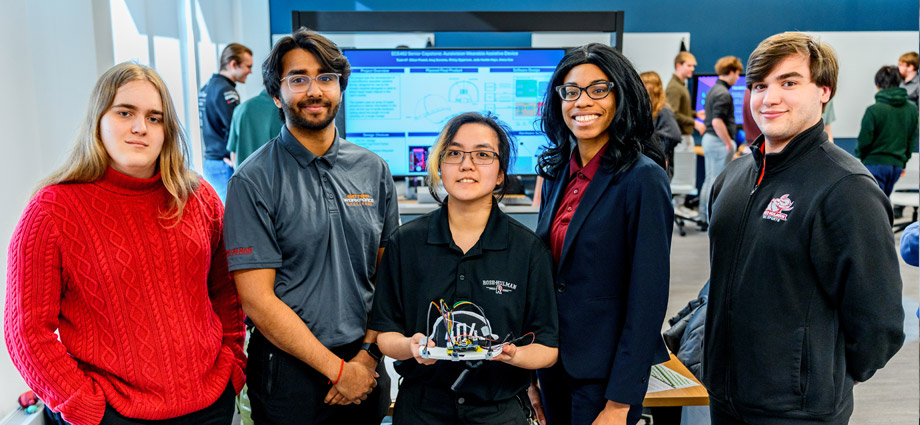
Working with 1983 electrical engineering and mathematics alumnus John Marum, this senior design team developed a wearable assistive device that uses time-of-flight sensors and haptic feedback to help visually impaired individuals detect objects their canes and guide dogs cannot. The mobile system can be used anywhere and is completely self-contained, without requiring software updates or a WiFi connection to function. The device — clipped onto the rim of a baseball cap — operates from a built-in battery system that lasts approximately 12 hours. Hunter-Hays and Powell conducted a focus group at a Terre Haute assisted living community to seek user feedback on the device.
"That collective bond of 'we're all in this together' and we're actively working together to make a product that fulfills a need and helps a community is such a reward," said Hunter-Hays.
Read more about the AuralVision senior design collaboration.
Bin Buddy: A device to Aid the Transportation of Trash Cans
Mechanical Engineering
Myra Duncan, Damian Komperda, William Wittich, Jack Murphy
Bin Buddy is an open-source device designed to aid elderly individuals or people with physical disabilities in taking their trash out. The device reduces the physical strain of moving a trash can to the curb manually. It provides a stable platform that allows users to efficiently attach the bin and transport it to and from the curb. As an open-source device, it can be built without specialized tools using common off-the-shelf parts.
"The whole user interface aspect is designed for people with arthritis, so all the buttons and controls and things are extremely large," said Myra Duncan, a 2026 mechanical engineering graduate.
Songbirds
Biology & Biomedical Engineering
Narindwa Semakula, Columba Rodriguez Real, Allison Kirk
Narindwa Semakula, Columba Rodriguez Real, and Allison Kirk harnessed the power of music to help their client, a former Rose-Hulman student with a traumatic brain injury, reach his physical therapy and rehabilitation goals. The device, which clips onto the brim of a baseball hat, features a sensor and an Arduino controller that send data about their angling and positioning to an app on the client's iPad, indicating his posture and the angle at which he holds his head. When he meets the threshold he set, the app rewards him by increasing the volume of his music for a short period of time. The final product combined the client's goals, his love of hats, his passion for music, and his interest in music biofeedback research.
"The most important part is it's human-centered design," said Kirk. "We're impacting someone, and it's about understanding that person, and that's what leads the whole design."
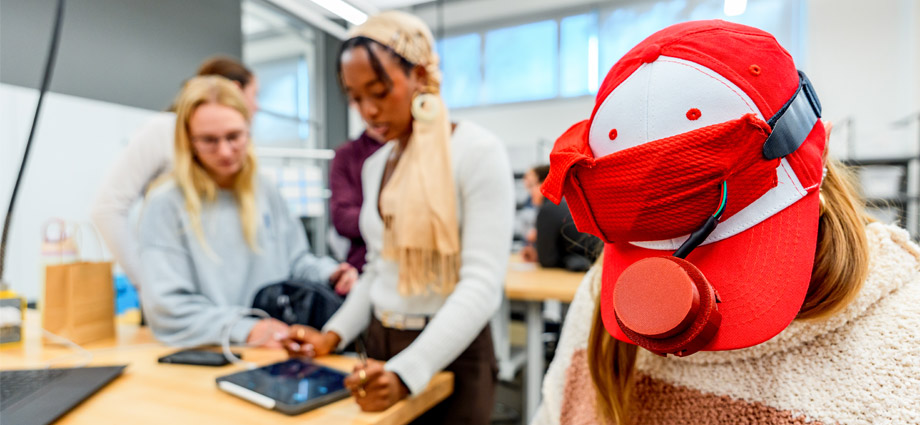
Read more about the Songbirds project and its impact here.
Boulder Buster Offroad Mobility Solution
Biology & Biomedical Engineering
Ezekiel Groom, Kevin Tang, Gregory Hippely
This project addresses the mobility needs of a 6'5" veteran with paraplegia and adhesive arachnoiditis, who sought to return to off-road driving and outdoor exploration. The team modified a TrailMaster XRS 200E by integrating a custom hand-control system that transfers all throttle and braking functions to the upper body, eliminating the need for input using the legs. Additional modifications included a repositioned seat mount for improved ergonomics, vibration-reducing components, and a reinforced transfer platform for independent entry and exit. The completed solution restores the client's ability to safely and independently participate in off-road recreational activities. The team also added aesthetic features to personalize the vehicle to the client's interests.
"It really highlights what engineering is and how inspirational it can be when you work on a project like this," said Kevin Tang, a 2026 graduate who earned a simultaneous bachelor's degree in biomedical engineering and master's degree in engineering management through the Rose Squared program.
Learn more about the Rose Show and past projects here.