Engineering Educational Opportunities
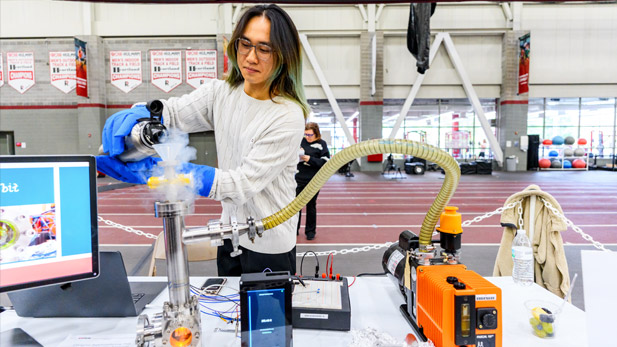
Through the capstone to their own education, Rose-Hulman students enabled educational opportunities for learners of all levels and disciplines at the 2026 Rose Show, including research equipment, training simulators, and elementary school activities.
Rose-Hulman students, faculty, and staff, understand that education is the key to innovation, and they provide learners with tools and opportunities to develop their skills while exploring their natural curiosity. Inspiration often reaches students through the efforts of other scholars, whether through educational outreach programs or through reimagining what "education" means. Several projects created for the 2026 Rose Show continued this legacy of learning, enabling learning opportunities across disciplines and knowledge levels, from elementary school students to practicing nurses.
Temporary Pacemaker Training Device
Biology & Biomedical Engineering
Jonathon Croker, Austin Daly, Cade Zonin
This device is a versatile medical training simulation system designed to provide realistic, hands-on procedural practice for healthcare professionals while remaining affordable and easily accessible to institutions. The system is intended to stimulate key aspects of surgical and clinical procedures, allowing users to develop technical skills and build confidence before performing procedures in real clinical settings.
"It can make a huge difference because this is a very high-stakes procedure that is difficult to learn without having the hands-on experience that we hope this device will give them," said Daly.
Unlike many existing commercial simulators, this training system prioritizes cost efficiency and ease of use without sacrificing educational value. The device is designed to be quickly assembled and deployed, making it suitable for simulation centers, classrooms, and resource-limited environments. Its durable construction allows it to withstand frequent use, while its intuitive interface ensures that both learners and instructors can focus on skill development rather than complex setup or operation. By providing a safe environment for repeated practice, this system helps reduce the risk of errors associated with insufficient preparation, ultimately supporting improved patient outcomes and healthcare safety.
Junior Astronaut Training Center
Mechanical Engineering
Michael Owens, Peter Gau, Kyle Colburn, Lance Fowler, Michael Hedenberg
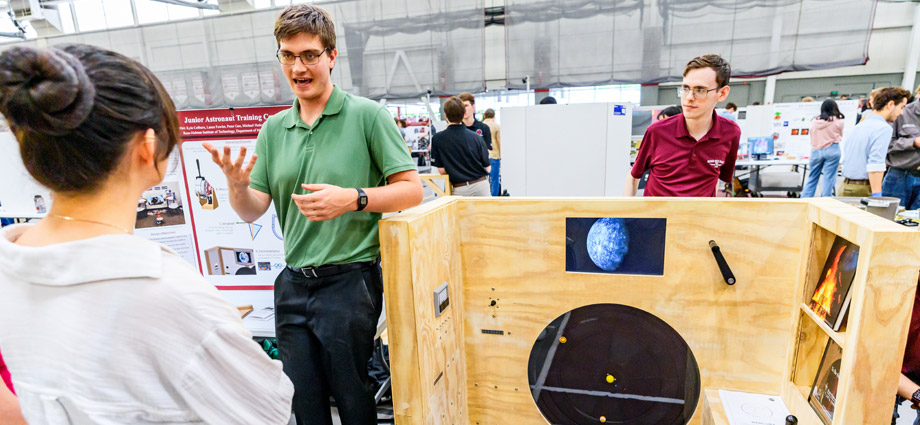
The Junior Astronaut Training Center is an interactive space-themed exhibit intended for entertaining and educating children at the Gibson Allen Memorial Planetarium in Terre Haute, Indiana. This exhibit allows children to engage meaningfully without disrupting planetarium presentations. Young planetarium visitors are provided the opportunity to feel like an astronaut and learn about space through a thematic and interactive experience. A mass-switching activity enables visitors to feel the change in weight of the same object across different planets, and a spirograph allows users to trace the trajectory of their spacecraft. The exhibit also includes an orrery that demonstrates the orbital paths of planets in the Milky Way. The Junior Astronaut Training Center provides a unique educational experience that encourages young students to explore the galaxies of their imaginations.
rose Data
Weston Seybold, Caleb Lehman, Jay Smith, Colin Flannagan
Computer Science & Software Engineering
Rose Data is an integrated platform for the Rose-Hulman Institute of Technology community focused on student scheduling and degree planning. Students can view courses, create multi-term paths, explore AI-assisted degree plans, and coordinate schedules with peers. Advisors see student progress degree plans, and enrollments to guide decisions. By linking schedules to degree requirements, Rose Data helps users stay on track and avoid conflicts. It serves as a lighter, more intuitive complement to Degree Works.
Wonders with Worms: An Interactive Vermicomposting System
Mechanical Engineering
Zach Applewhite, Anders Caldwell, Aidan Carter, Parker Kollar
Working with the Montessori Academy of Terre Haute, this team built an interactive and educational vermicomposting system, designed to teach students ages three to eight about composting. The system enables young learners to explore the environmental benefits of composting and the crucial role worms play in the process. The project aligns with the Early Childhood Education method followed by the Montessori Academy of Terre Haute that encourages the well-rounded growth of every student through physically interactive learning.
Cryogenic Superconducting Thin Film Characterization Apparatus
Electrical & Computer Engineering
Bone Borca, Chong-Yi Su, Yueqiao Wang, Quinton Wang

As superconductor technology has become essential in fields such as quantum information science and engineering, Rose-Hulman Assistant Professor of Physics, Optical Engineering, and NanoEngineering Nicole Pfiester, PhD, has conducted research on high-temperature superconducting thin film with her students. To characterize the thin film samples she fabricated in lab, this team designed and built a system that houses the material in the required cryogenic temperature. Samples are also housed in a vacuum that can perform the Van der Pauw method to electrically characterize the sample, determining its superconducting material properties. The team designed the printed circuit board (PCB) used in the project to conduct heat well and cool the sample quickly.
Delphic AI Workstation
Multidisciplinary Design
Ryan D'Aquila, Jonathan David, Bryson Lee, Spencer Halsey
Over the course of their education, Ryan D'Aquila, Jonathan David, Bryson Lee, and Spencer Halsey learned to navigate obstacles throughout the ideation and design process, but they found some hurdles — such as manually copying information from a workspace to a digital form — split their focus from the task at hand. They sought to create a tool that reduced operational delays to enable engineers and STEM students to direct their problem-solving energies to their project.
Delphic is an AI-powered workstation that integrates a projected workspace, voice interaction, gesture control, and contextual memory to enhance engineering workflows. The system bridges physical and digital tasks by enabling users to capture handwritten notes, manage tasks, and interact with tools seamlessly. By combining hardware and software into a unified interface, Delphic reduces friction between ideation and execution while supporting intuitive and reliable user interaction.
"Delphic's main purpose is to make the engineering process as efficient and smooth as possible through a variety of different methods. It can learn about yourself and the products you're doing and switch contexts and provide you recommendations based on what it's learned," said Halsey, a 2026 software engineering graduate.
Learn more about the Rose Show and past projects here.