Wayne Tarrant Deepens Global Partnerships Through East Africa University Connections
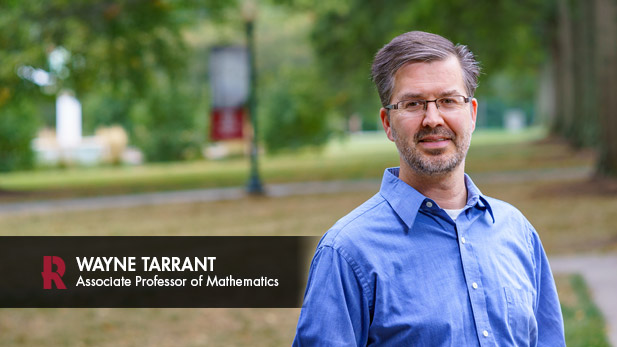
Wayne Tarrant, PhD, who serves as the Endowed Chair for Innovation in Science, Engineering, and Mathematics Education and associate professor of mathematics, believes the resources he brings from Rose-Hulman to Africa can help make the world a better place.
Wayne Tarrant, PhD, first traveled to Kenya as a Fulbright Scholar in 2021. It was on that trip that he found a mission that now defines his work as Rose-Hulman’s Endowed Innovation Chair: building lasting partnerships with East Africa’s universities to advance education, improve health systems, and open the world to Rose students. Since that trip, Tarrant has forged partnerships with several African institutions, including Strathmore University in Nairobi, Africa International University in Kenya, and the African Institute of Mathematical Sciences in Rwanda. He returns to Africa in December for a six-week trip to work on a variety of projects and continue his mission.
Tarrant, who serves as the Endowed Chair for Innovation in Science, Engineering, and Mathematics Education and associate professor of mathematics, is motivated by optimism for humanity and a desire to leave the world a better place. He believes his work as a professor, and the resources he brings from Rose-Hulman to Africa, can help make that difference.
“If we as engineers and scientists and mathematicians can recognize the opportunities and partnerships we can have, we can go much further,” said Tarrant. “So many people are limited by resources. If we can find a way through doing engineering for good to provide those resources, that’s something to aspire to.”
Tarrant will spend time working at Strathmore University in Nairobi, where his focus will be on economic development and taxation structure modeling. Kenya has the most developed mobile payment system in the world, and Tarrant is especially interested in the country’s M-Pesa mobile payment network and its companion M-Shwari quasi-banking system. He is also studying whether similar models could help extend financial access to underserved communities elsewhere in the world.
Tarrant will also teach a course at Africa International University in Kenya. He has been working with Vice Chancellor Nelson Makanda on ways to help the resource-starved university. With the help of President Rob Coons and Vice President of Information Technology and Chief Information Officer Wayne Dennison, Rose-Hulman donated 20 refurbished faculty laptops to the university. Tarrant plans to take additional laptops during his upcoming visit.
“These laptops are life-changing there, as their computer labs have machines that I estimate were state-of-the-art in about 2002,” said Tarrant, who is also the advisor of the student group Binary Heart. The group restores old computer equipment from individuals and businesses in the community and then donates them to charitable organizations throughout Wabash Valley. Tarrant will take some of these refurbished pieces of computer equipment to Kenya for individuals living in more rural areas who do not have access to computers.
“If a child can get in front of a computer and connect to the internet … that opens up the entire world to them,” he said. “Maybe, through those computers, kids will end up calling the AskRose homework helpline.”
Another part of his trip to Africa includes working with the African Institute of Mathematical Sciences in Rwanda on health systems, healthcare, and health insurance. Tarrant works closely with Conrad Tucker (ME, 2004), associate dean for international programs at Carnegie Mellon University in Rwanda, who has created algorithms that enable a 15-second cell phone video to detect a person’s vital signs. This mechanism allows rural community health centers that do not have access to expensive equipment to diagnose and treat patients.
“Rwanda has more than 90% health insurance penetration, whereas Uganda has only 1.1%,” Tarrant said. “That’s a great divide, even though those countries are neighbors. We will be looking at what structures Rwanda has put in place that Uganda has not, as well as examining whether there are better health and educational outcomes if an individual has health insurance.”
Woven throughout all of Tarrant’s work is the idea of connecting Africa to the Rose-Hulman community and its students. He hopes his work will inspire Rose students to visit and take their skills to developing countries.
“The developed world has great things, but developing worlds have so many opportunities,” said Tarrant. “And if we can make a difference in lives in Africa, we can make a difference in what happens in the world.”
He hopes to create virtual and in-person exchange programs with Strathmore University in which Rose students can work in the university’s new energy resource center. He is also collaborating on a co-teaching project with Lucy Muthoni, a mathematical scholar and senior lecturer from Kenya who served as Rose’s Visiting Fulbright Scholar-in-Residence for the 2023–24 school year. The two professors are developing a course in which both will teach portions of the class, and the Rose students would converse with Strathmore students.
Tarrant plans to return to Africa next summer as a Fulbright Scholar to work with the Institute for Mathematical Sciences at Strathmore, where he will focus on applying distributed ledger technology to healthcare, government, and the economy. The Fulbright Specialist Program has existed since 2001, and Tarrant will be Rose’s second Fulbright Specialist.