Rose-Hulman Team Places 10th in NASA USLI Challenge
Tuesday, July 14, 2026
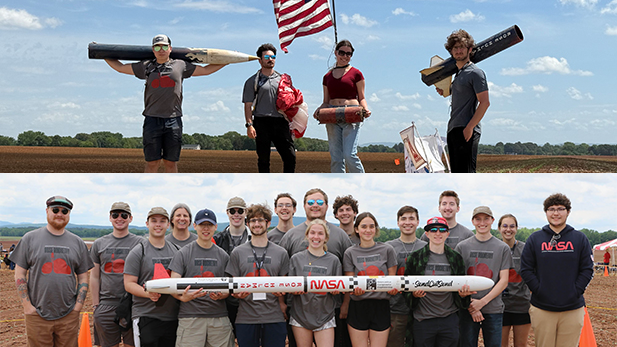
Rose Rocketry placed 10th in the NASA University Student Launch Initiative, successfully launching and recovering their rocket at Marshall Space Flight Center in Huntsville, Alabama.
Rose-Hulman's Rose Rocketry earned a 10th-place finish in the NASA University Student Launch Initiative (USLI), a nine-month research and exploration program challenging college students across the country to design and launch a rocket with a scientific payload. The team successfully launched, landed, and recovered their rocket during the challenge's final launch at NASA's Marshall Space Flight Center in Huntsville, Alabama.
"It went up, the drone parachute and the main parachute deployed, and it came down just exactly as you want to see it," said Peter Tselekis, a senior mechanical engineering major who serves as program manager for the Rose-Hulman USLI team.
Designed to follow the NASA engineering design cycle, the USLI challenge and payload is determined each year by NASA's Space Launch System and Artemis Program Offices to engage the next generation of aerospace professionals. This year, teams were tasked with launching and landing their rockets, as well as drilling and extracting a soil sample from their landing site and analyzing its pH and moisture levels.
After a competitive proposal process, Rose Rocketry passed a series of checkpoints and reviews before qualifying for the final launch in Huntsville, including Preliminary Design Review, Critical Design Review, Flight Readiness Review, and Launch Readiness Review. At each stage, the team submitted a technical report, technical drawings, simulation data, safety and hazards analysis, timeline and budget estimations, and STEM engagement. They presented their work to a NASA review panel for feedback.
"I've really enjoyed the level of ownership on some of the hardware here — being able to design something, build it, put it on a rocket, fly it, recover it, and be involved in all the steps in that process," Tselekis said.
Rose Rocketry, a relatively young team compared to its competitors, soared to the top of the 30 teams qualifying for the launch. In addition to the satisfaction of besting teams from much larger schools, such as UCLA, Ohio State University, and Carnegie Mellon University, Rose-Hulman's top-10 finish earned them the pride of topping their own record of success. The team did not successfully launch in its first two years due to safety concerns and a non-deploying parachute, respectively, but learned from the experience to hone their design for the third year. Last year, the team successfully cleared each checkpoint and constructed their first operational payload, but the Huntsville launch was cancelled due to inclement weather.
"We spent a lot of time with the design and construction of the rocket to make sure that it would be reliable and functional in Huntsville," said Tselekis of this year's successful launch. "We interacted with a lot of people who've been doing Rocketry for a longer period of time to make sure that we understood what was going into all the systems, as well as really trying to get some knowledge transfer to new members."
Some of that knowledge transfer has included working with NASA Subject Matter Experts and industry professionals, as well as resources within the Branam and Kremer Innovation Centers. Last year, the team even worked with members of Rose-Hulman's Ham Radio Club to develop radio transmission for the required payload.
Each milestone passed represents a small step for the rocket, but a giant leap for the students propelling their careers.
"Our competition team is a really good way to get started, a really good way to meet other people who share the same interests and really get hands-on a lot faster than you might get in some of the classes," said Tselekis. "I've gotten a lot of fun out of building rockets, out of flying rockets, out of participating in the different rocket organizations here at Rose. Every interaction I've had with the aerospace industry has pushed me to want to do it more."
"It went up, the drone parachute and the main parachute deployed, and it came down just exactly as you want to see it," said Peter Tselekis, a senior mechanical engineering major who serves as program manager for the Rose-Hulman USLI team.
Designed to follow the NASA engineering design cycle, the USLI challenge and payload is determined each year by NASA's Space Launch System and Artemis Program Offices to engage the next generation of aerospace professionals. This year, teams were tasked with launching and landing their rockets, as well as drilling and extracting a soil sample from their landing site and analyzing its pH and moisture levels.
After a competitive proposal process, Rose Rocketry passed a series of checkpoints and reviews before qualifying for the final launch in Huntsville, including Preliminary Design Review, Critical Design Review, Flight Readiness Review, and Launch Readiness Review. At each stage, the team submitted a technical report, technical drawings, simulation data, safety and hazards analysis, timeline and budget estimations, and STEM engagement. They presented their work to a NASA review panel for feedback.
"I've really enjoyed the level of ownership on some of the hardware here — being able to design something, build it, put it on a rocket, fly it, recover it, and be involved in all the steps in that process," Tselekis said.
Rose Rocketry, a relatively young team compared to its competitors, soared to the top of the 30 teams qualifying for the launch. In addition to the satisfaction of besting teams from much larger schools, such as UCLA, Ohio State University, and Carnegie Mellon University, Rose-Hulman's top-10 finish earned them the pride of topping their own record of success. The team did not successfully launch in its first two years due to safety concerns and a non-deploying parachute, respectively, but learned from the experience to hone their design for the third year. Last year, the team successfully cleared each checkpoint and constructed their first operational payload, but the Huntsville launch was cancelled due to inclement weather.
"We spent a lot of time with the design and construction of the rocket to make sure that it would be reliable and functional in Huntsville," said Tselekis of this year's successful launch. "We interacted with a lot of people who've been doing Rocketry for a longer period of time to make sure that we understood what was going into all the systems, as well as really trying to get some knowledge transfer to new members."
Some of that knowledge transfer has included working with NASA Subject Matter Experts and industry professionals, as well as resources within the Branam and Kremer Innovation Centers. Last year, the team even worked with members of Rose-Hulman's Ham Radio Club to develop radio transmission for the required payload.
Each milestone passed represents a small step for the rocket, but a giant leap for the students propelling their careers.
"Our competition team is a really good way to get started, a really good way to meet other people who share the same interests and really get hands-on a lot faster than you might get in some of the classes," said Tselekis. "I've gotten a lot of fun out of building rockets, out of flying rockets, out of participating in the different rocket organizations here at Rose. Every interaction I've had with the aerospace industry has pushed me to want to do it more."