Rose-Hulman Students Win NCAA Final Four Analytics Challenge
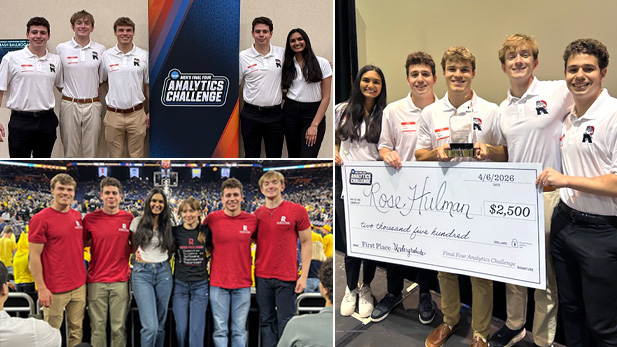
The Rose-Hulman “Data Miners” team claimed the undergraduate title in the 2026 NCAA Men’s Final Four Analytics Challenge, outpacing a field of 157 teams from 15 schools to emerge as one of four finalists to compete the same day as the national championship game.
There were more than just men’s basketball teams competing for a championship during this year’s NCAA Final Four in Indianapolis.
A team of Rose-Hulman students claimed the undergraduate title in the 2026 NCAA Men’s Final Four Analytics Challenge, outpacing a competitive field of 157 teams from 15 schools to emerge as one of four finalists to compete Monday, April 6—the same day as the national championship game—and ultimately, the winner.
The Rose-Hulman “Data Miners” included senior computer science majors Brian Beasley, Matteo Calviello, and Preksha Sarda, senior biomedical engineering major Tommaso Calviello, and sophomore mathematics major Aron Varga. All five are pursuing second majors in data science.
The competition challenged students to analyze the NCAA Division I Men’s Basketball Championship from multiple angles, using data science and machine learning to uncover insights about team performance, tournament success, and fan engagement. The event began Feb. 2 at the NCAA Hall of Champions and culminated with the final four teams converging at the Indiana Convention Center.
Facing finalist teams from University of Notre Dame, Butler University, and DePauw University, Rose-Hulman earned the top prize of $2,500, with all finalists also receiving tickets to the championship game.
The RHIT team developed predictive models to answer key questions about what defines a championship-caliber team and how analytics can enhance both tournament strategy and fan experience.
Among their findings: defensive efficiency, roster talent, and team consistency emerged as critical indicators of postseason success. The team combined these factors into a custom “championship-caliber” metric that showed strong correlation with tournament wins.
They also built a model capable of predicting close games and potential upsets—insights that could help the NCAA better allocate media resources and highlight the most compelling matchups.
The project was guided by faculty advisors Olga Scrivner, PhD, and Ian Ludden, PhD, assistant professors of computer science and software engineering.
“This competition gives students the opportunity to work with real-world data and tackle problems that extend beyond the classroom,” Scrivner said. “They are not just building models—they are learning how to communicate insights and deliver solutions that have practical impact.”
Scrivner noted that Rose-Hulman teams have participated in the competition for three consecutive years, but this year’s expanded format made reaching—and winning—the final round especially significant.
For the students, the challenge offered a chance to apply technical skills in a new and meaningful context.
“I think it was a very interesting experience working with different data than what most of us are used to,” said Tommaso Calviello. “We had the chance to work with real NCAA data and figure out how to turn it into something meaningful.”
Matteo Calviello emphasized the importance of connecting technical work to business outcomes.
“This was a new way to combine what we learn—machine learning, data science—with an actual business case,” he said. “It’s something that can create real value for an organization.”
For Varga, the experience was both collaborative and educational.
“I honestly just had an absolute blast,” he said. “Working with upperclassmen and applying what I’ve learned in the classroom—it was a great experience.”
Beasley highlighted the professional impact of opportunities like this.
“Projects like this are great real-world experience,” he said. “They give you something meaningful to talk about in interviews and show how you can apply what you’ve learned.”
And for Sarda, the challenge provided insight into the complexities of working with real data.
“In class, data is usually more structured,” she said. “Here, we had to clean it, understand it, and really dig into what it was telling us. That’s a skill you don’t always get in the classroom.”
The Data Miners were selected to represent Rose-Hulman after an internal competition that featured six student teams.
“The hardest part was beating the other Rose teams because everyone is so smart and talented,” said Tommaso Calviello.
The team’s success reflects Rose-Hulman’s emphasis on hands-on, experiential learning—particularly in fast-growing fields like data science and its newest major, artificial intelligence.
By combining technical expertise with business insight and communication skills, students were able not only to compete—but to stand out on one of the biggest stages in college sports.
And as the Final Four crowned its champion on the court, Rose-Hulman’s Data Miners did the same—using data to deliver a winning performance of their own.