Rose-Hulman Graduate Ahaan Kothari Places Second at TechPoint Xtern Challenge with Agentic System
Monday, September 21, 2026
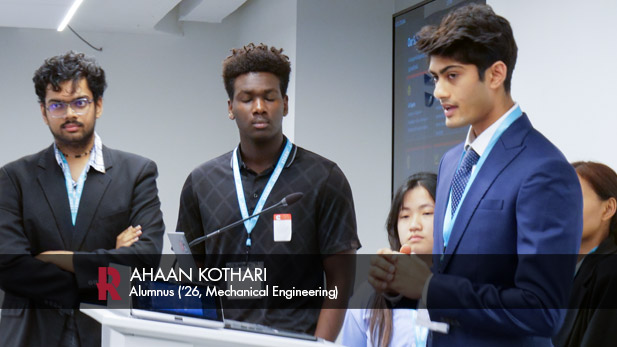
Several Rose-Hulman students competed at the Cummins and MISO Xtern Challenges, presenting solutions to client workflows. Ahaan Kothari's team presented an agentic system that earned them a second-place finish.
At the 2026 TechPoint Xtern Challenge, several Rose-Hulman students improved real business operations and service workflows for Cummins utilizing artificial intelligence systems. Ahaan Kothari, a 2026 mechanical engineering graduate, led his team to a successful second-place finish, while junior mechanical engineering major Colleen Busher's team earned honorable mention. Jack Tanner, a junior computer science major, and Kaung Mon Thar, a sophomore computer science major, were also selected for the competition. Computer science major Alexander Gestwicki and electrical engineering major Zachary Flynn also competed in the fall 2026 MISO Xtern Challenge.
Matched with peers from colleges across Indiana, the students had just a few short weeks to develop an AI-assisted workflow to increase technician efficiency at Cummins. The teams worked remotely on the project while balancing their academic workloads and commitments at their various campuses, relying on less than an hour a week of synchronous communication to progress their goals. On the day of the competition, the teams had three hours to put final touches on their projects and to prepare their presentations for a panel of Cummins leadership.
"I think Rose prepared me to face a technical audience and be able to speak comfortably in a room full of strangers," Kothari said. "It represented Rose in a really positive light."
Kothari's team pitched an agentic system designed to help junior engineers better understand issues and know when to escalate a problem to upper management. The team's solution also included an admin userbase for monitoring progress, as well as a token limit on application programming interfaces (APIs) calls to limit the costs to Cummins. After the challenge, Cummins spoke with each of the top-finishing teams to develop a plan that incorporated aspects from each proposal.
From Kothari's perspective, the Rose-Hulman undergraduate students became the de facto leaders of their multi-institution teams, even those predominantly constituted of master's students.
"One thing that Rose really taught me was how to work very effectively in teams," he said. "My capstone and my (mechanical engineering) lab played a pivotal role in this because both projects were ones without a clear path to an end goal. Progress came from a lot of small positive changes and an openness to pivoting.”
Though the challenge included more computer science elements, Kothari, a mechanical engineering major, had “learned how to learn”, utilizing resources and his foundational knowledge to grow outside his comfort zone. Building upon introductory computer science courses he had taken at Rose-Hulman, Kothari spent the weeks leading up to the competition teaching himself the basics of agentic systems.
"When you're working on a system like an engine, it's a very methodical process. I was drawing the parallel to how coding is very similar," said Kothari. "It's very structured and organized, with a mathematical foundation in formal logic, and that’s what really made the transition easy for me."
The challenge changed his perspective so deeply that Kothari shifted his future plans just a few months before graduation, realizing he wanted to pursue a master's degree in AI engineering. He emailed Carnegie Mellon University and asked that his application, which had been previously submitted for a different program, be transferred to reflect his newfound passions.
"Coming out of the challenge…I wanted to be able to work on all aspects of the system," he said. "I always thought that it would be me actually designing the robot and someone else doing the coding. I never thought I could do both."
Matched with peers from colleges across Indiana, the students had just a few short weeks to develop an AI-assisted workflow to increase technician efficiency at Cummins. The teams worked remotely on the project while balancing their academic workloads and commitments at their various campuses, relying on less than an hour a week of synchronous communication to progress their goals. On the day of the competition, the teams had three hours to put final touches on their projects and to prepare their presentations for a panel of Cummins leadership.
"I think Rose prepared me to face a technical audience and be able to speak comfortably in a room full of strangers," Kothari said. "It represented Rose in a really positive light."
Kothari's team pitched an agentic system designed to help junior engineers better understand issues and know when to escalate a problem to upper management. The team's solution also included an admin userbase for monitoring progress, as well as a token limit on application programming interfaces (APIs) calls to limit the costs to Cummins. After the challenge, Cummins spoke with each of the top-finishing teams to develop a plan that incorporated aspects from each proposal.
From Kothari's perspective, the Rose-Hulman undergraduate students became the de facto leaders of their multi-institution teams, even those predominantly constituted of master's students.
"One thing that Rose really taught me was how to work very effectively in teams," he said. "My capstone and my (mechanical engineering) lab played a pivotal role in this because both projects were ones without a clear path to an end goal. Progress came from a lot of small positive changes and an openness to pivoting.”
Though the challenge included more computer science elements, Kothari, a mechanical engineering major, had “learned how to learn”, utilizing resources and his foundational knowledge to grow outside his comfort zone. Building upon introductory computer science courses he had taken at Rose-Hulman, Kothari spent the weeks leading up to the competition teaching himself the basics of agentic systems.
"When you're working on a system like an engine, it's a very methodical process. I was drawing the parallel to how coding is very similar," said Kothari. "It's very structured and organized, with a mathematical foundation in formal logic, and that’s what really made the transition easy for me."
The challenge changed his perspective so deeply that Kothari shifted his future plans just a few months before graduation, realizing he wanted to pursue a master's degree in AI engineering. He emailed Carnegie Mellon University and asked that his application, which had been previously submitted for a different program, be transferred to reflect his newfound passions.
"Coming out of the challenge…I wanted to be able to work on all aspects of the system," he said. "I always thought that it would be me actually designing the robot and someone else doing the coding. I never thought I could do both."