MATE Makes a Splash at World Championship
Friday, August 21, 2026
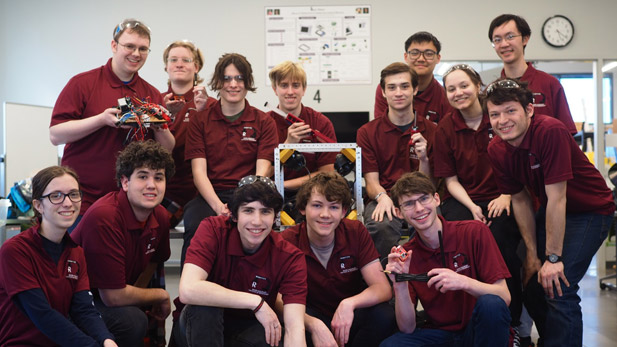
Rose-Hulman's RoseVG Robotics earned 16th place at the MATE ROV World Championship in Newfoundland & Labrador, Canada, earlier this summer.
Rose-Hulman's MATE Robotics team made a splash at the MATE ROV World Championship, earning 16th place and becoming one of the first teams in the competition's history to operate their vehicle successfully in the ocean.
MATE — or Marine Advanced Technology Education — enables students to explore marine research through robotics, challenging teams to complete tasks that simulate real-world applications of remotely operated vehicles (ROVs) and autonomous underwater vehicles (AUVs). Robots appear to "fly" through the water, gliding smoothly through the current as they manipulate objects, take measurements, and read sensors.
Rose-Hulman's MATE team, known as RoseVG Robotics, is one of four subteams operating under the Robotics Team organization through the Branam and Kremer Innovation Centers. RoseVG Robotics built a new ROV from scratch in just one academic year, developing a fully symmetric ROV frame and more advanced flight controls. The modular design features omnidirectional capabilities and a biologically inspired compliant gripper.
Rose-Hulman's MATE team also dove into a new challenge and developed an autonomous profiling float, a separate robot that uses a buoyancy engine to control its depth in the water and is capable of collecting environmental data in polar conditions.
For RoseVG Robotics, the MATE ROV World Championships — held earlier this summer at the Fisheries and Marine Institute of Memorial University in Newfoundland & Labrador, Canada — went swimmingly. The team's two robots floated easily through the competition challenges, which included mapping a deep-sea coral reef, collecting coral samples, operating an AUV under sea ice, and repairing an environmental DNA (eDNA) sensor. Judges awarded points for each team's marketing presentation, technical documentation, safety standards, and community impact.
Most teams performed the tests in a controlled artificial marine environment, but the Rose-Hulman students were not content to go with the standard flow, choosing to test their capabilities in the ocean itself.
"We have a culture of innovation and trying new things while staying competitive," said Kevin Cotellesso, a 2026 mechanical engineering graduate who served as RoseVG Robotics president during the most recent academic year. "Our team operates like a startup, allowing our students to learn about task management, advertising, and documentation, in addition to technical skills."
Already looking ahead to next year's competition, RoseVG Robotics members keep swimming toward deeper challenges, cresting the wave of innovation amid a sea of opportunities.
MATE — or Marine Advanced Technology Education — enables students to explore marine research through robotics, challenging teams to complete tasks that simulate real-world applications of remotely operated vehicles (ROVs) and autonomous underwater vehicles (AUVs). Robots appear to "fly" through the water, gliding smoothly through the current as they manipulate objects, take measurements, and read sensors.
Rose-Hulman's MATE team, known as RoseVG Robotics, is one of four subteams operating under the Robotics Team organization through the Branam and Kremer Innovation Centers. RoseVG Robotics built a new ROV from scratch in just one academic year, developing a fully symmetric ROV frame and more advanced flight controls. The modular design features omnidirectional capabilities and a biologically inspired compliant gripper.
Rose-Hulman's MATE team also dove into a new challenge and developed an autonomous profiling float, a separate robot that uses a buoyancy engine to control its depth in the water and is capable of collecting environmental data in polar conditions.
For RoseVG Robotics, the MATE ROV World Championships — held earlier this summer at the Fisheries and Marine Institute of Memorial University in Newfoundland & Labrador, Canada — went swimmingly. The team's two robots floated easily through the competition challenges, which included mapping a deep-sea coral reef, collecting coral samples, operating an AUV under sea ice, and repairing an environmental DNA (eDNA) sensor. Judges awarded points for each team's marketing presentation, technical documentation, safety standards, and community impact.
Most teams performed the tests in a controlled artificial marine environment, but the Rose-Hulman students were not content to go with the standard flow, choosing to test their capabilities in the ocean itself.
"We have a culture of innovation and trying new things while staying competitive," said Kevin Cotellesso, a 2026 mechanical engineering graduate who served as RoseVG Robotics president during the most recent academic year. "Our team operates like a startup, allowing our students to learn about task management, advertising, and documentation, in addition to technical skills."
Already looking ahead to next year's competition, RoseVG Robotics members keep swimming toward deeper challenges, cresting the wave of innovation amid a sea of opportunities.