Explore the science behind quantum technologies—and learn how computing and engineering can turn quantum concepts into real-world solutions.
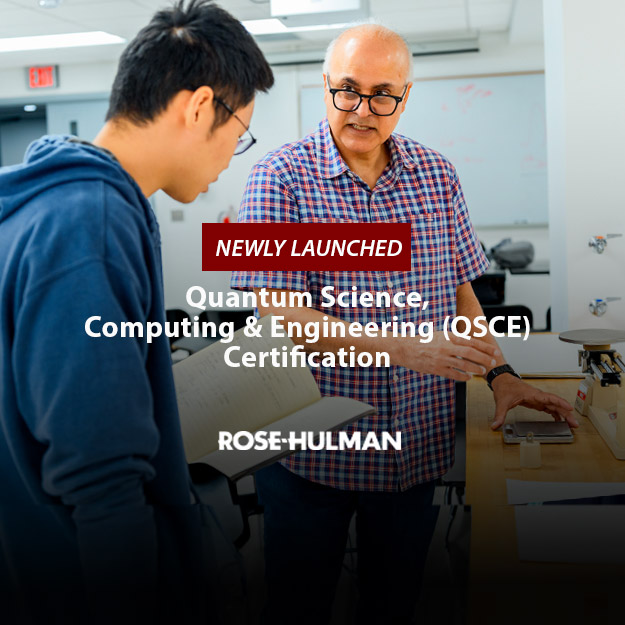
Rose-Hulman’s Quantum Science, Computing & Engineering (QSCE) certificate gives students across STEM disciplines a foundation in quantum mechanics, computing, information, and engineering.
Through a combination of core courses, laboratory experiences and interdisciplinary electives, you will develop the knowledge needed to understand this rapidly emerging field and consider how it connects with your major and career interests.
What Is Quantum Science, Computing, & Engineering?
Quantum science explores how matter and energy behave at the smallest scales. Quantum computing and engineering apply those principles to develop new approaches to computation, communication, sensing, security, materials, and other technologies.
The field brings together physics, computer science, mathematics, and multiple areas of engineering. Its continued development will depend not only on quantum physicists, but also on engineers and scientists who can design hardware, develop algorithms, fabricate materials, build reliable systems and translate discoveries into practical applications.
Why QSCE Matters
Quantum technologies have the potential to reshape how information is processed, transmitted, and protected. Researchers and industry leaders are exploring applications that could help solve complex problems beyond the reach of conventional technologies.
Although many quantum applications are still developing, activity is growing across research, industry, and workforce development. This creates a need for quantum-ready scientists and engineers who understand the field’s fundamental principles and can contribute their expertise from a variety of disciplines.
By building that foundation now, you can better understand where quantum technology is headed—and how your area of study could contribute to its future.
Why Study QSCE at Rose-Hulman?
Rose-Hulman’s QSCE certificate is designed as an accessible undergraduate opportunity for students from a variety of science and engineering majors. You don’t need to be a physics major or plan to become a quantum mechanics researcher to participate.
The curriculum combines theoretical concepts with applied learning and laboratory experience. You will explore topics such as:
- Quantum states and qubits
- Superposition and entanglement
- Quantum gates and circuits
- Quantum algorithms
- Quantum measurement and information
- Quantum cryptography and teleportation
- Physical qubit platforms
- Error correction
- The potential and limitations of quantum computing
Interdisciplinary electives allow you to connect quantum concepts with areas including optical engineering, nanoengineering, mathematics, computer science, chemistry, materials science and directed research.
View the Academic Catalog to learn more about the certificate course requirements and electives.