VEX U Robotics Competes at World Championships
Monday, July 27, 2026
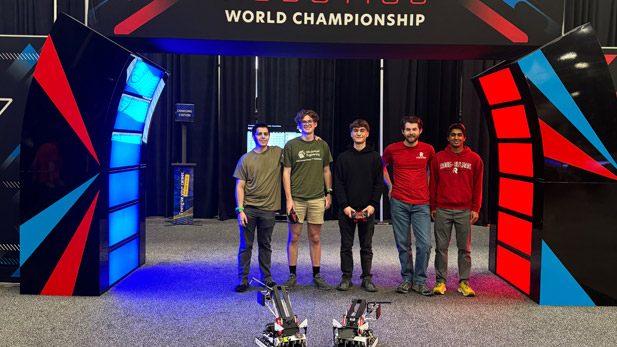
VEX U Robotics competition team qualified for and competed at the World Championships competition in St. Louis.
Rose-Hulman's VEX U Robotics team programmed a dominant display, earning a VEX U Robotics World Championship berth in just its second year on campus. At the April event, the team finished with a match record of 8-2, besting college teams from around the world, including Purdue University.
"We worked hard to compete at a high level and with integrity," said Austin Vesich, a 2026 software engineering graduate who served as president of Rose-Hulman's VEX U Robotics team this past year. "Following this season, we've received many positive comments from our peers, other VEX teams around the world, refs and judges that we interacted with, and the Rose faculty that worked with our team."
As a young organization competing in its first full competition season, VEX U worked to build a foundation for the team to ensure its continued success. Since the competition's game and objective were announced last May, the Rose-Hulman students have built and documented robots that can effectively shoot, stack, and roll game elements. Over the course of the season, the team made four different robot designs, building a total of six robots that incorporated three of the designs. The team brought the two final robots to each competition.
"In VEX, keeping up with the current meta of the game is huge, so for us, a big part of remaining competitive was having a highly iterative design process," said Vesich. "We believe that, throughout the season, you can't get emotional about scrapping things, or get scared of redesigning or rebuilding the robots."
In addition to constructing their competition bots, the team implemented a rigorous strategy development process. Operating much like a championship-caliber athletics team, VEX U Robotics students watched competition film of other teams, scouting their opponent's designs, autonomous driving paths, driver ability, and robot behavior.
"This process kept us well-prepared for each of our Worlds matches, as we could know going into a match what strategies could work, which ones couldn't, and how we should generally approach each of the opposing team's robots to most effectively defend and outscore them," Vesich said.
Between January and March, Rose-Hulman's VEX U Robotics team competed in three local tournaments, qualifying for the World Championships in St. Louis, where the game for next year was announced. As the team looks ahead to continued growth next season, Vesich emphasized that the team has roles for students from nearly every major.
"A lot of our hardest problems are solved in CAD or by our programmers with a focus on control algorithms and custom sensors, so students interested in mechanical design, position and control algorithms, and electrical engineering with application to sensors for robotics should make sure to check us out," he said.
The team is eager to continue representing Rose-Hulman on a local and global stage, applying lessons learned in the classroom to the competition.
"We worked hard to compete at a high level and with integrity," said Austin Vesich, a 2026 software engineering graduate who served as president of Rose-Hulman's VEX U Robotics team this past year. "Following this season, we've received many positive comments from our peers, other VEX teams around the world, refs and judges that we interacted with, and the Rose faculty that worked with our team."
As a young organization competing in its first full competition season, VEX U worked to build a foundation for the team to ensure its continued success. Since the competition's game and objective were announced last May, the Rose-Hulman students have built and documented robots that can effectively shoot, stack, and roll game elements. Over the course of the season, the team made four different robot designs, building a total of six robots that incorporated three of the designs. The team brought the two final robots to each competition.
"In VEX, keeping up with the current meta of the game is huge, so for us, a big part of remaining competitive was having a highly iterative design process," said Vesich. "We believe that, throughout the season, you can't get emotional about scrapping things, or get scared of redesigning or rebuilding the robots."
In addition to constructing their competition bots, the team implemented a rigorous strategy development process. Operating much like a championship-caliber athletics team, VEX U Robotics students watched competition film of other teams, scouting their opponent's designs, autonomous driving paths, driver ability, and robot behavior.
"This process kept us well-prepared for each of our Worlds matches, as we could know going into a match what strategies could work, which ones couldn't, and how we should generally approach each of the opposing team's robots to most effectively defend and outscore them," Vesich said.
Between January and March, Rose-Hulman's VEX U Robotics team competed in three local tournaments, qualifying for the World Championships in St. Louis, where the game for next year was announced. As the team looks ahead to continued growth next season, Vesich emphasized that the team has roles for students from nearly every major.
"A lot of our hardest problems are solved in CAD or by our programmers with a focus on control algorithms and custom sensors, so students interested in mechanical design, position and control algorithms, and electrical engineering with application to sensors for robotics should make sure to check us out," he said.
The team is eager to continue representing Rose-Hulman on a local and global stage, applying lessons learned in the classroom to the competition.