Rose-Hulman Team Powers Best Student Paper Award at Georgia Tech Protective Relaying Conference
Tuesday, August 25, 2026
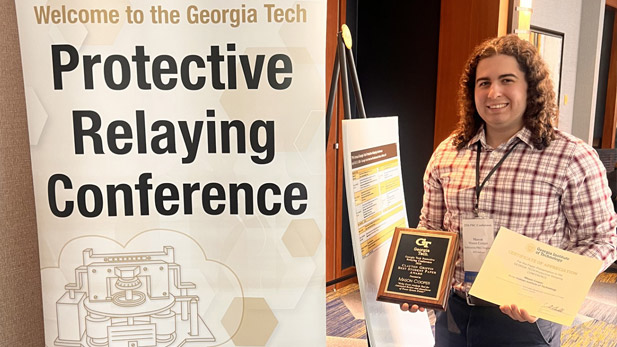
Mason Cooper, Tuan Tran, Robert MacDougall, and Bhargav Nagalamadaka earned the Clayton Griffin Best Student Paper Award at the Georgia Institute of Technology Protective Relaying Conference for their senior capstone project, the Relay Event Analysis Tool.
An incandescent team of recent Rose-Hulman graduates powered both their careers and industry innovations through their senior capstone project and earned electrifying recognition. Electrical engineering alumni Mason Cooper and Tuan Tran and computer engineering alumni Robert MacDougall and Bhargav Nagalamadaka, all 2026 graduates, received the Clayton Griffin Best Student Paper Award at the Georgia Institute of Technology Protective Relaying Conference.
Partnering with AES Indiana (formerly Indianapolis Power & Light Company), the team developed a Relay Event Analysis Tool (REAT), a software tool that helps power engineers quickly review and understand power system events — such as faults or outages — by automatically analyzing relay event data.
This type of analysis is often performed manually and is a time-intensive process subject to variability. REAT automates the process by parsing event files, extracting key electrical and protection data, identifying fault characteristics, and illuminates unusual data points for further review.
"In practice, those flagged events can lead to a range of follow-up engineering actions," said Cooper. "These may include traveling to substations or field locations to inspect physical equipment, performing detailed system studies to evaluate protection coordination or system operations, reviewing breaking and relay performance, or identifying maintenance needs and long-term reliability trends across the system."
He added, "By helping engineers prioritize and interpret these events more efficiently, the tool supports faster and more informed decision making. Ultimately, this contributes to improved reliability of the electric grid by enabling quicker analysis of disturbances and better-informed engineering decisions following those events."
The bright team of engineers developed REAT in Python using a modular architecture with separate parsing, analysis, and reporting components. Designed to be extensible to different relay types and deployable as a standalone Windows executable, the tool can be run manually or scheduled to operate automatically at defined intervals, making it practical for real-world deployment in a utility environment.
In testing, the team worked with 341 real-world distribution system event files provided by AES Indiana. REAT demonstrated its efficiency in handling large data, processing the dataset with an average rate of less than five seconds per file. The tool also showed a high level of accuracy across fault identification, current measurements, clearing time calculations, and other key metrics when a subset of 50 events was compared against the results of manual engineering analysis for deeper validation.
Cooper presented the paper, entitled, "Relay Event Analysis Tool for Automated Review and Assessment of Power System Events" at the Georgia Tech Protective Relaying Conference, where he accepted a plaque and a monetary prize on behalf of the team. The conference is one of the premier conventions in the power system protection field.
"It's been really rewarding to take a senior design project and see it grow into something recognized at a national conference, especially knowing the work has practical value for engineers and contributes to improving the reliability of the electric power system," said Cooper.
The project helped light the way for powerful positions for the team, who all graduated after the 2026 winter quarter. Tran is an electrical designer at BSA, MacDougall is a research and development hardware engineer at Keysight Technologies, and Nagalamadaka is a software engineer at Mphasis. Cooper now works as a substation protection and control engineer at AES Indiana.
"This project was especially meaningful to me because it directly connects to my path into the power industry," said Cooper. "I interned with AES Indiana in the Substation Protection and Control Engineering group during the summer of 2025, and I worked with my manager to help define this project so that my senior design experience could contribute to real-world engineering challenges."
Cooper noted that he had been selected as an IEEE Power & Energy Society Scholar for the 2025-2026 academic year. He successfully completed the Fundamentals of Engineering (FE) exam during his internship and is now a registered Engineering Intern (EI) in Indiana, a key step toward obtaining professional engineering licensure. He plans to pursue a master's degree in power systems focused on protection, modeling, and control.
Cooper and Tran also earned a power certificate at Rose-Hulman, completing courses in electric machinery, renewable energy, power electronics, power system analysis, and power system protection. Taught in the Electrical & Computer Engineering Department, the power certificate program prepares students for a career in the electric power industry, opening opportunities for positions and advancement in consulting firms, the electric utility industry, and manufacturers of high-power equipment.
Partnering with AES Indiana (formerly Indianapolis Power & Light Company), the team developed a Relay Event Analysis Tool (REAT), a software tool that helps power engineers quickly review and understand power system events — such as faults or outages — by automatically analyzing relay event data.
This type of analysis is often performed manually and is a time-intensive process subject to variability. REAT automates the process by parsing event files, extracting key electrical and protection data, identifying fault characteristics, and illuminates unusual data points for further review.
"In practice, those flagged events can lead to a range of follow-up engineering actions," said Cooper. "These may include traveling to substations or field locations to inspect physical equipment, performing detailed system studies to evaluate protection coordination or system operations, reviewing breaking and relay performance, or identifying maintenance needs and long-term reliability trends across the system."
He added, "By helping engineers prioritize and interpret these events more efficiently, the tool supports faster and more informed decision making. Ultimately, this contributes to improved reliability of the electric grid by enabling quicker analysis of disturbances and better-informed engineering decisions following those events."
The bright team of engineers developed REAT in Python using a modular architecture with separate parsing, analysis, and reporting components. Designed to be extensible to different relay types and deployable as a standalone Windows executable, the tool can be run manually or scheduled to operate automatically at defined intervals, making it practical for real-world deployment in a utility environment.
In testing, the team worked with 341 real-world distribution system event files provided by AES Indiana. REAT demonstrated its efficiency in handling large data, processing the dataset with an average rate of less than five seconds per file. The tool also showed a high level of accuracy across fault identification, current measurements, clearing time calculations, and other key metrics when a subset of 50 events was compared against the results of manual engineering analysis for deeper validation.
Cooper presented the paper, entitled, "Relay Event Analysis Tool for Automated Review and Assessment of Power System Events" at the Georgia Tech Protective Relaying Conference, where he accepted a plaque and a monetary prize on behalf of the team. The conference is one of the premier conventions in the power system protection field.
"It's been really rewarding to take a senior design project and see it grow into something recognized at a national conference, especially knowing the work has practical value for engineers and contributes to improving the reliability of the electric power system," said Cooper.
The project helped light the way for powerful positions for the team, who all graduated after the 2026 winter quarter. Tran is an electrical designer at BSA, MacDougall is a research and development hardware engineer at Keysight Technologies, and Nagalamadaka is a software engineer at Mphasis. Cooper now works as a substation protection and control engineer at AES Indiana.
"This project was especially meaningful to me because it directly connects to my path into the power industry," said Cooper. "I interned with AES Indiana in the Substation Protection and Control Engineering group during the summer of 2025, and I worked with my manager to help define this project so that my senior design experience could contribute to real-world engineering challenges."
Cooper noted that he had been selected as an IEEE Power & Energy Society Scholar for the 2025-2026 academic year. He successfully completed the Fundamentals of Engineering (FE) exam during his internship and is now a registered Engineering Intern (EI) in Indiana, a key step toward obtaining professional engineering licensure. He plans to pursue a master's degree in power systems focused on protection, modeling, and control.
Cooper and Tran also earned a power certificate at Rose-Hulman, completing courses in electric machinery, renewable energy, power electronics, power system analysis, and power system protection. Taught in the Electrical & Computer Engineering Department, the power certificate program prepares students for a career in the electric power industry, opening opportunities for positions and advancement in consulting firms, the electric utility industry, and manufacturers of high-power equipment.