Computer Science & Software Engineering Students Present Capstone Research Projects at Third-Annual Symposium
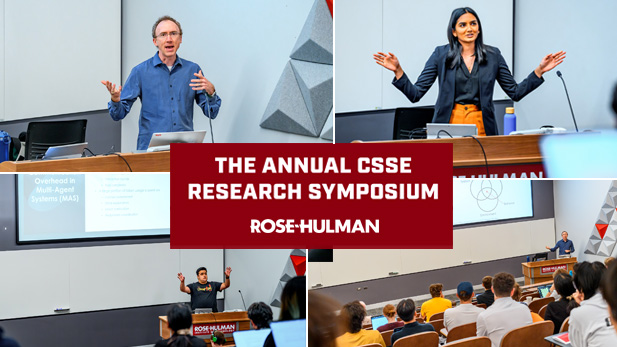
Six Computer Science & Software Engineering (CSSE) majors recently presented their research-based capstone project to Rose-Hulman faculty and fellow student community during the third-annual CSSE Research Symposium.
Six Computer Science & Software Engineering (CSSE) majors recently presented their research-based capstone project to Rose-Hulman faculty and fellow student community. The seniors spent 30 weeks planning, executing, and fine-tuning their projects that will mark the end of their years at Rose. The students presented their findings May 13 during the third-annual CSSE Research Symposium.
“The CSSE research symposium provides us with an opportunity to celebrate the research journeys of our graduating seniors,” said Professor and Head of Computer Science & Software Engineering Sriram Mohan, PhD. “The experience of presenting their work in an arena similar to a research conference is helpful as they embark on their research careers. We hope that it is the first of many similar opportunities for our students.”
“Additionally, the symposium provides the department with a platform to point the destination for our younger students, inspiring them to engage in research,” said Mohan.
The symposium began with a keynote presentation from Rose alumnus Jerod Weinman (2001, computer science and mathematics) and professor of computer science at Grinnell College. Weinman’s presentation explored how AI systems have been trained to read text from real-world images and how past evaluation methods may have overstated progress as challenges became more difficult. He introduces a new AI model, LIGHT, designed to read and interpret text from historical maps by combining language, image, and geometric analysis.
Following Weinman’s speech, each student delivered a 20-minute presentation about their research and answered questions from fellow students and faculty. Projects ranged from using AI to improve curriculum generation to using an algorithm to understand parents’ use of food content on social media.
“The quality of our students’ work is often surprising — paralleling (and sometimes exceeding) that of early career graduate students,” said Mohammad Noureddine, PhD, assistant professor of computer science & software engineering. “They approach their topics diligently and scientifically, go through several rounds of review and questioning, and adapt to the challenges of research in a fast-changing field. In fact, many of our students have gone to publish and present their thesis work at highly-respected computer science conferences.”
Matteo Calviello, a senior majoring in computer science and data science, was honored with the Michael Atkins Outstanding Senior Thesis Award for his work, “Replication and Architectural Enhancement of Omni Aggregation Networks.” Throughout the research process, Calviello learned that sometimes the best engineering decision is knowing what to remove. In his case, deleting one layer helped significantly improve his model’s performance.
After completing three summer project-based internship experiences, Calviello chose to pursue a research-based capstone to experience research first-hand. The research also gives him a foundation should he decide to pursue a master’s degree in the future. After graduating, Calviello will join one of his previous internship companies, ComEd, as an associate data scientist where he will put to work some of the models he developed through his senior research project.
“The idea of this project came from my experience with ComEd because I worked with satellite images,” he said. “Those images are hard to read, so having the tool I presented in this study will be a major improvement to help them read and learn from their images.”
Preksha Sarda, a senior double majoring in computer science and data science with a minor in robotics, also chose a research-based capstone project and presented her findings at the symposium. Sarda’s project, “Predicting R-Loop Formation in the ATXN Gene Family via Convolutional Neural Networks,” was not the first research experience she had at Rose. She has completed four research endeavors that combine her interests in computer science and medicine.
“The biggest thing I’ve learned from doing research is the importance of reframing questions,” said Sarda. “When you reframe questions and solutions in a different way, you then have a problem you can solve.”
After graduation, Sarda will begin work at Disney as a software developer in the robotics and animatronics division. Her previous research in medical robotics helped land the Disney opportunity.
Other projects included:
- Dominic Reilly: “Improving AI-Assisted Curriculum Generation Through Iterative Refinement and Retrieval-Augmented Generation”
- Amruth Annavaram: “Feeding the Algorithm: Understanding Parents Use Behaviors of Food Content on Social Media”
- Thomas Bioren: “The Performance of Direct Mapping Strategies on the Evolution of Irregular Circuit"
- Medhansh Khattar: Minimal Signaling for Mediated Coordination in Multi-Agent LLM Systems”