Building the Next Generation of Innovators, Discoverers, and Entrepreneurs
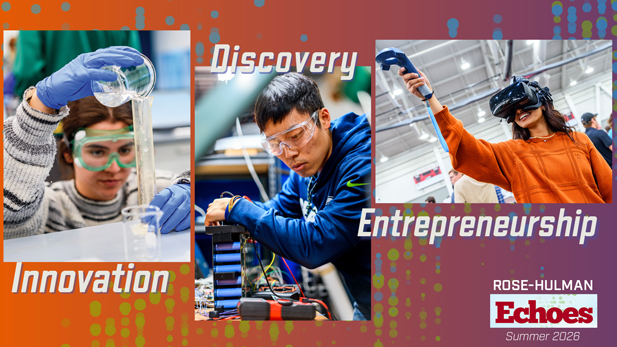
Rose-Hulman is building a culture designed to cultivate the next generation of innovators, discoverers, and entrepreneurs. That vision sits at the center of the Institute’s Advancing by Design strategic plan.
Editor’s Note: This story first appeared in the Summer 2026 issue of “Echoes” magazine.
A steel beam stretched skyward against a cold February sky as construction crews guided it into place atop the future home of Rose-Hulman Ventures. Covered in colorful signatures from students, faculty, and staff, the beam carried an American flag, a Rose-Hulman flag, and an evergreen tree — a traditional symbol of prosperity and safe completion.
As the beam settled into position, marking the highest point of the first building in Innovation Grove, it represented more than a construction milestone. It reflected a broader transformation taking shape across campus.
Rose-Hulman is not only building new facilities. It is intentionally building a culture — one designed to cultivate the next generation of innovators, discoverers, and entrepreneurs.
That vision sits at the center of the Institute’s Advancing by Design strategic plan, which calls on Rose-Hulman to “instill a mindset of innovation, discovery, and entrepreneurship” throughout the student experience. The strategy extends beyond launching new programs or constructing new buildings. It is about creating an ecosystem where students are encouraged to experiment boldly, pursue ambitious ideas, and apply their knowledge to real-world challenges from their very first days on campus.
“Bringing Ventures to the campus — and anchoring Innovation Grove — amplifies the potential for future impact,” said President Robert A. Coons. “It strengthens the connection between academic discovery, entrepreneurial thinking, and community engagement.”
That mindset increasingly can be seen everywhere across campus.
It is visible inside the state-of-the-art Fowler Academic Building, which opened in 2021 with collaborative studios, innovation spaces, and flexible classrooms designed for interdisciplinary learning. It is taking shape inside MRH — affectionately known by students as “Hall TBA” — the Institute’s newest residence hall designed to support community and collaboration. It is evident in the ongoing renovation of Speed Hall, set to reopen in Fall 2026, and perhaps most visibly in Innovation Grove, the $102 million district rising at the corner of State Road 42 and State Road 46 that will connect education, entrepreneurship, healthcare, and regional economic development in entirely new ways.
Together, these spaces reflect an evolving vision for how future generations of students will learn, create, and lead.
Innovation: Designing the Technologies of Tomorrow
For decades, Rose-Hulman students have learned by doing. Increasingly, they are learning by building technologies connected to some of society’s most pressing future challenges.
This spring, Rose-Hulman was selected as one of only 20 universities across North America to participate in the EcoCAR Innovation Challenge, a premier four-year collegiate automotive engineering competition sponsored by the U.S. Department of Energy and industry leaders including General Motors and Stellantis.
The competition continues Rose-Hulman’s growing national presence in advanced vehicle technology competitions. Earlier this year, a Rose-Hulman and Ivy Tech Community College team finished among the top three teams in North America in the Battery Workforce Challenge, a three-year electric vehicle battery competition sponsored by Stellantis and the Department of Energy. Competing largely against graduate-level programs, Rose-Hulman’s primarily undergraduate team designed, integrated, and tested advanced battery systems while earning national recognition for its software and systems engineering work.
Those experiences mirror the direction of the broader automotive industry — and the interests of students themselves.
Inside the Branam and Kremer Innovation Centers, members of Rose-Hulman’s Grand Prix Engineering team have spent the past two years undertaking one of the most ambitious transitions in the organization’s history: building the program’s first electric Formula SAE race car.
“It’s a whole new ballgame,” said senior mechanical engineering major Alex Spitzer, president of Rose GPE. “Last year, we didn’t get the car finished. But we took what we learned in that process and are using it to build our first electric car.”
The transition has expanded the team beyond its traditional mechanical engineering roots to include students specializing in electrical engineering and computer engineering as they tackle high-voltage systems, controls, and battery integration.
That same spirit of technological adaptation is reshaping academics across campus.
Rose-Hulman recently launched a standalone major in Artificial Intelligence designed to prepare students not only to build next-generation AI systems, but to apply them responsibly and ethically. Complementing the major is a multidisciplinary AI minor open to students across campus.
The changes reflect a larger institutional effort to evolve rapidly alongside emerging industries and technologies.
“Higher education cannot afford to move at the pace it once did,” Coons said. “When industry and student needs transform in real time, our academic structures have to be flexible enough — and bold enough — to transform with them.”
Discovery: Advancing Knowledge, Research, and Possibility
Innovation at Rose-Hulman is not limited to engineering prototypes and startup ideas. It also thrives through discovery—in laboratories, research collaborations, advanced computing, and the pursuit of new knowledge.
This year, junior computer science major William Valentine became the 18th Rose-Hulman student since 2004 to earn the prestigious Goldwater Scholarship, one of the nation’s top honors for undergraduate researchers in science, engineering, and mathematics.
Valentine’s research focuses on human-robot interaction, particularly how socially assistive robots can better support older adults living with dementia or cognitive impairment. Already the author of seven conference papers as an undergraduate, Valentine hopes his work can help preserve meaningful human connection for vulnerable populations.
“When I was a kid, I remember visiting my grandparents and finding out they didn’t recognize me,” Valentine said. “That’s why I want to spend my career creating robots that help people like my grandparents—older adults living with cognitive impairments who deserve to maintain a connection with the people they love.”
His work reflects Rose-Hulman’s growing emphasis on undergraduate research opportunities that place students at the forefront of emerging disciplines.
Discovery at Rose-Hulman is also advanced through faculty scholarship that creates meaningful opportunities for undergraduate involvement. This year, Associate Professor of Chemical Engineering Irene Reizman, PhD, earned national recognition for her leadership in undergraduate STEM research, work that has helped expand hands-on discovery opportunities for students across disciplines. Through efforts such as the Rose Research Fellows program, Reizman has helped connect students with ambitious research experiences spanning fields from sustainable chemistry and biotechnology to computing and materials science — reinforcing a culture where students are not simply learning established knowledge, but contributing to the creation of new knowledge alongside faculty mentors.
That commitment also shaped the launch of the Institute’s new Quantum Science, Computing & Engineering certificate, which prepares students for one of technology’s fastest-growing fields. Designed to be interdisciplinary, the certificate introduces students from engineering, mathematics, computer science, and physics backgrounds to quantum systems, computing, and engineering applications.
“We want this to be campus wide,” said Professor Maarij Syed, PhD. “The quantum workforce needs to be very diverse.”
Discovery increasingly also means understanding and interpreting data.
Earlier this year, a team of Rose-Hulman students calling themselves the “Data Miners” captured the undergraduate title in the NCAA Men’s Final Four Analytics Challenge, outperforming 157 teams from 15 universities.
Using machine learning and predictive modeling, the students analyzed NCAA tournament data to identify characteristics of championship-caliber teams and predict close games and potential upsets.
“This was a new way to combine what we learn — machine learning, data science — with an actual business case,” said senior computer science major Matteo Calviello. “It’s something that can create real value for an organization.”
Experiences like these increasingly define the Rose-Hulman student experience: opportunities where technical expertise, research, creativity, and collaboration intersect in ways extending far beyond traditional classroom boundaries.
Entrepreneurship: Turning Ideas into Impact
If Innovation Grove represents the physical foundation of Rose-Hulman’s entrepreneurial future, the students and alumni already building companies represent its momentum.
That momentum was on full display this spring during Sawmill Society Weekend, where student founders pitched startup concepts, alumni investors offered mentorship, and entrepreneurial conversations stretched across classrooms, conference tables, and networking sessions.
Hosted alongside Alumni Awards Weekend, the event highlighted the rapidly growing entrepreneurial ecosystem emerging at Rose-Hulman through programs such as RISE, Rose Angels, Engineerathon, and the Noblitt Entrepreneurship Program.
One of the weekend’s most visible examples of entrepreneurial success came from Tsenta, the AI-powered startup created by computer science students Agnay Srivastava and Pulkit Gupta.
Frustrated by the repetitive and time-consuming nature of job applications, the pair developed a platform that automates and streamlines portions of the application process while still allowing users to customize and control submissions. Their work earned acceptance into Y Combinator — the influential Silicon Valley startup accelerator behind companies such as Airbnb, DoorDash, and Reddit — along with $500,000 in funding.
“It’s an amazing opportunity to enter the San Francisco startup ecosystem, learn from founders who have built impactful companies, and accelerate Tsenta by learning directly from their experiences,” Gupta said.
For Srivastava, the experience also reinforced the entrepreneurial confidence he developed at Rose-Hulman.
“One great thing that Rose-Hulman does is it makes you unafraid of diving deep into the technical details,” he said.
That entrepreneurial mindset increasingly begins long before graduation.
During this year’s Engineerathon competition, more than 100 students spent 48 intense hours brainstorming, prototyping, coding, fabricating, and pitching solutions to real-world problems supplied by companies and startup founders.
Throughout Fowler Academic Building and the Innovation Centers, classrooms filled with sticky notes, CAD models, half-built prototypes, energy drinks, and students working through the night to transform ideas into functioning solutions.
“Entrepreneurship isn’t just about building a business or selling a product,” said junior engineering design major Deven Wells, president of the Rose Innovative Student Entrepreneurs (RISE) club. “It’s about making sure what you’re building actually solves a real problem for your users.”
The entrepreneurial ecosystem students now experience also increasingly includes direct mentorship from alumni founders.
During Sawmill Society Weekend, 1993 mechanical engineering alumnus Joe Ritz received the Tom Mason Innovation Award recognizing his groundbreaking work developing advanced Nitinol-based medical devices through companies including Blaze Biotech, RMR Ortho, and Chorus Cardiothoracic Technologies.
Ritz credits Rose-Hulman — and even a sideline football conversation with former President Samuel Hulbert — with helping shape the trajectory of his career.
“He asked me why I wasn’t taking his courses in biomaterials,” Ritz recalls. “I signed up and then immediately knew that my career would be as an engineer in medical devices.”
Today, Ritz helps mentor student entrepreneurs through the same ecosystem that helped inspire him decades earlier.
That ecosystem continues expanding.
This year, Rose-Hulman appointed Victor Padilla-Taylor as its inaugural Noblitt Entrepreneurship Director and Professor of Practice in Engineering Management. Previously a founding director at Yale University’s Tsai Center for Innovative Thinking, Padilla-Taylor now helps coordinate and expand entrepreneurial opportunities throughout campus.
At the same time, student leaders recently announced plans for a new Entrepreneurship Lounge in Blumberg Hall — another sign that entrepreneurship is increasingly becoming embedded in the fabric of campus life itself.
More than 150 years ago, Chauncey Rose founded a sawmill before helping establish the technical school that would later bear his name. Today, Rose-Hulman students continue building on that spirit — designing electric vehicles, launching startups, advancing quantum science, training AI systems, and solving problems not yet imagined.
And increasingly, they are doing so in spaces intentionally designed to help those ambitions grow.
As the signed steel beam settled into place atop Innovation Grove earlier this year, it symbolized more than the completion of a building phase. It represented a future still under construction — one being shaped every day by students learning not simply how to succeed in the world they inherit, but how to create the one that comes next.