Ben Waite Pedals Toward Innovations for Bicycles, Tour de France
Thursday, August 20, 2026
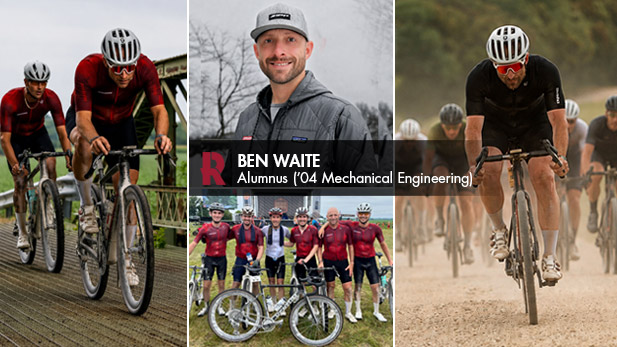
Ben Waite, 2004 mechanical engineering alumnus, pedals towards innovation at SRAM, a producer of high-end bicycles, where he is responsible for developing Zipp wheels used by Tour de France athletes.
Ben Waite never forgot that feeling of freedom that came with his first bike: a sense of exploration and wonder, of limitless possibilities just a pedal away. Power surged through his legs as he realized his own potential, and, as so many children have, he felt as though he could fly.
He never dreamed that one day he would help others fly faster and explore farther.
Waite, a 2004 mechanical engineering alumnus, is the senior design engineer at SRAM — a producer of elite, high-end bicycle components — where he is responsible for developing Zipp wheels. Waite applies his mechanical background, as well as his biomedical engineering minor, to optimize every element of an athlete's ride for peak speed and efficiency.
"Rose does a great job of taking it beyond academic theory," he said. “It’s a different style of learning. It’s what happens on a small, intimate campus, versus a large, research-based campus. Rose-Hulman graduates…are in high demand.”
Waite continued, “I remember a project in a biomechanics class was analyzing arm angles of pitchers. It's completely different sports, but breaking everything down…I do that all the time now [with] bike fitting."
Waite works closely with SRAM's different customer segments —including consumers, bike shops, and professional athletes — to design custom solutions for their needs.
Throughout this summer's Tour de France and Tour de France Femmes, multiple athletes raced using SRAM equipment, particularly Zipp wheels. Because of the time difference, Waite woke up each morning to see what equipment decisions had been made in France while he slept, and his team kept a broadcast of the event playing in the office, watching with pride as their handiwork raced across the screen.
"It's really cool to see. You've done a lot of work over the last six to nine months with one of these teams to put them in the best position," Waite said. "We're trying to eke out one-tenth of a kilometer per hour here or there, whether that's from aerodynamics or rolling resistance."
Innovation, too, moves at the speed of bikes. Waite and his colleagues apply the company motto 'Making You Faster' in their decision-making, sometimes ideating a design in the morning and testing a prototype by their lunchtime ride.
"Our day-to-day innovation can greatly affect the end product that comes out next year," Waite said. "It really fosters this idea of continually innovating because in the end, if we make something that's exciting for us and that we feel is better, our customer gets the same thing."
To Waite, the principles of engineering are like riding a bike — though perhaps not in the idiom's traditional sense — and enable him that same sense of freedom he has come to crave.
"The mechanics of a bicycle are always the same. On the bicycle, you can take those basics and just go explore with them," Waite said. "That's the parallel — the fundamentals of engineering will obey the laws of physics, but how can you go use that to help you explore outside?"
He never dreamed that one day he would help others fly faster and explore farther.
Waite, a 2004 mechanical engineering alumnus, is the senior design engineer at SRAM — a producer of elite, high-end bicycle components — where he is responsible for developing Zipp wheels. Waite applies his mechanical background, as well as his biomedical engineering minor, to optimize every element of an athlete's ride for peak speed and efficiency.
"Rose does a great job of taking it beyond academic theory," he said. “It’s a different style of learning. It’s what happens on a small, intimate campus, versus a large, research-based campus. Rose-Hulman graduates…are in high demand.”
Waite continued, “I remember a project in a biomechanics class was analyzing arm angles of pitchers. It's completely different sports, but breaking everything down…I do that all the time now [with] bike fitting."
Waite works closely with SRAM's different customer segments —including consumers, bike shops, and professional athletes — to design custom solutions for their needs.
Throughout this summer's Tour de France and Tour de France Femmes, multiple athletes raced using SRAM equipment, particularly Zipp wheels. Because of the time difference, Waite woke up each morning to see what equipment decisions had been made in France while he slept, and his team kept a broadcast of the event playing in the office, watching with pride as their handiwork raced across the screen.
"It's really cool to see. You've done a lot of work over the last six to nine months with one of these teams to put them in the best position," Waite said. "We're trying to eke out one-tenth of a kilometer per hour here or there, whether that's from aerodynamics or rolling resistance."
Innovation, too, moves at the speed of bikes. Waite and his colleagues apply the company motto 'Making You Faster' in their decision-making, sometimes ideating a design in the morning and testing a prototype by their lunchtime ride.
"Our day-to-day innovation can greatly affect the end product that comes out next year," Waite said. "It really fosters this idea of continually innovating because in the end, if we make something that's exciting for us and that we feel is better, our customer gets the same thing."
To Waite, the principles of engineering are like riding a bike — though perhaps not in the idiom's traditional sense — and enable him that same sense of freedom he has come to crave.
"The mechanics of a bicycle are always the same. On the bicycle, you can take those basics and just go explore with them," Waite said. "That's the parallel — the fundamentals of engineering will obey the laws of physics, but how can you go use that to help you explore outside?"