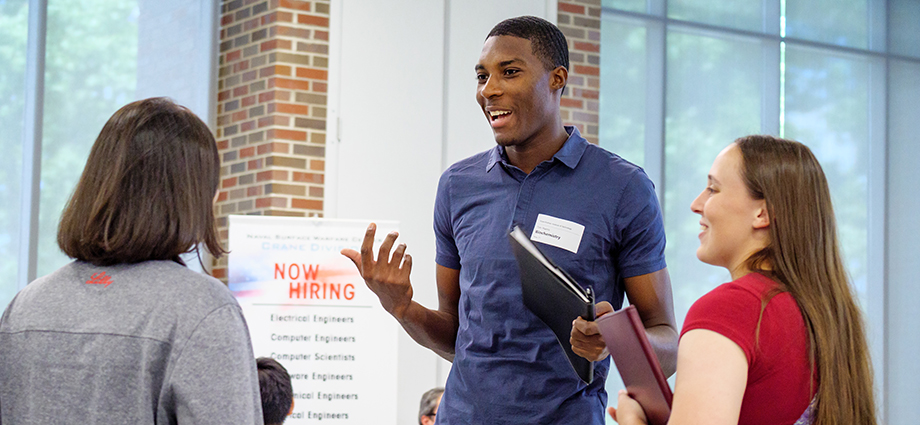
Attending Rose-Hulman Institute of Technology allowed Timothy Harris to combine two of his passions: basketball and biochemistry.
“I thought this was a really cool opportunity,” said Harris, a 2021 biochemistry graduate. “I could not just play basketball in college but also go to one of the best schools in the country.”
Harris’s childhood fascination with science became focused on chemistry and biology through high school experiences in the classroom and at a summer program. But as he neared graduation, Rose-Hulman wasn’t a school he had considered for furthering his education in biochemistry.
Then his coach at West Side High School in Gary, Indiana, sent video clips of Harris’ play to Rose-Hulman’s basketball coaches. When Harris accepted an offer from the Rose-Hulman coaching staff to visit the campus, he learned that he could continue his basketball career while also studying in a program whose rigor would push him academically.
“Rose is hard, but it’s supposed to be,” Harris said. “I learned how to critically think, and that’s the most valuable skill you can teach anyone in life.”
His courses emphasized the real-world applications of biochemistry concepts. An inorganic chemistry class, for example, saw Harris visiting locations throughout campus to take photos of objects to note their molecular properties. His exams required him to consider how concepts he had learned apply in a variety of scenarios.
Harris also learned about biochemistry’s applications in day-to-day life when studying breast cancer treatments with Professor Ross Weatherman, PhD, head of the Rose-Hulman Department of Chemistry and Biochemistry. That experience piqued Harris’ interest in medicinal chemistry—and Rose-Hulman’s focus on problem-solving guided his decision to pursue a doctoral degree in that field.
“I really wanted to take that next step to see how I can solve the problem of trying to combat or mitigate a variety of different diseases,” he said.
He earned a doctoral degree in pharmaceutical sciences from the University of California, Irvine, and now is a clinical chemistry fellow at the University of California, Los Angeles. Harris hopes that one day his work will lead to earlier disease diagnoses.
And he believes his undergraduate experiences at Rose-Hulman set the stage for success in those efforts.
“The training I got at Rose-Hulman definitely made me a better scientist,” he said.