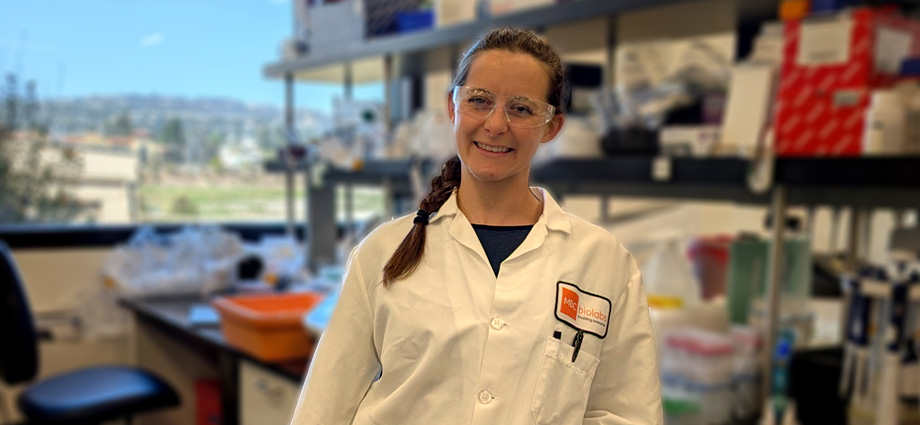
Lauren Gutgesell thought she wanted to be a physician. But her experiences at Rose-Hulman steered her in a direction she hopes will allow her to make an even greater impact on treating and preventing disease.
Today Gutgesell, a 2014 chemistry graduate, works as a scientist, conducting experiments that could pave the way to more effective medicines for fibrosis of the lungs and liver. It’s a career she didn’t know existed when she arrived at Rose-Hulman.
But as she progressed through her undergraduate career, Gutgesell began to think more about what drew her to the medical field. Her advisor, Professor Ross Weatherman, PhD, head of the Department of Chemistry & Biochemistry, urged her consider how she wanted to focus those interests.
“After I talked with him about the reasons I was interested in medicine—puzzle solving and finding ways to treat people in innovative ways—he pointed out that if what I was interested in was curing and preventing disease, I could do the doctor path and treat people one by one, or I could go into research to treat populations.”
Soon, she was working in Weatherman’s lab, finding that she enjoyed the research and biology aspects of her chemistry studies. In her current role, with San Francisco-based startup Aruda Therapeutics, Gutgesell relies on the skills and interests she developed while working in the lab at Rose-Hulman—including a willingness to consider new research tools and approaches.
“There were multiple experiments where I could test the efficacy of a drug,” she said. “And there was one standard way to test, but there are also other ways. Dr. Weatherman encouraged me to look into other options, not just the easiest.”
She received a doctoral degree in medicinal chemistry and pharmacognosy from the University of Illinois Chicago. Now, Gutgesell’s research, which has produced drugs that have been in clinical trials and have received patents, uses innovative technology in procedures like imaging, microscopy, and RNA sequencing.
Gutgesell also is examining the benefits and drawbacks of using artificial intelligence in her work.
“You always have to be ready for the next innovation to help you, for new technologies and new ways of looking at data,” she said. “To be able to leverage these new technologies, including AI, you have to be curious and keep asking questions.
“And, generally, it’s not just about asking the questions. It’s about being able to think through the answers.”