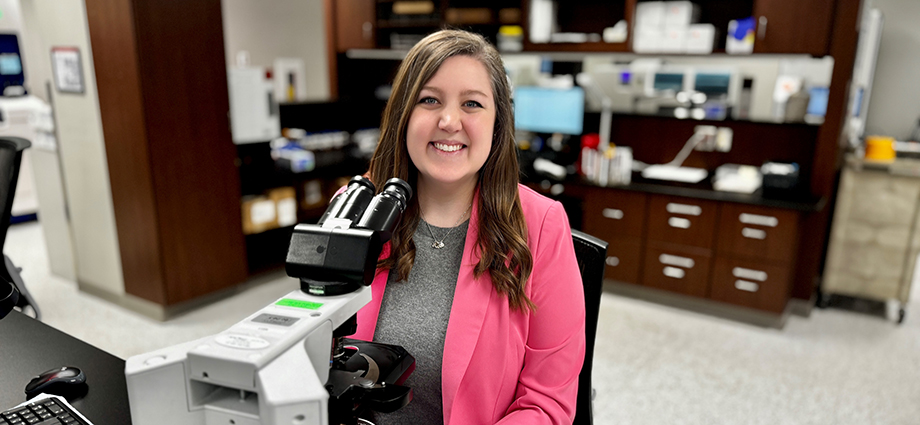
Anna Weber was no stranger to Rose-Hulman’s strong academic reputation, particularly its science programs. The second member of her family to attend the college (her brother earned a degree in chemical engineering), Weber was drawn to Rose’s hands-on learning environment and early access to laboratory experience. After graduating in 2016 with a bachelor’s degree in biology and a minor in chemistry, she joined Powers Health Community Hospital in Munster, Indiana, where she now serves as clinical laboratory manager.
Weber began her career as a microbiologist at the hospital before advancing to clinical laboratory manager. She oversees the laboratory’s daily technical and operational functions, ensuring equipment and processes meet regulatory standards.
“Many people don’t know that the clinical lab is a highly regulated industry,” Weber says. “My position has a heavy focus in quality management. This involves meeting the standards of our laboratory regulatory agency, the College of American Pathologists and various regulations set forth by healthcare related governing bodies.”
Shortly after graduating from Rose-Hulman, Weber completed a nationally accredited Medical Laboratory Scientist training program through the National Accrediting Agency for Clinical Laboratory Sciences. After completing the program, she earned certification as a Medical Laboratory Scientist through the American Society for Clinical Pathology.
Weber is passionate about her work and the role the clinical laboratory plays in patient care.
“The lab is really the backbone of what happens in healthcare,” Weber said. “Research suggests that about 70% of medical decisions are based on lab work. That really speaks to all the touch points that a lab has on many aspects of healthcare. For me personally, I recognize the impact lab values have on patients. We provide crucial information about the antibiotics best suited for patient care and help drive treatment plans based on our metrics; that’s all very rewarding.”
Weber enjoys that her current position combines both science and patient care. “My current role blends together all the things I love. I’ve always had a strong science background and enjoy the technological and biological aspects of science. That comes together nicely with the patient interaction I get in the healthcare field.”
Weber credits Rose with preparing her for the clinical laboratory, particularly through her senior thesis, which strengthened both her scientific knowledge and independent research skills.
“Knowing that I could tap into the knowledge and critical thinking skills I learned in the curriculum and apply it to my work in a clinical lab was so helpful,” she said.
Weber also credits Rose-Hulman’s small class sizes with creating an environment where students could build meaningful relationships with professors and classmates.
“One of my favorite things about the smaller scale of Rose is the interdisciplinary approach to classes,” Weber says. “There is a lot of interdisciplinary work in a hospital. Even though I was a biology major, I had classes that also had an engineering focus or chemistry focus. You see common threads among all the STEM offerings and that has continued to help guide my career because the laboratory is just one part of a much larger healthcare system.”