Alumni at the Helm of Completion of Historic DigIndy Project
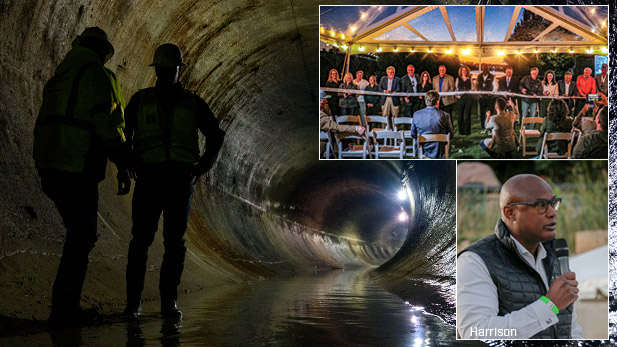
Several Rose-Hulman alumni played engineering roles during the 14-year-long DigIndy project, in which 28 miles of underground tunnels to transport wastewater were constructed to help eliminate sewer overflows into area waterways.
Editor’s Note: This story first appeared in the Summer 2026 issue of “Echoes” magazine.
For 14 years, Citizens Energy Group has been working to construct 28 miles of underground tunnels to transport wastewater in Indianapolis. The DigIndy Tunnel System project began with the goal of nearly eliminating combined sewer overflows (CSO) into area waterways, including Indianapolis’ White River. In October 2025, that vision was realized when the last two tunnels – Fall Creek and Pleasant Run – were completed. The construction of DigIndy set three world records and included several Rose-Hulman alumni working on it throughout the years. At the helm was 1989 electrical engineering alumnus Jeffrey Harrison, president and chief executive officer of Citizens.
The impetus for the DigIndy project was the city’s CSO problem. When rain events come through the community, stormwater flows into a combined sewer system designed to carry both sanitary sewage and rainwater in a single system. When the system becomes overwhelmed, untreated wastewater can flow into local waterways. These discharges are part of a national problem of sewer overflows occurring in 700 cities across the country. Under the Clean Water Act, which stipulates that water and rivers need to be swimmable and fishable, and driven by federal and state requirements, a plan to address the CSO in city waterways was created.
Citizens acquired Indianapolis’ water and wastewater assets in 2011. Harrison was involved in the DigIndy project from its initial stages. He served on the team that developed the request for proposal (RFP) and procurement strategy, along with other early elements of the project, laying the groundwork for the project’s realization. “This was a substantial engineering project and Indy needed a solution that could work for generations, not just for a short time,” said Harrison. “From the start, our goal was to protect customers while protecting the long-term environment. It was not just checking a box; it was about changing our relationship with our rivers.”
Harrison said his time at Rose-Hulman shaped who he is today: a service-oriented engineer committed to improving the community. That philosophy played a role in his shaping of the DigIndy project.
“This is a transformational project,” he said. “It is the largest action anyone can take to clean up our waterways and we’re already seeing measurable improvements in water quality. We have already prevented nearly eight billion gallons of wastewater that would have gone into our rivers and streams. … Rose-Hulman teaches discipline and problem-solving, innovation and creativity and that has certainly played a significant role for me in my entire career.”
Harrison, who is also a member of the Rose-Hulman board of trustees, is proud the DigIndy project has not only set world records in construction but also came in under budget and finished ahead of schedule. The original budget for the project was $2.4 billion and it came in under budget by $400 million.
DigIndy’s tunneling contractor, the Shea-Kiewit Joint Venture, set three world records for hard rock mining production for a 20-foot diameter tunnel boring machine: most mining footage in one day (409.8 feet), most mining footage in one week (1,690 feet), and most mining footage in one month (5,755 feet).
As reported in the Spring 2019 Echoes, Several Rose alumni played engineering roles during the lifetime of the DigIndy project. For Harrison, that’s not a surprise given what Rose instills in engineering students and that DigIndy represents the kind of difficult and meaningful work engineers aspire to achieve. (Editor’s note: Read the original article at rhit.edu/digindy.)
“Rose-Hulman is a premiere source for intellect, and we have a number of Rose graduates on our staff,” said Harrison. “This project benefited from Rose engineers, as well as other trained engineers, who think analytically, collaboratively, and practically. That value engineering is part of what helped us stay $400 million under budget.”
Alumni who were among the project engineers included Jessica Bastin (Civil Engineering [CE], 2001) who managed the DigIndy planning and design work between 2015 and 2109. Chelsie Wilgenbusch (CE, 2016) an intern at Citizens in 2016. Following her internship, Chelsie went into consulting and worked on the tunnel program in various roles and has since returned to Citizens as an engineer. Maceo Lewis (CE, 2001) is with Black & Veatch and served as their project manager for an extensive amount of DigIndy work. He is now serving on another Citizens project. Derek Davidson (CE, 2007) is preconstruction manager at FA Wilhelm and was very involved with DigIndy for many years.
The DigIndy project now moves into a maintenance, operations and monitoring phase. Citizens is focusing on resilience-driven infrastructure to prepare central Indiana for growth. It is working on another significant engineering project: providing 25 million gallons of water per day to Lebanon Utilities. That project will span six years and over $500 million.