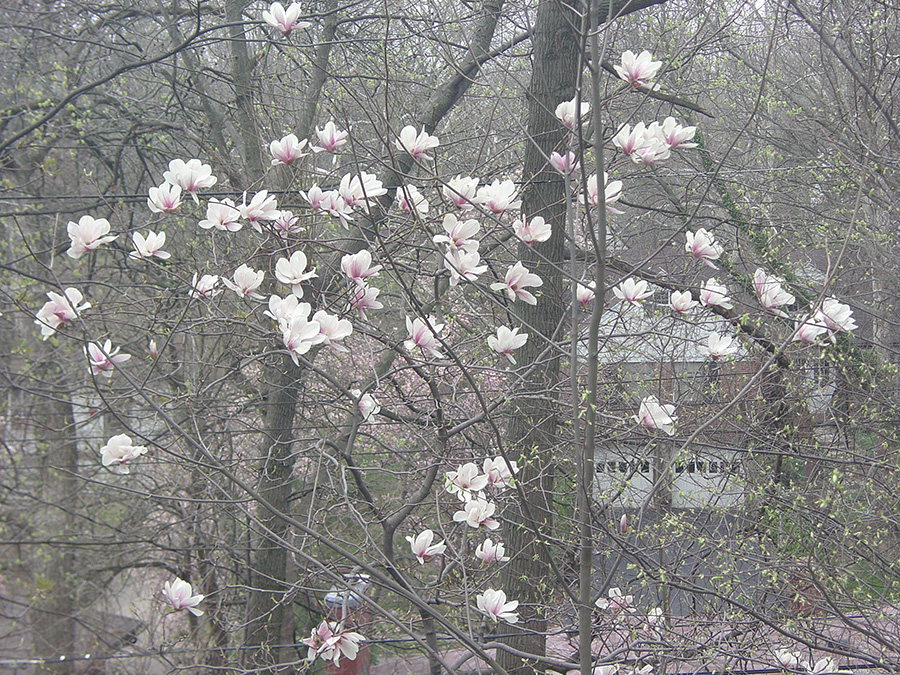
How will Steve's students' lives play out? What will they contribute? How can we faculty help them blossom? What unplanned metaphors, for all that, pop into your head, as you gaze at this only slightly germane image? |
The power of surprise similes — Let's trace the history of Steve's Dayton back yard, using the 2006 snapshot at left, linking it analogically to his students and work at Rose-Hulman! In the foreground, a magnolia that bloomed first, often getting frosted-out. Like students at Rose, the tree was wired to take chances, for the earlier opportunity to thrive. "I can graduate in 3 years if I overload!" Steve advises such calls. Our younger daughter loved climbing this tree. Perching in it spurred her imagination; pre-school, she told herself stories there, shamelessly aloud. This year, she passed her prelims, in Slavic languages and literatures. Did you also have a favorite tree, from which to view the world in splendid isolation? Where is your crow's nest now? The ash whose tall trunk is seen behind lost to the emerald ash borer in 2012 — it was old, shown full-sized on our 1939 plot plan, and it gave us majestic shade. In your career, you may say goodbye to good friends too often. Software engineers change groups, jobs and locations. Even if you don't, they will. Can you plan a social life around that? Our whole lower-level grove, constantly evolving, shields the view of those nearby homes for half of each year. No grass cutting needed, as well! Time has told: Partial cover's good-enough seclusion without adding risk. It's an inner-city neighborhood, but we've had just one break-in, over 33 years. How's your sense of privacy and security, as a young adult? What is "good enough"? |
|---|


Hot topics
Standalone Online Graduate Courses: We now have two online courses we'd be happy to teach "anywhere" — Software Project Management and Software Architecture. Contact Steve for details! MSSE Program: Link to Rose-Hulman's Masters of Science in Software Engineering (MSSE) program is here. And a sample course, his Software Design course, is here; it's typically taught winter term. Service Learning: Steve's funnest involvement — Service Learning. Click here for the ppt presentation. Creativity: For brainstorming methods Steve's used a lot, and how to try them out, see here! Improving Student Learning: See some of the sections below, under Special Interests and Preferences. Like Teaching observation, Making change, and, of course, Trendy stuff. Engineering project ethics: See the slide set, designed to stimulate discussion, here. Architecture reviews: Another great way to learn more regarding the goodness of a design by getting more points of view about it. (Adds to our growing list, like Agile customer involvement, code reviews, interaction design studies, and DevOps.) See ppt intro here. General Ideas to Share: Most of the content in on this page is intended to be informal thoughts on engineering education, which most readers will identify with. The mix of serious, whimsical, and biographical topics is intentional — in an essay tradition dating back to the 16th Century. The opening section on "Philosophy in motion?" sketches the rationale a bit more, as well as kicking business off with one sweeping proposal for Steve's students. Possible research questions, that Steve's curious over, are marked with ??, so just search the page for that, to see if you share any of his special interests! There are like 40 to choose from. |
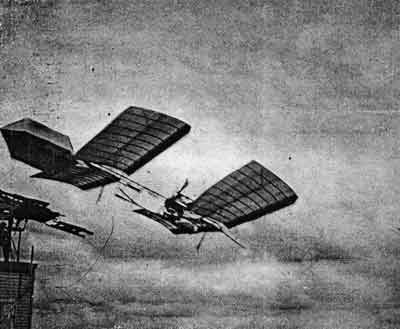
Is this your project in action? It's the next to last attempt at manned powered flight, Oct 7, 1903. before the Wright brothers did it for real. Designed by academics, based on solid calculations and experimentation. What you see is the good part. They fished the pilot out of the Potomac River.25 Then again in December. The Smithsonian Institute had backed the project, and it gave them and the inventor, Samuel P Langley, a bad name. The Institute tried to rewrite history, declaring victory until 1942. Are egos involved in engineering, or what?
Like this image of the test flight, undergrad engineering projects only present enough to declare initial success. After all, you exercised the underlying principles. If the professor smiles, at this point, you earned an "A." Even senior design experiences tend toward prototypes. Our mutual growth path is to work beyond that, though it's harder on everybody. We should keep the current achievement claims modest, in the meantime, with expectations for that maturation. Note: Throughout this web site, Steve uses images like the above, taken from the Internet. This is intended to fall under Sec 107 of US Copyright law, the "Fair Use" section. Steve's intent is specifically for "criticism, comment, news reporting, teaching (including multiple copies for classroom use), scholarship, or research," and he is part of a non-profit educaitonal organization. If you feel, nevertheless, that an image infringes on your copyright or other IP, please let Steve know, and he'll happily remove it! Steve recorded the links where the images came from, clickable in the captions for the images, as above. |

Where to find him?
A history of Steve's Rose offices, with the final one being where he actually is...
 Double change of venue! At left, this was his old office: F-220 (Top floor, back of Moench Hall by
the chimney), where he lived from 2003 - 2016.
Double change of venue! At left, this was his old office: F-220 (Top floor, back of Moench Hall by
the chimney), where he lived from 2003 - 2016.
Now of historical interest, it had nice bright lights at the northern end of the long Moench hallway with the elephant mobile above the door and brain stimuli on the bulletin board next to the electronic one and before you get to the box of hinges? You're there. In the closer high window you see a reflection of the lights from our F-217 lab. In Steve's office were beaucoup kinds of goodies, contrasting with the hallway's plainitude.
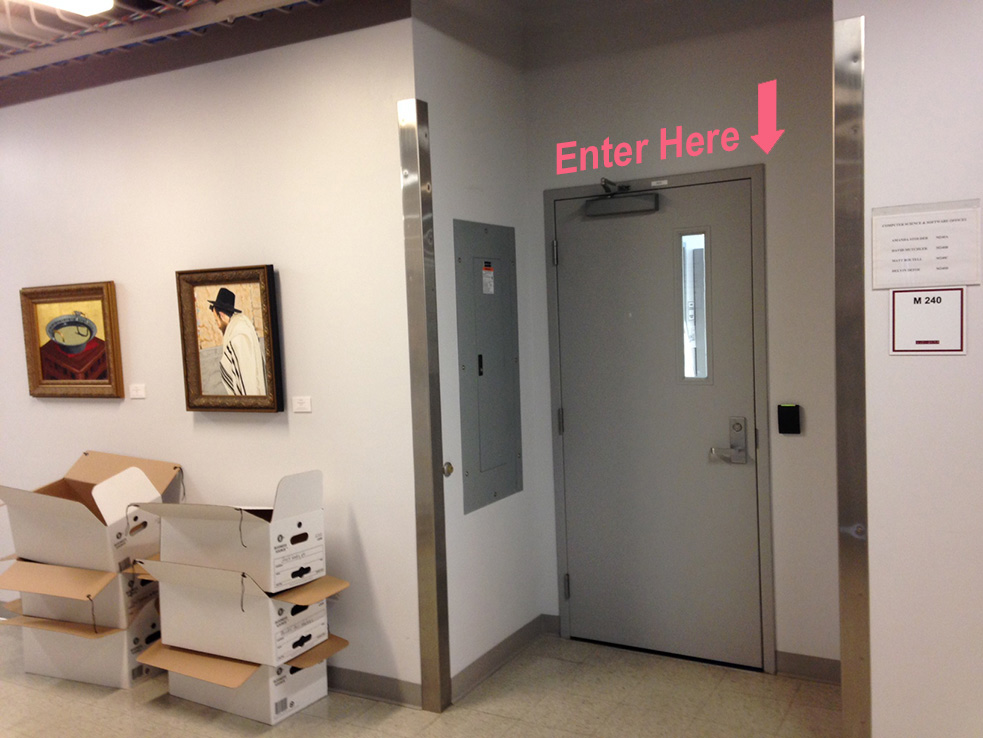
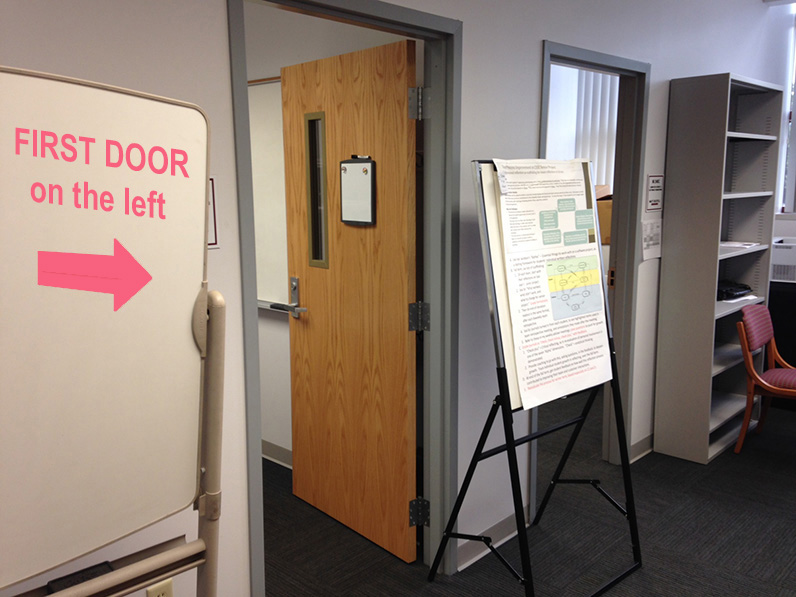
Next location: Basically, Myers 240, first door on the left. See the images, below.
As he took the pictures, below, hew was moving in, as you can see in the first image, on the left.
You have to know where Myers is, and make it up to the second floor.
It doesn't really say, "Enter Here," as you might imagine. That's imaginary. Arrows are as "real" as things get on the Internet, from http://www.wpclipart.com/blanks/arrows/arrows_glossy/arrow_glossy_right_red.png.html.
The art work is likely unchanged, so people used that as a guide.
Usually, the gray door was unlocked.
When you walk in, it's the first door on the left, but, again, the handy red guidance won't be there, even though a white board would be a dandy place for it.
See you there!
 |
 |
Latest and greatest location, as he writes this now: Moench D215B, more or less across the hall from the Bio office. Steve marked a few highlights in the picture, below:
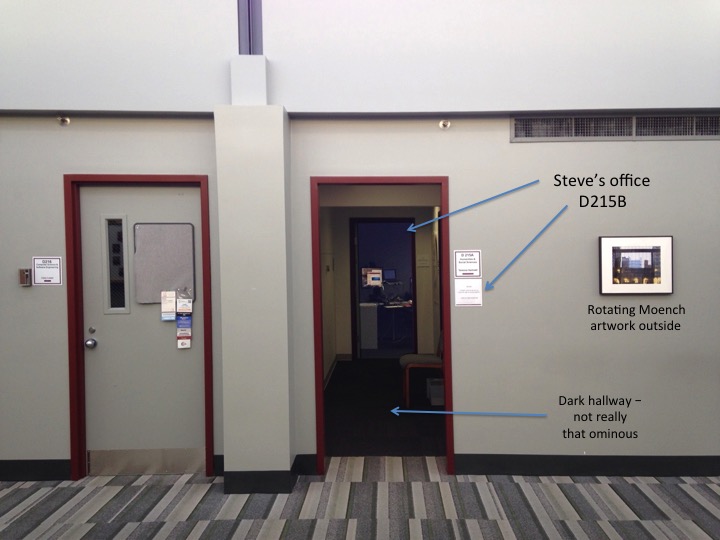
Office Hours: Stop by whenever his door is open and there's not a team meeting going on. Steve, of course, will not be there during his classes; or during our scheduled department meetings, or when working from his home in Dayton, etc. See the schedule by his door.
Or, using technology, try his email address or office phone number. Which probably are listed around where you clicked to get here, maybe?
Steve offers a gentleman's wager to Google, that its search is not yet smart enough to put the address of this home page together with his email address or phone number, unless the latter two appear directly on the home page itself. So far, since 2003, he thinks he's ahead. No spam that looks like it's using content from here. Your search algorithm would have to backup a link to find those missing access methods.
At right we see Google software, in the form of fairy tale inventor Charles Perrault, searching for The Sleeping Beauty on the Internet. This doodle was Google's logo on Jan 12, 2016.
And what else?
All the rest of this page is a giant draw to find common interests, items Steve might share with random those happening on it.51 You could be a student, professor, software engineer, or just a regular person!
Students are an outstandingly important reader of the stuff. They come into college very curious, hoping to discover a steady stream of substance they had no idea of, but which they might contribute to. If, instead, they find only a place where proper ideas are drilled into them, and we check for this on final exams, they will emerge less curious. Is that what we want? Steve believes if we present them also with ideas we know are half-baked, and we would appreciate their help in the baking, they will grow this instinctive curiosity.
In academia, we are open to speak or write as citizens, unconstrained by institutional censorship or discipline. This position in the community imposes special obligations, such as considering our impact on likely listeners and readers. Since we are (supposedly) learned researchers and educators, the public may either get sucked into believing something because of that status, or else judge us all by one individual's personal thoughts. Steve saw this happen at Bell Labs, when a particular Nobel-Prize-winning former researcher expressed very public views which could be considered racist.
Steve intends his half-baked discussion, that follows, to be stimulating, yet he recognizes some readers may see one part or another as controversial, from their own perspective and experience. Steve is not speaking for the Institute he works for, or for his department, or for all professors. Having a home page at a school is a part of our historical and sweeping academic freedom. The Institute bravely provides a platform for us to discourse with diversity.
Toward this end of stimulating interchange, Steve made a lot of the page ad hoc, wandering the way we do when we are inquisitive in an opportunistic way. As you skip through it to see what's what, the main sections you'll see are these:
Academics
BackgroundSpecial interests and preferences
|
If you want to skip down to fun-looking sections, Steve provided some on-page links, at left.
For unplanned exploration, page through this page, like a book, finding the little filaments.22
Here's a thread out on its own now —
Above — Advancing engineering requires debunking myths. And, aren't we all somewhere in the middle?? This image, making fun of flat earth believers, was from a site where the author argues against carbon dating, an engineering process most of us believe is valid. |

Or,
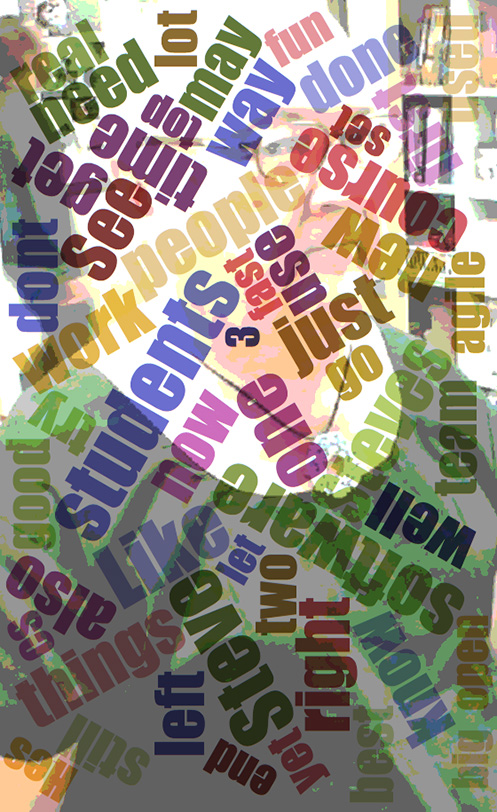
Can I see it all at once?
Cloudy with a chance of students: Here's what Steve says on the above, in a simple word cloud. It gives you an idea of what is emphasized, in everything below, at a glance!
In the image beneath the words, an upperclassman saunters past Steve's door, and he gives him a glance, the way you do when you hear something, so as to figure it out, without actually trying to look directly at it. How did Steve know, then, that he was not a first year?
You can tell from this word list Steve pays most attention to the social side of what we software people do.
Steve cannot for the life of him tell you why the word cloud software thought "3" was important in the essays below. You figure it out! There are lots of course numbers referred to, with a 3 in them. Is that it?
Here Steve's playing the role of the "stupid user," who can't decipher what the system is doing for them when, apparently, the system's authors intended that to be a feature.
In the "And more" section, above, Steve discusses the stand-up desk he's working at.
Word clouds are only the beginning: In the "Coding avocation" section, he scans the world of coding we live in, from the perspective of veritable present-day philosophers. It's surprising how closely their deconstructions of authorship apply to writing software.

Or,
Can you please show the flow of it?
The whole page in 3 gulps: The concept map at right overviews how Steve thinks of his students' learning, as reflected on this web page. Here we see a nice group of Rose students showing their work at the 2016 Robot Art competition. How did they get here, and where are they going?
- On the left in the map: We rely on what they already ARE as people, as shown by the arrows connecting them at Rose back to their roots; and us, who represent Rose, gaining an understanding of that. This background is kind of a container we can draw upon, from their personal past. And,
- On the right: We need to attach them to their futures, too, and we need to be in sync with those futures. This one's kind of a cloud, on account of it's still forthcoming. So, there's more guesswork on it.
- In the middle: The students are perched upon us, Rose-Hulman, in their present which hooks it together for them. As shown, students may present themselves as these nondescript eggs to be hatched, though we know they aren't so simple. The present rules, because it's where we and they act, but it's also this combination of past and future, as the shape indicates — a container with cloudy edges. Whatever we are, the students are ready to "drop in" for a while, hoping to hatch.
The tricky part, for us, is having to be aware of so much of this, just to do what's right, for them and for the "stakeholders" in their lives, like society, the environment, and their employers. Doing what's right regarding the student requires surmising their background, but they are here to represent that to us. The cloud of their future, over there, is more invisible. We see the students a lot in the halls, not that looming mist. |
We ought to dwell holistically with our students, and with our programs for them, matching what they are capable of, coming in from one side, with where they will end up going, on the other.
The two related pieces of that constant matching we do are these —
- Changing the students, over four years, so they move from one side to the other, and
- Changing the institution as the goals of that vary, a less routine task but equally important.
The first of these, the learning, is hard on our students, as we faculty observe when we deliver it to them.
The second piece puts a weight on us, since changing isn't easy for us, either. As you'll see, Steve believes we can be wise as to it only by seeing our role from many directions, not just the one correct direction. He further believes, as noted under "Philosophy in Motion?," below, that trade-offs among all the forces out there, in what we represent to students, are essential to dealing with the conflicts inherent in those directions.
Here we go!
Or,
Make an image of this whole page?
The whole page at a glance, just a little out-of-date — Search for what looks like it has a curious format or icon, by paging down till you see it. The progressive order is down each column first, then across:

 |
Above — If you don't find any answers here, that's ok. At least consider some bracing questions. And laugh. The Zen part must've worked. Too cryptic? |
What looks good? See if you can page down to it...

Or,
Can you show how it relates to me?
Inferring meaning, bottom-up? How about the "Voyant" view of the page? In order of usage, the first non-trivial word in this whole document is "Students," as suggested in the Word Cloud, above. Steve uses it 431 times, more than he uses "Steve." Here's the plot of that usage, through the text, so you can perhaps find the parts most on students, by where the page slider is. Just taking a wild guess you might find that amusing...
Stylistically, Steve uses a lot of words (8461), but it's not that high in lexical density (26%), so Gunning-Fog says it's highly readable! The average word is only 4.75 letters long, and the average sentence is 17 words, with 1.3 commas. His favorite 4-word phrases here are "may or may not" and "of what we do." Look for them!
The phrase "Steve believes" outpaces "Steve thinks." It's enabling — "you can" happens 69 times here, and "you are" 71 times, while "you have to" only gets used 28 times.
It's all big views: "In contrast" and "in front of" each occur 11 times, "of this" 45 times and "of what" 33 times, "of us" 21 times, "of being" 13 times, "they are" 86 times.
All this may or may not be instructional.
Academics
Who is this guy?
Steve Chenoweth is an Associate Professor in the Department of Computer Science and Software Engineering at Rose-Hulman Institute of Technology. His principle areas of work, over the years, relate to the design of complex systems and also these systems' associated human concerns such as how to get the stakeholders in a large project to understand each another and the system being proposed.
& How's higher ed like a Persian rug?

His vocational interest is transformational change — making dense growth happen, even though it's complex and a bit unpredictable. Change requiring underlying fabric to vary as an enabler. Mainest center of study for that — higher ed itself. Say, immersive programs like Rose's HERE for first-year students. Rippling applications — Impossible junk, like the 14 Grand Challenges of Engineering.
Above right — Here's transformational change to ponder. Consider what hidden mechanisms would be required to make these finely-woven Persian rugs morph as shown... The change instrument would be even more entangled than the rugs, don't you think?20
Philosophy in motion?
Steve covers three intro topics here, for you to feel out where he's coming from. The first relates to his beliefs on what "engineering education" is. The second tries to justify faculty having less official-looking home pages, especially for student access. The third answers the question, "What's beyond the currently popular 'active listening' aim, as a way of understanding other people, students being one example?
Social learning in engineering education
Is there a secret social sauce?
Around 1980, when Steve was working for NCR, he saw the rise of small software startups, competing with computer vendors to develop apps for their customers. The successful ones used a much different approach to building these apps. Instead of sending someone to go get a spec from the client, then spending a long time in a distant place building to that spec, these startups would setup shop right on the customer's premises, and work closely with them every day. Like, "Here's that screen to take orders — Give it a try!" And, because of where they were, if the client couldn't answer a question themselves, they'd go get the person who could. The triumph of this new competition, over the vendors, lay not in being technically better, but in being socially better.
To work closely with folks like that, you can't be an arrogant technologist. You probably have thought of that, already.
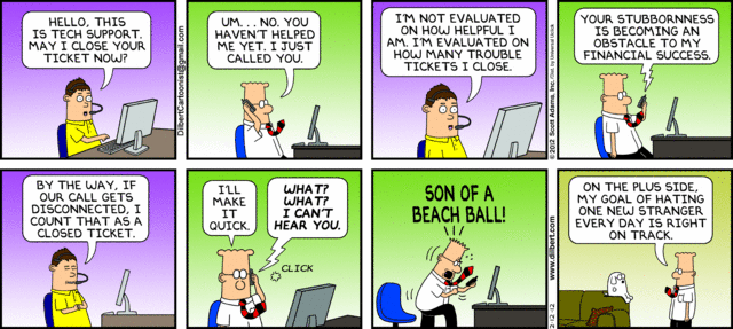 It's taken large, established organizations a long time to conclude that this way of building systems beats any way which preserves their current methods of operation. After all, those in charge were moved up due to success with those methods, not by being good at overturning them. The idea that social skills are equally important to technical skills also violates most engineers' rationale for being. They spent years valuing most the secret sauce of the hard sciences, and their application to engineering. It's just not "them," to admit the value of what they do lies elsewhere.
Left — It's easier to see flaws in someone else's domain; in this case the help desk crowd, a group who likely are supposed to be serving you, the reader. They may come off more like the cartoon. Whoever invented the help desk operation portrayed, did not consider the social repercussions of giving the workers a countervailing, closely watched goal to close tickets. On the other hand, Dilbert comes off as a prototypical, socially immature engineer, at the same time, based on his reaction.
Steve used to be a systems engineer, and this group was founded, by people like Arthur Hall, on understanding big pictures, like the social context within which our fabrications had to operate. Computer science, queerly, not so much, for a lot of reasons, but its application in the outside world has suffered for that. A sample cause — students enter college enthused over CS because of the possibility of creating what might be called Descartian figments, like computer games and virtual realities.50 I.e., replacing concern over utility with their inventions. The "value," to them, is along the lines of getting the coding right to produce an effect which they personally enjoy. These internally focused folks are then turned loose to hatch instruments with social impact, like Facebook, Twitter and Tinder, with predictably massive, unforseen impacts.
Software engineers do build systems that are entirely inward-facing, such as to make one machine talk to another machine, or a lower layer of software. Yet even these usually need some recognition of what humans will be doing in collaboration. In the current (as this is written) Communications of the ACM, Tom Limoncelli writes how IT automation, such as putting everything in "the cloud," cannot ignore deep understanding of the role of humans. If the systems become more and more self-controlling, the "leftover" role of the humans, when they fail, becomes harder and harder, until you reach the point where nobody understands what's going on and can act in time to fix deviations. It is much like the problem of having more and more self-flying airliners where, on rare occasions, the pilots must spring into action.
Both the users and the software teams themselves have deep social aspects which students need to have working knowledge of before we turn them loose. The historic academic trend preventing that is played out even today. A recently created software engineering program, at a school with a very strong engineering history, contains only 11 actual software courses, 30 courses in math, science and traditional engineering, and possibly 4 courses partly touching on the relationship of users and teams to software. The target employment for graduates is software development in the New York City area.
New momentum is being felt, toward including social learning in engineering education. This is seen in The engineer of 2020 : visions of engineering in the new century, where the Renaissance Engineer is portrayed as having a wider range of critical skills, including leadership, teamwork, communication, decision making, and working effectively in diverse cultural environments.
Left — The prob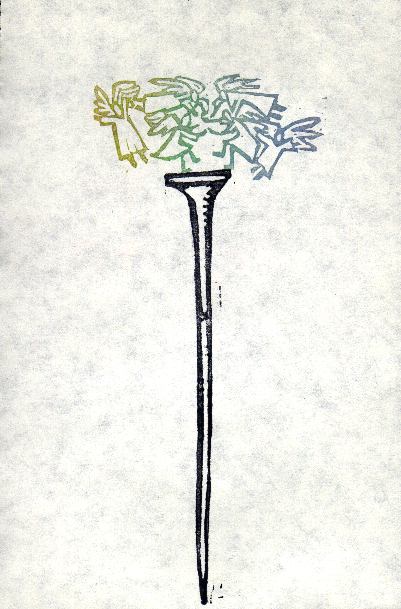 lem of being inward-facing is a fundamental issue. If CS folks almost inherently prefer to stare down at code, and so our departments are even more socially unaware than typical academic departments, then, wow, there's a big disconnect with the "real world" we send our students out into. By refusing to lift our own eyes off our screens, naturally, we can deny this needs attention. The image at left comes to mind, medieval scholars debating minutiae, like how many angels can dance on the head of a pin, while the Turks besieged Constantinople.
A step in the right direction is that most of the employers, of Rose alums at least, now have personnel policies which sound like, "We hire for technical skills, but promote for social skills." Yet even this is not due to that's what would work the best. The problem is more that they don't know how to test for social skills or fit in a potential new-hire. For technical skills they can look at a student's transcript, ask specific questions, and send them to the white board. However, Rose already benefits from turning out students with more social skills. In Steve's department, we teach teamwork and presentation skills throughout the curriculum, and students often take on multiple projects with outside clients.
There's plenty about teaming scattered on this page. Steve asks forgiveness that it isn't in one spot. Search for "teamwork" to find where it's woven-in.
It's a happening subject now, no question. As Steve writes this, a New York Times article describes recent teamwork studies at Google. Their Project Aristotle compared 100 of their teams. They were surprised: Psychological safety (see next paragraph), dependability, structure and clarity, personal meaning of work, and belief in the impact of the work were the important teamwork factors. On the other hand, the personality types and mix of skills didn't make any difference. Teams of friends and strangers did equally well.
Having agreed group norms, which overrode individual proclivities, did make a difference The group needed to supersede the individual. There had to be compromise. This is exemplified by everyone on the team speaking approximately the same amount. And those on the teams needed to be sensitive to the personal cues of others, skilled at intuiting the feelings of others, based on voice, expressions, and other non-verbal cues. If people continue acting like individuals and ignoring syncing-up with others, doomsday. The development of psychological safety on the team drove productivity.
Unfortunately, the kinds of developers hired by Google "became software engineers because they wanted to avoid talking about feelings in the first place." Those of us preparing them to work there have our work cut out for us.
The researchers also concluded that everyone needs to be free enough to share personal happs in their lives, discuss what is messy or sad, and not feel compelled to leave such things at home. "We can't just be focused on efficiency" and expect to be effective.
In colleges, we are still not as good as we should be. Consider this way of assessing that: What if the extent to which we systematically taught software skills were like the way we teach social skills? We would say it was disorganized and spotty.
At Rose, we do provide constant opportunities for interaction, between students and with faculty. So, it's a start.
It's possible our Millennial students are better at understanding everything falls within a social context, and more of them now come in as social relativists than absolutists. Steve's impressions of how they differ (from us profs, say) is in his section on "Post-modern students," quite a ways below. Yet they are still at the age where "the truth" has vast appeal, and hunkering down to ensure that is an option for them.
One way to improve social skills is for students to have more to talk about with us. This home page is designed to stimulate conversations, particularly with them. Which leads to the next topic.
Rationale for home pages like this...
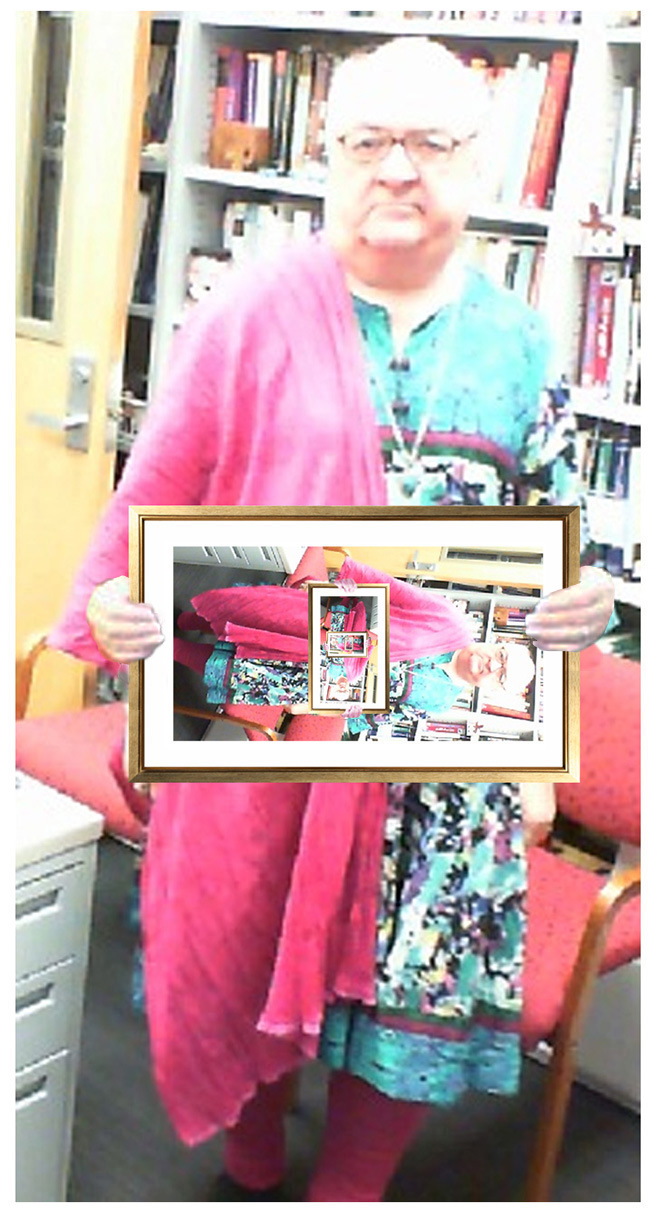 |
Above — Here's Richard Feynman's famous poem acted out:
You have to pull a special twisty maneuver to see yourself. Trust Steve that the final inside image nugget comes back around to right-side-up after four Feynman flips, the way the math predicts! Steve's look is for Diwali, to demonstrate kinship with his Indian students who are far away from their home culture, and he turns himself 90° to help achieve that. But, to get an alternate sense of the world, you have to bend your own way of seeing subjects, dropping safeguards you usually employ. Not easy. So, doing it multiple times helps you pull away. More on making such essential compromises, in the very next section. |
Explain where you're going here, Steve!?
Being born in a mirror, Steve loves self-referentials, and this wouldn't be any fun if it weren't auto-flexing, as shown at right.
On home web sites, why do we have to guess what academics stand for, in more general terms, based on bread crumbs like the titles of research papers in their CV's, or maybe a couple identifying topic areas? Shouldn't these public sites be places for open discussion, like interests, values, directions, and possible research explorations? Who they are as people, who happen to be faculty?
 The historical systems for academic knowledge exchange could be described as broken. For three decades we've been hearing that half the papers written are never read by anybody, schools no longer try to stock bound volumes of all that, and most papers now lie behind publisher boundaries you have to pay to cross. At many schools, faculty are compensated to travel to only a very small number of conferences a year, to improve on those peer interactions. In the current (as Steve writes) Communications of the ACM, Collberg and Proebsting write how non-repeatable most computer systems research is, partly caused by the authors never guessing anyone would want to do that. Their image, at left, decries the problem.
The system we use rewards us primarily for churning out these papers, not for making our ideas useful to colleagues or students. It is a transaction-based system, honed for efficiency. We read each other's, primarily, to create the background section in our own contribution. How often do the papers start a lasting conversation, other than with the purpose of writing that next monograph? We can cite a few seminal papers; this is known as anecdotal eveidence.
Yet we continue to rely on our publication system as a measure of progress and of the academic worth of faculty, as a means for graduate student training, and as the supposedly most informing way to learn each other's directions and results. What we need in addition, if not instead, is easier ways than that to have "water cooler" conversations crossing academic boundaries.
If we look at the learning our students do, over their careers, most of it is informal and involves making connections. Many software firms set up their own education systems, so that those good at teaching and at foraging for new technologies, say, can pass expertise along efficiently to the rest. Steve came out of organizations like that, and was one of the teachers there. Our role, as its predecessor, for each of our budding engineers, should build in this direction. Having our own informal channels, which students and faculty can participate in across borders, just makes good sense.
With any luck, this page has enough on it that it will score some "hits" — like, folks trying to discover who else is interested in evidence-based teaching could find that out regarding Steve. It's a lot cheaper than going to a conference on it. Even more, Steve's students can scan through this, to see "what makes Steve tick," so they have a broader view of who they're working with in class. Like, "Oh, he wants me to be learning this stuff deeply, in preparation for industry, not just get an A."
The web has become our reliable source of knowledge, but it lies in billions of pieces, like a puzzle. How do you know what others mean when they say a curious word out there? It would be nice to have more general points of reference. A home page is a chance to give everyone else that grounding, about yourself. Steve feels this is at least as good as Facebook, whose main reason for existence is to sell you stuff. And he says that as an audio ad blares at him when he accesses his own Facebook page, on top of the visuals.
Steve studies and teaches machine learning. It's not going to solve those issues of tying complexities together for us. The classic example is finding terrorists out of Big Data. Any set of analysis criteria, which might find half of them in the US, is also likely to list, oh, 100,000 non-terrorists, for the FBI to go investigate. It's a well-known side-effect. Even more serious when you consider how possible targets for drone strikes are decided. In general, the false-positive problem is initiated in the deciding of whose value system carves-out the categories in the first place. It's founded in the difficulty of knowing, boxed-in by who we are. Say, whom should we surveil more, to cut down on mass shootings in schools?
Dollars to donuts, no gun owner in the US would pick group # 1, and for good reason — most are law-abiding. Probably no college student would pick # 2, since 25% have a diagnosable illness, which is a lot of students to be monitoring, and 40% of those don't seek help, anyway, making them hard to spot. Might you need roughly one undercover officer for every dozen students, altering the whole feel of a college education? How about the easier, if inhumane, resolution, of dismissing those who have been abused by other students, because they are historically most likely to go off the deep end. (This one's a Jonathan Swift style Modest Proposal, solving the problem in the most awful way.) Sue Klebold, mother of one of the 1999 Columbine High School murderers, wrote a book recently, recounting why she had no idea there was anything wrong with her son.36 So long as no group is willing or able to step out of their particular box, we'll continue as we are. Data might suggest new directions to us, if we're alert to notice it, but we'll want to do a lot of thinking along with that, connecting any new dots. Having more exchanges of fresh ideas is as important as k-means. |
Steve's using this topic to build up for the next one; perhaps you can tell.
"What does this mean?" ain't easy. An aspect of Steve's interests is broadening that exploration, beyond our current frames of reference. Thus the dress for the "fesitval of lights," celebrating knowledge over ignorance.
So, if you are in a position where you spew bits of knowledge all the time, like Steve does in his classes, why not have one spot where everyone can go find out what he, at least, believes that means?
And, here goes!
The need to go beyond listening
How might I approach the new ideas I encounter?
This is an exciting era, don't you think? The software and associated technologies we are inventing are throwing us together, folks from the world over, in new and unpredictable ways. We are encountering folks who are much different from us, much closer in proximity than used to be the case. Among the issues that causes — We can't be right regarding the entire set of absolutes we were brought up to believe, and "they" also be right on every one of the ones they were brought up to believe. That hurts. We were not prepared, by our separate social institutions, for such constant togetherness. Yet we have begun to invent solutions.
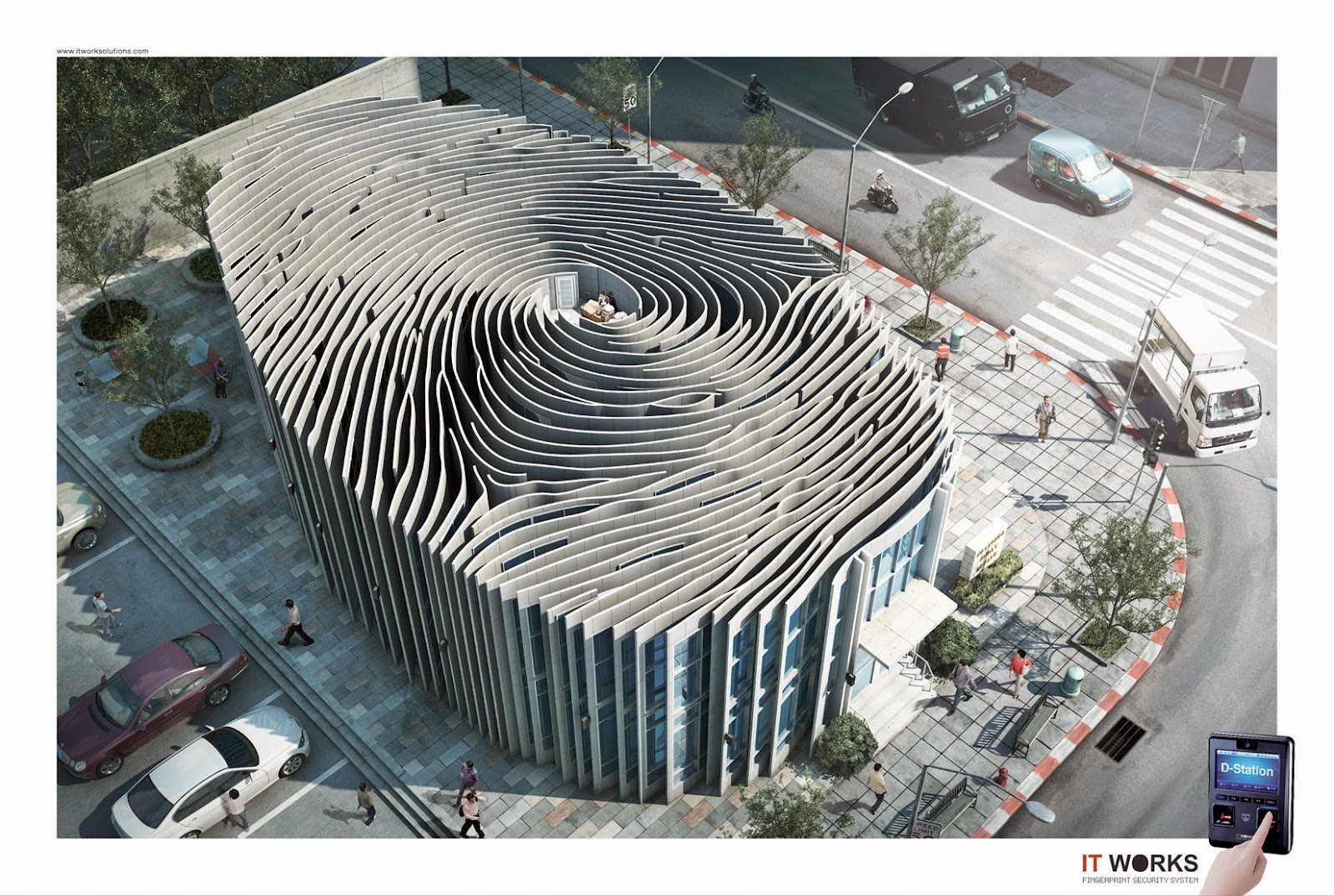 Buried in Steve's musings on what he's been doing and what he's interested in, you'll see a variety of angles taken. He wishes this rubs off, as you read. We have the ability to step back, or we can be trained to step back, to try for new perspectives. We also can explore coexisting well, by working on that together. This teamwork, and this in-and-out-of-focus skill, are effective for messy social problems. And, lo and behold!, for big technical ones, as well. Which commonly have an important, underlying people aspect.
Left — This imagined building is part of a marketing campaign by SpicyH for a Thai company, It Works, who make the fingerprint-reading device shown, lower right, and associated software. Is it a good idea for a legitimate building design? Maybe. Meantime, it certainly provides the semi-conscious implication that the device could make your building more secure. The fact it is so peculiar inspires curiosity in ad viewers. And the images of this fictional edifice have created a buzz about what's possible in architecture. Would it be too unhinged to build? Ask Longaberger.
In social and technical realms alike, the idea of retreating, to try a new angle, solely for creativity's sake, tends to violate sacred or well-accepted principles. This roof will surely leak! Is the inside indeed connected? Questions, an oblique method of attack, will fly at you.
Steve understands there is no simple solution to the world's problems, with or without high tech. Yielding, from where we each drew a line in the sand, and moving to see that from each other's positions, and sharing in the effort to resolve the differences, as if we were coordinated — that sounds like a general opportunity. On occasion, it will neutralize conflicts, when nothing else does?
 Now, any of us could find a summary dismissal of this idea, along the lines of, "That will never work with ISIS, will it?"35 Or, "How do you negotiate-away the drug epidemic? You have to stand on principles!" Or, "The key to building what's new and daring is extreme amounts of effort by a top person!" And it's true that any game plan, like mine, works better in some places than others. However, listening to alternative ideas is how we ended up with the majestic Golden Gate Bridge, longest in the world when built, instead of the originally-planned strangeness. Analysis dominated by one renowned expert is how we got the Tacoma Narrows Bridge, seen in action in the famous image at right.4 Collaboration among disagreeing parties, who at least share a common goal, is a basic, powerful tool. It's not just at idea discovery time. As Rose-Hulman's Bill Kline says in his current Innovation slide set, the execution of an innovative design requires a "team of unlike minded members from all operating groups."
A part of Steve's thinking preference is seeing knots from unrelated directions. It's an architectural quirk, one that used to be refuted by almost everyone else, in favor of having the right viewpoint. Say, writing on the subject of himself in third person to gain perspective — who else would do such a thing?26 In order to let this be a fun and different home page, he did it as if Rose were journaling his experiences at Rose.
6.8 Million Americans are on drugs, and half a million are in prison for it. El Chapo's not happy about how matters are going, but none of the rest of us are, either. The drug wars we've fought, based on cherished principles, haven't worked too well. Nor has leaving the problem up to experts to solve for us, using that set morality. Reexamining where we drew a line in the sand, in regard to good and evil, could be useful.34
In the last row of his last table of chit-chat, Steve returns to the question of when this idea of giving-up, to gain agreement, works. Which you might agree with!
| How come? Why would anyone in academia include obviously debatable subjects on their home page? |
Our goal with students is to engage their heartfelt interests and grow those. Faculty should be doing the same with each other. The Web enables extending hallway chat to everyone, if we'll just do it. The contrary view, of having home pages mostly as keys to official trappings, like curriculum vitae and lists of papers, feels like it undercuts this blazing opportunity.
If more of us take an informal approach, of course it opens the possibility, as well, that people will latch onto each other's preliminary notion of good, go off and run with it, in all likelihood without giving credit. Indeed, by the point where they develop the thoughts into something more bullet-proof, they may have forgotten how the original mess evolved. We see this on engineering projects, too. Those who are on the project at the end take the credit. Strauss did it with the Golden Gate Bridge, discussed above.
But, maybe that's ok. As discussed in the prior section, our system, of giving credit just to listed authors, and counting papers to decide tenure, isn't anything to write home about. The more important goal is advancing the underlying science and the skills of our students.
There is a huge advantage in getting others to "own" ideas. These then become an internal motivation for the people, spreading your (hopefully good) ideas. If they can claim your idea, or modify it to suit, all the better. Steve loves it when students come in describing ideas they've just thought of, like it sprang out of nowhere, and he recognizses it as a concept they heard from him, a while before. Don't sidetrack them with an authorship correction — they are on a roll!
So, this is a shotgun approach, to throw intriguing ideas out there for colleagues and students. Let them decide what feels like it could have value, go iron out the kinks, and enjoy that. It's invigorating, not honed for eloquence.
 Left — Please keep in mind that the concepts suggested here are intentionally fragile. You could do them in, just reading one, thinking of a reason it's wrong, saying "Nope!", and going on to the next one.
The graph here is a Synectics favorite, though, as you see, Francis Bacon also approves. Bacon goes on to say that new ideas "trouble by their inconformity," and so we tend to dismiss them prematurely, ignoring their utility.
The Synectics method suggests a less harsh attack on the novel. First get a lot of ideas out there, which vary in different dimensions. They predictably are "Bad" in the sense just described. Then try to nudge them over the "Threshold of Acceptability," one at a time.
How would you do that nudging?? For each, first think of some good or intriguing aspects for it, so that Bacon's "utility" is in your head. Then list just a few of the issues it has — the main ones.
Now for that nudging: Brainstorm ways you just might whittle away at the biggest one of those issues. Develop an action plan, for who would do what, to start whittling. You now have a method for making the provocative be more acceptable.
Nice work!
Steve once got a personal lecture from a visiting pastor, after Steve had noted, during a church service, that miracles seem only to be visible to believers. The pastor's point was that "the Truth" was defined to be what was in the Bible; science and observations were fallible, and were expected to fall in line with this. Not long after, an NPR story on science in the Muslim world included an assurance by an Imam that scientific truth was to be accepted, so long as the truth of the Quran came first. This seemed to be a shade more liberal. Yet it was much easier to predict that the two religious positions would be the source of perpetual conflict, than it was to imagine how those following these lines of thinking could compromise so as to live more closely together. Will just mixing in a purposefully neutral environment take care of it, like when we work together at places like Rose? In his famous "Solitude Trilogy" for CBC radio, pianist Glenn Gould used stereo sound to play admonitions from a Mennonite pastor in one channel, and young adults describing in the other their college experiences. The problem of their being exposed to a broader base was not, as the pastor had warned, that they'd encounter lots of evil people headed for Hell. Instead, it was that they'd discover folks with varying religions, or no religion at all, were equally good. As long as schools of thought with a long record of conflict insist on unquestioned allegiance, how will we break out of that pattern? Send them to university?? Feel free to apply the brainstorming methods described above, and start a dialog! |

Expository style
Can I just dabble in it?
Right-brain thinkers — whatever that means — tend to ramble. One aspect of a holistic perspective is wandering through the view, looking for nothing, but finding a good deal to be beguiled by. Like the landscape behind Galloping Gertie there, which has the illusion of being far closer than the better part of a mile it really is. Are some of the trees there visibly blowing in the wind? Or, why colorized green? Maybe to punch-up the money loss? The insurance agent had made off with the premium. What do you do with a bridge that falls? (Steve believes they just left most of it lying in the water.)
 |
Above — Gestalt is required for synthesis, what designers do. And also for discovering what doesn't belong with the rest, in the analysis of complex objects. Why exactly can't the cloud exist here? Couldn't it have floated in, when the window was open? Couldn't the light be from the right angle, to give it that combination of opacities? College students' educational history tells them that apparati they can assemble, from parts which work, also are likely to be good. They love bottom-up agendas, like the "greedy algorithm." The more complex the system, the less likely such plans are to pay off. For example, with software made up of many pieces, if one gets upgraded, the odds are pretty high some other part relying on it will now fail. Having only dealt with simple systems, so as to make their lessons direct and to the point, students are unprepared for this aspect of their careers. Did you consider that it might be smoke, not a cloud, and perhaps we should be calling 911 and running for it about now? |
And, we Gestalters tend to write that way. So, in the sections below, all kinds of content are mixed in one document, according to very general themes since, to us, the thoughts overlap. You may have to search for topics of interest to you.
One possible use for this — read until you see or think of what's interesting to go do! Like, oh, how to insert your own em dashes in html? Or, in that Santa song, what's the line before "Dash away! Dash away! Dash away all"?18 Steve shouldn't be disappointed if you quit after this paragraph. |
Among other things, the next part is a FIFO history — If you're looking for recent, scroll down a bit in the section.
Motivations
How come?
Ethics: It's no mistake that Steve shares with the rest of Rose's faculty the desire to inspire and transform students. In a liberal arts school, this could be the main goal of undergraduate education. Students come to an engineering school like Rose hoping for this gain, as well. Yet, in engineering, we feel that a larger part of a student’s undergraduate education has to be dictated, not chosen for enjoyment, versus what they would get in a liberal arts degree. Some Rose majors have no free electives. Students are, after all, being prepared for a specific role. If they are to be an ME, we’d not let them choose to skip dynamics, based on their personal preferences. Insisting on social preparation is the same argument as these technical mandates. And punting this part of their education, to the places where they will work, to avoid doing it ourselves, is not reasonable if we want to ensure it gets done.
Steve came to Rose straight from industry, with the idea of starting a software engineering program here. Like ME, SE is related to using the right processes to get the right results, on top of the underlying technical principles. Those processes heavily involve interactions with a team and with management. Engineering decisions need to be made, including compromises. In case you didn't realize, engineers are supposed to rise above the profit motive and act properly on behalf of the mortals affected by their decisions. They need to be professional, a notch up on Kohlberg's stages of moral development. Learning such social lessons may or may not appeal to students while they are being taught, but they need to wrestle with tough social issues regardless. One of Steve's business experiences went as follows:
- Customer (at their world headquarters in NYC): So the first release of the product will have this feature? [Looks at Steve, the designer.]
- Steve: No, it won't. [The feature would not be possible to develop, first-out. Customer looks at sales manager down the table.]
- Sales manager: Yes, it will. [Customer looks back at Steve.]
- Steve: No, it won't.
- Sales manager: Yes, it will. [He looks at Steve now, who wonders how long his employment will continue.]
Right — The most common vocational image that visiting high school students and their parents have, of what they would do with a career in CS, is write code for video games, kind of in isolation like the experience playing them. This is a Far Side carto
on from Psychology Today.23
Students need to prepare for such events! They are unlikely to enter Rose wanting to be a part of these social sides of programming, or even knowing they occur regularly.
Targeted learning: The Langley Aerodrome metaphor under Hot Topics, above, is typical of Steve's underlying thinking on higher education. In the software industry, half the code is error handling or error prevention, stuff you add just to harden the system. Yet durability is not even touched upon in most college software programs. The goal for undergraduate students is to produce a series of progressively more sophisticated toys which work once at the end of the term. When Mark Ardis, Don Bagert and Steve initiated the Software Engineering major, we changed that situation in the department's capstone program. Starting in 2004-5, our senior project had three terms versus two, and the last of those terms was specifically to harden the product, while an audience greater than just one client tried to use it. We wanted this experience to be a true test of a student's preparation for a software job.
The reason such sizable mistakes can fall into CS curricula may be that academia doesn't understand how success happens in the fast-moving world of software development. See the Carnegie Mellon model, under "Ok, design mostly?" below. We believe good ideas emerge from research in universities, and are then bestowed upon industry via our students and through patents and technology transfer partnerships. That's a little bit true. Do we believe it just on the grounds we were trained so long to be academics, or because CS departments largely evolved out of math departments, or the theory is simply what we relish and excel at? Few of our students will end up in our careers, and a career in the constantly changing software development field is not the same.
In engineering, more often, we academics pull practices already used in industry, and we perfect them. Like, "A great amount of CPU time is being spent in searching and sorting. How could they be doing that even faster?" The honestly new IP, say, "MapReduce" or "Micro-architectures" or "Simian army" or "Extreme programming" or "Cloud computing" are more likely to be originated in practice. You could complain, "Extreme programming isn't new anymore!" That being the case, how have we hardened it through research, since Kent Beck invented it 20 years ago? Why are the 12 practices still debated, without a solid underlying set of studies?? We don't yet know when pair programming works better! Few of us academics even use it. Extreme programming is still new to us.
Our mistaken bias the other way is enough for us to discount the teaching, to undergraduate students, of whole topics from industry that don't feel like they have enough theory to be worthy, or which we ourselves don't get very well, due to our lack of business experience. We picture our students "getting all that once they are out there," graduating with just a base in theory. To some extent industry accepts this deal, seeing as they are so hungry for talent, but it is not advantageous for either them or the students.
Steve's goal has been to match students to industry, so that they are prepared for the careers they intend to pursue. In addition to our rationalist bias, we also don't know enough as to what they do as alumni. We see a lot of what high school students are like, coming into our educational system, because we have them in front of us constantly. We see incredibly less of the finished products, and we don't get the same level of feedback, at all, about their success. Steve addresses this problem in more depth, in his section on Evidence-Based Teaching. We need more information on their outcomes.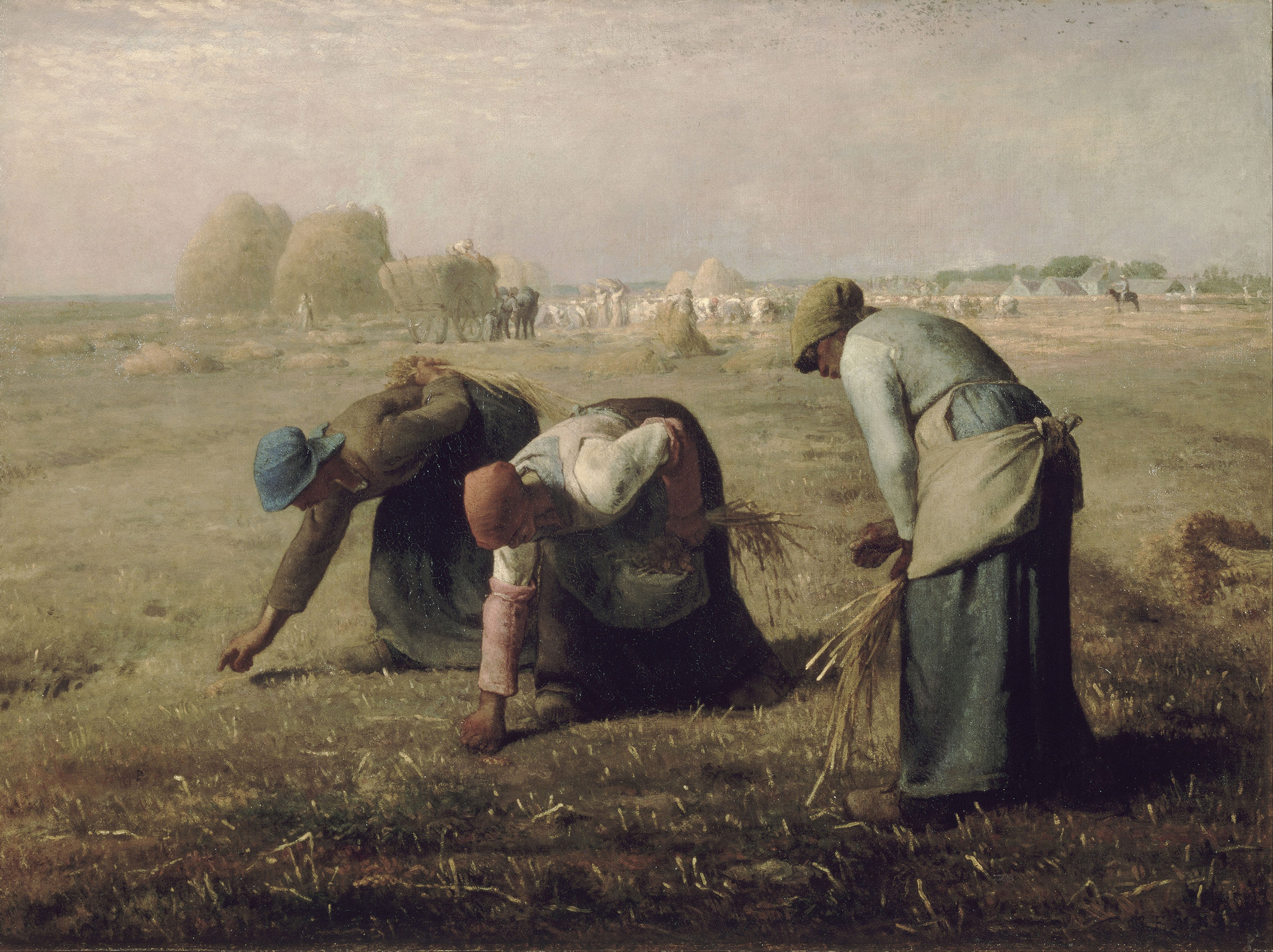
Appropriate learning roles: That same section discusses the related pros and cons of our considering students to be customers. In several ways, they are not like industrial customers or even consumers. Those customers believe they know the required utility of a product and make buying decisions based on that. Even iPhone users shopping the half million apps out there feel intuitively the need they are looking to fulfill. Students, in contrast, are being taught the utility. Customers pay for goods themselves. Students' parents often pay. At state schools, the public chips in. Most customers of big-ticket items are entirely grown up. Students gain reasoning skills while in college. Students who don't cut it are washed out. Few companies would dismiss their customers for failure to meet standards. As ASEE President Joe Rencis puts it, "Students are both the customer and the product" in education, with attributes of each.
Fixing our own processes: Sophisticated products are a bit messier. In the world of Agile software, we have discovered customer advice is imperfect enough that we cannot dependably ask them, up front, to say what they want in a complex product. Either they can't say it well enough or the developers don't get it. The outcome they need to evaluate is still evolving, and thus judgments are unreliable. They'll know it when they see it in use for a while. In educational developments, we still make the mistake of employing the old "waterfall" development model, based on some starting interpretation of the needs, and waiting until first delivery to verify that. And our undergraduate programs have unchecked ways of evaluating processes; they assume that first year students, say, can click-off boxes evaluating the quality of their learning against some far future need. Why do we use such things to decide academic careers??
To the extent students are customers, we can learn from existing business models of customer relationships. Most companies try to maintain a loyal customer base forever; it's harder to attract new customers. Every plan is made to continue getting current customers' business for add-on and replacement products and services. Customers of software businesses may use a key product indefinitely, providing the vendor with a constant stream of feedback. Steve can see how, for an undergraduate school, the repeat-sale situation is different: Once they are gone, we want to try to keep track of them, whether we have more educational services to sell or not. The need remains, to get high quality, long-term data about the value of what we do provide.
So, Steve came from the world our students are heading into, and he's motivated to match his students to that world, improving aspects which will help make them successful. Steve's section "Students → Realties of Software Engineering," below, amplifies on this position, complete with another plane crash. His teaching philosophy, toward that end, is sketched in the very next section here.
Above, left — Jean-François Millet's "The Gleaners," 1857, considered to be a great example from the Realist movement in painting. If we want students to know what their work will be like, why would we be happy with anything less than the best possible realism they can handle? Steve supposes that's true even if they end up discovering, like here, it's not glamorous. Maintenance work, which we do a lot of in software, is kind of like gleaning the grain remnants from a field!
Starting at Rose, a while before now...
Describe the path through time!?
Steve applied for the job in 2002, proposing a variant teaching philosophy, just slightly edited here. When his older daughter read it, she felt a better name than Professor, for the job he wanted, was Suggester. Steve has proposed, to his department, that we adopt that title, since means change so fast in the software world. Professing anything, as if it were absolute, just sets you up to be wrong. Key aspects of Steve's field, which you will see referred to below:
- No single right answers.
- One has to be able to turn off traditional "critical thinking," i.e., analytical thinking, to do synthesis well.
- Despite the fact coding is a linear flow, you can't make it do what it should, by just thinking linearly at it.
- You can't use fake problems with pat answers, in a class, and prepare students for the software world.
- Teamwork is essential, because no one person knows everything, or can do everything, to solve hard problems.
- Students need to prepare for failure by experiencing it in class. Thus, they can't be expected to get almost everything.
And, Rose-Hulman bought it. So, here he is! An Associate Suggester.
Next are some classes Steve enjoyed teaching, right off:
|
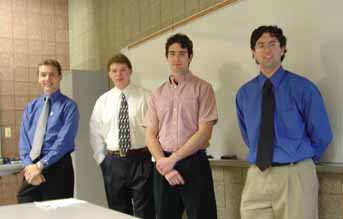
Fall term 2003-4 he team-taught CSSE 371 — Software Requirements, with Don Bagert. On a roll: Fall term 2004-5 he did this again, with Mark Ardis. Kept going on requirements, teaching it in 2008-9 and in 2012-13 with Sriram Mohan. In 2013-14 Chandan Rupakheti and he did it. In 2015-16 four of us each ran one section. The course's RHIT catalog description is: Basic concepts and principles of software requirements engineering, its tools and techniques, and methods for modeling software systems. Topics include requirements elicitation, prototyping, functional and non-functional requirements, object-oriented techniques, and requirements tracking. Here we see a happy "Team 8" from one section of the 2003-4 course, Tyler, Ben, George and Derek, presenting their requirements for a system to help ensure student graduation. They may be smiling also in part since there in fact was no "Team 8" in this class, but they posed as it successfully. As noted in a similar picture, below, the teams were obtaining and managing information for a real system to be developed. Ten years later, we succeeded in creating a worthy version of that, as a student project. It allows students to do "what if" planning concerning majors, courses, and graduation dates. One result is that a higher percentage are able to build models which let them graduate early. With graduates: One of these guys went to Stanford after Rose. Another participated in a start-up — talk about orgs who need requirements! And, Steve's taught a graduate version of this course in Indianapolis on three occasions, to software professionals. Is there a difference? Juniors fresh from math class want to know why clients don't just tell them the correct requirements to begin with. The requirements course is a challenge for many of these students, because it comes on top of their taking many a career of courses where their own analytical thinking always wins the day. While requirements are indeed analyzed in solving problems in CSSE 371, they are largely not analyzed mathematically, but more in terms of the needs of others, like users and paying customers. It's a new focus, which requires a change of thinking modes! To the grad students, the idea of making any kind of dent in this nebulosity problem has tremendous value. |
Requirements!
Few CS departments have an undergrad course in requirements, and for even fewer is it required. Come to think of it, not many other engineering fields dedicate a course to it for BS students. Yet, "getting it right the first time" is cited by a very large number of alums as one of their biggest problems.
There are other anomalies that look like program / career mismatches. Perhaps half of most software projects' effort goes into testing. Reducing that interval could be a huge win for the industry. Yet what programs have just one required QA or testing course, to teach the latest and greatest tricks??
Right - Famous Steve Skelton Loose Nuts cartoon on requirements, so old that some of the programmers are using coding pads. When Steve asked him for permission to use it, in 2002, he couldn't even remember doing it! |
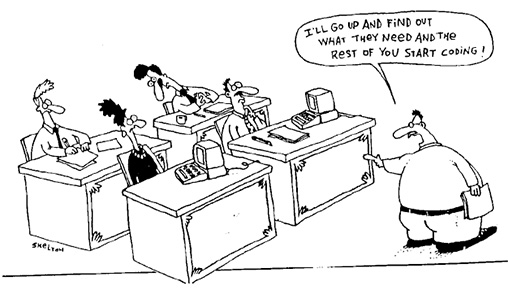
|
Watch out — AI: Winter term 2003-4 he taught CSSE 413 — Artificial Intelligence; he taught this again fall term 2004-5 and 2005-6, and will be in fall 2006-7. Steve used Russell & Norvig's book and targets the learning so as to be useful for students who are going directly out into the workforce as well as for students headed to grad school. Here are Eric, Matt, Richard and Guy, from the winning team in the checkers tournament which also was featured in the 2003-4 course. Each year we change the game, with the course assistant getting to have a major say in the structure of the new game. The final project in 2003-4 was to create an intelligent web search program, a pragmatic application of various skills learned throughout the course. In the succeeding years we have let teams of students pick their own final project — a breathtaking alternative.
Left - AI has turned out to be super-important after all! In the decade since this class, machine learning has taken off as integral to big data, and reverse engineering the brain is one of the 14 Grand Challenges for Engineering. |
Artificial Intelligence!
Steve added lotsa teamwork into this course, a feature that's still a major ingredient. For his first try at that, see the last green block of discussion, way below. |
 Three of these four students ended up working at Microsoft.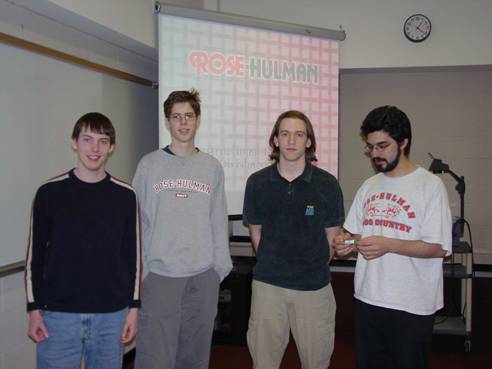
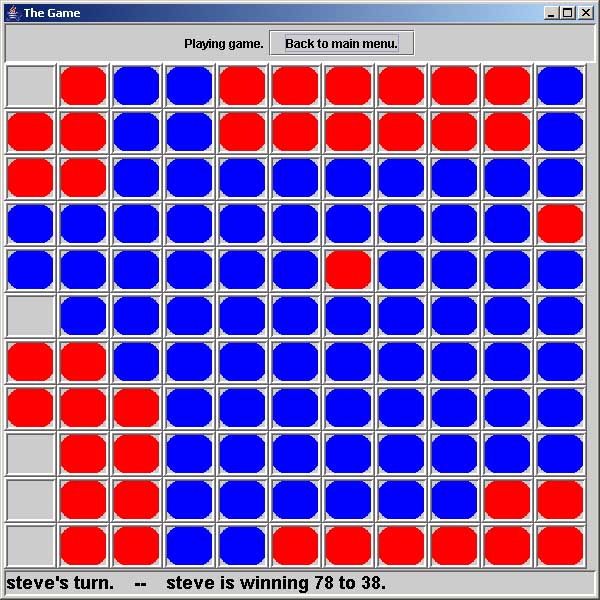
Blobs take over: In 2004-5, Steve's assistant Clint Weis did a fabulous interface for a "Blobs" variant program, and it enabled both an in-class and a Rose-open Blobs tournament. Here's Steve trying to beat one of Clint's "default" players in a game. Against the class's minimax players, humans didn't fare so well. As a final activity the class AI teams picked their own project — these varied, from neural nets solving practical problems, to text analysis from knowledge bases, graphical games, and learning systems. |
|
Specializing in variety!
Did you branch out?
If you read his additional teaching practices, below, Steve would love to know what endeavors you liked hearing about the best:
Project Management: Winter term 2003-4 he also taught advanced topics in project management to one grad student and as a volunteer seminar, primarily for students who already were working in software development. Later, he taught full classes of this subject. Many undergrads want to be coders, so it's a big step up for them to consider learning skills so as to move "to the dark side," management. Some do, though. One of our grads began her career as a project manager at Rockwell Collins.
In software, the nature of the PM position has mutated, from someone representing management, whose role was to inspire the developers and keep them "moving forward." Now, the first-level position is like a "scrum master" who is fully a part of the team and shares responsibilities with the rest. There also are process people whose job is more technical than in the old days, like whoever has to keep a "continuous delivery" system running. So, we teach that stuff.
Software Architecture: Spring term 2003-4 he taught CSSE 374, — Software Architecture and Design (now Software Design), a course like CSSE 371 in methodology which he developed. Way cool results especially for students with software development work experience, one of the few courses where undergrad SE majors genuinely get to architect a significant system. So much fun that, for 2004-5 this will be 2 courses. In 2004-5 Steve taught this again, with the enhancement of additional material on software patterns. He also taught a second term of this subject which also included interaction design. More of that second course in 2005-6 — great fun! And a challenge for students, on the grounds that some have not had related work history yet, and most won't be put in charge of designing systems in industry until a few years into their careers. Steve's now taught software design and/or architecture most years he's been at Rose.
Steve presented how the architecture course is designed as part of a workshop at CSSE&T in March 2004, and again at a seminar at SEI in August, 2004. Which led to regular involvements at both these places. For the 2014 CSEE&T conference, Steve's on the program committee; he and his wife are going to Austria!
Fundamentals: Steve also taught a section of CSSE 120 in spring 2003-4, the intro to software development course, and again in spring term 2004-5. He has regularly taught "core sequence" software development courses "on demand," whenever we needed someone fast to cover these. These include CSSE 132, 220, 221, and 230. "We" being his department. Some of these happenings are detailed later.
|
Launching high school students: Summer 2004 Steve taught a session of Rose-Hulman's Catapult program for high school students. Three weeks of fun, and many of the 16 went from not knowing Java or programming at all to being able to code surprisingly sophisticated systems. At right, here's the original picture one team did to kick off their genetic fish growth experiment in Java. Later they collaboratively created a 3800 line graphical "Settlers of Catan"-type system. One team of two created their own instant messaging system with file transfer, and by the end of the session other teams were using it to send messages. This entrepreneurial pair won second prize overall at the concluding Catapult expo and were ready to take orders for their software! He taught Catapult again in 2005, and also in summer of 2006, then 2008, 2009, 2011, 2012, 2013 and 2014. Quite a few of these high school students end up coming to Rose. Steve's now seen his former students at their jobs in industry!
|
Catapult!
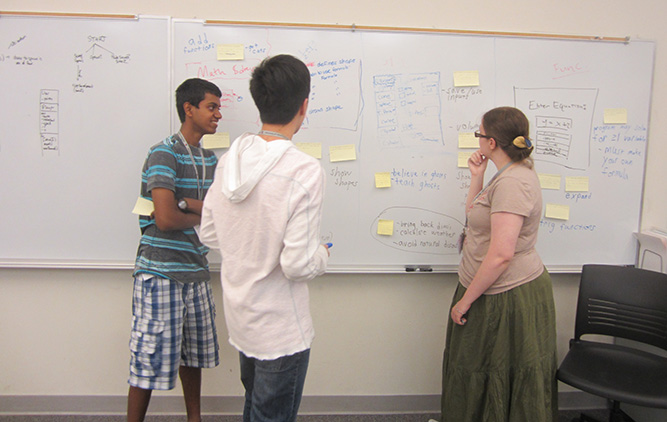
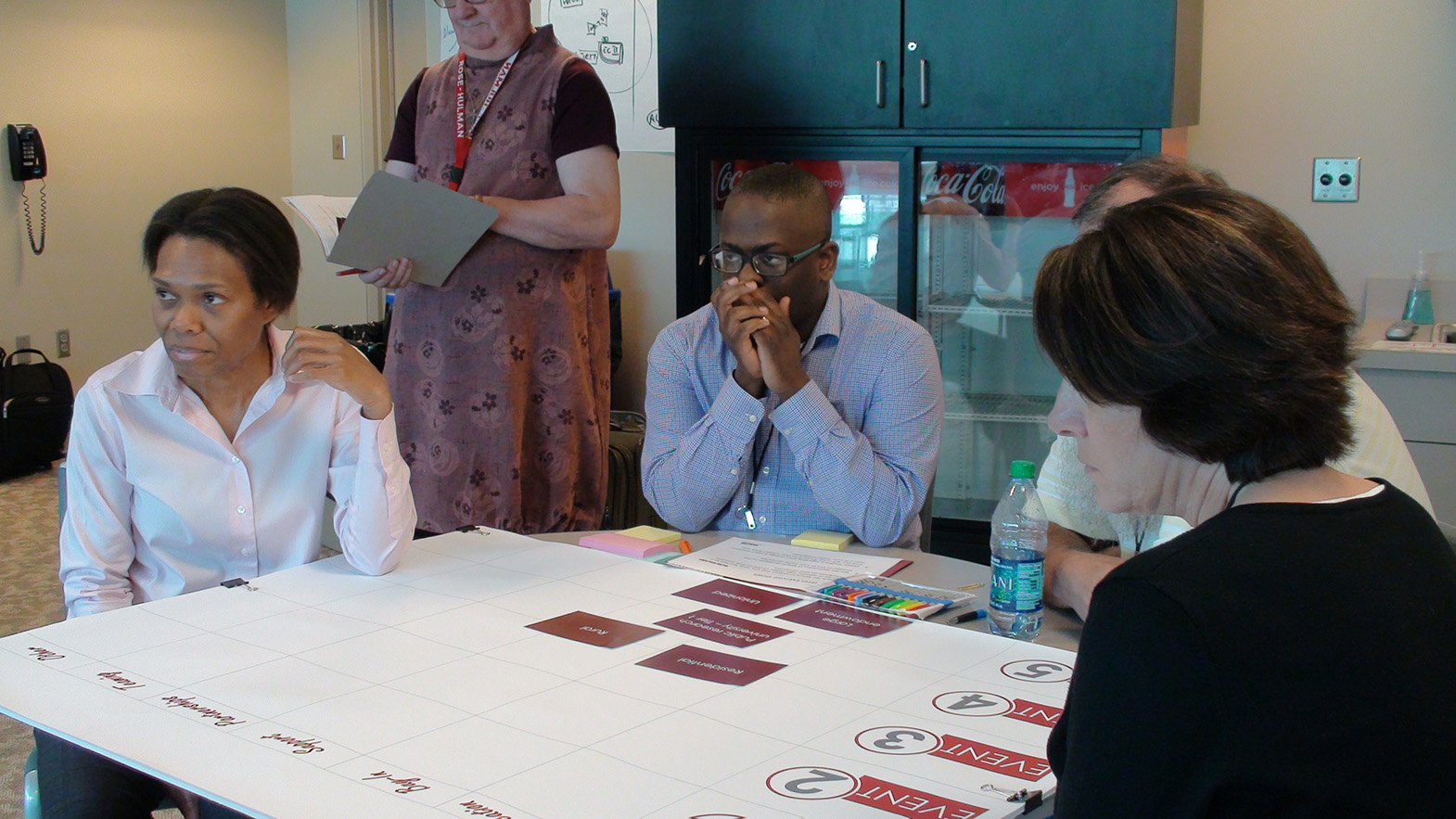
At left we see a 2013 team brainstorming their problem, to invent ways to help scaffold high schoolers as they practice geometry problems. In the process, they invented a new software development tool, attaching user stories, on the PostIt notes you see, to their preexisting story boards! |
Ok, design, mostly?
Did you focus, at the same time?
All kinds of software architecture: Winter 2004-5 Steve ran labs for the Database courses (CSSE333) taught by Salman Azhar. Salman left to be a program director at University of San Francisco, and then returned to industry. Now teaching at Duke.
Arch and more arch: Steve taught the new, expanded version of Software Architecture and Design (CSSE374) which became the first half of a 2-course sequence. He used Bass's book for the architecture and David Budgen's book for the design, adding more material on patterns as noted — also regarding customer relations, and so forth — you can imagine... he expects — the software architecture world seems divided into those who understand the critical nature of the architect's role as a leader, the rest stuck on technical issues of design-in-the-large. One suspects most of the latter have never actually been software architects on a project being judged by outsiders. Just Steve's opinion; he could be wrong. In 2008-9 we switched to Craig Larman's book, so as to make 374 an OO design course.
 He invented and taught CSSE 377, now 477,
the second course in software design/architecture, which includes lots of
Interaction Design as well as regular old design for the usual reasons. What
are those reasons, anyway? He combines the pure coolness, like increasing cohesion
and enabling reuse, with the pragmatic, like how to choose tools, how to design
what others can detail, and how to architect so that
geographically dispersed groups can implement simultaneously.
He invented and taught CSSE 377, now 477,
the second course in software design/architecture, which includes lots of
Interaction Design as well as regular old design for the usual reasons. What
are those reasons, anyway? He combines the pure coolness, like increasing cohesion
and enabling reuse, with the pragmatic, like how to choose tools, how to design
what others can detail, and how to architect so that
geographically dispersed groups can implement simultaneously.
In 2014-15, Steve and Chandan did a CSEE&T paper summarizing their experiences teaching the architecture part over 10 years. Steve delivered it in Florence as a whammy; instead of lecturing, asking the others there to share their own involvement. Pretty rich stuff.
Left — This image is from a systems architecture course Steve did at Lucent, then described in his presentation applying for work at Rose. He's used it in the software architecture courses he's taught here since.
The concept, from Shaw and Garlan's book, attributed by them to Carnegie Mellon generally, is that there is a progressive maturity to our design ideas, starting with maestros who look like they solved a new problem magically (the "ad hoc" solutions at left), progressing clockwise through folkloric water cooler socialization, to writing records down, and lastly creating testable models and doing experiments on those. It's provisional the whole way, with research last, not first. In the final step, we push the boundaries again, darn near falling off the design cliff until some fresh magician rescues us with a new, flighty idea.
Perhaps most bewitching, about this cycle, is that all of us tend to get stuck at a certain spot in it, and don't want to operate in any other way. Steve's worked with some of those magicians, who weren't particularly social in explaining their novel solutions. He's known, as well, plenty of engineers who wanted to stick with oral traditions, never writing anything down but code. These days, they can even justify that — it's "agile." The folks who codify processes are another clan. And, of course, the real CS scientists think they did the most important work, too. But we're intrinsically each just one piece of this growth cycle, each finding the needle in Monet's haystack in their own way.
Right — The right half of Steve's righteous software architecture class, fall, 2010. The teams of students used a system they had previously built, for six architectural experiments. Each was designed to test what worked and didn't work, to improve a particular quality attribute (QA). For example, the first challenge was, "Make it run twice as fast." The lab notes for each experiment captured their process and results. You can see they were very serious over it.
Most newly graduated software engineers will not be building major systems from scratch. But, they may have a chance to improve some QA like this, and use the knowledge gained from the class.
Dr. Bohner sits in the back row, left. We eagle-eye each other's classes regularly, for the reasons you can imagine.
And more DB: The database warm-up proved valuable when Steve co-taught 3 sections of the database course with Curt Clifton, during the 2005-6 year. This also involved a collaboration with Rose-Hulman Ventures, who thereafter hired some of the students. Curt's now moved on to developing cool software for Apple products with Omni Group.
Teamwork: In spring 2005-6 Steve taught the innovative
Teamwork and Robotics course with David Mutchler. In this
service learning course, 34 students helped high school and middle school
Botball teams create competing robots from Legos. The Rose teams also built
their own Beyond Botball entries, and as pairs wrote a paper on an area of
interest in robotics. Steve and David wrote a paper on this class, as a
work-in-progress, presented at an ASEE conference in far-away
 Senior project: Steve taught the
BS capstone course to some teams each year he's been at Rose. This year he has
multiple sections (currently 12 teams). It's exciting to see what the students
you've had for other pieces along the way can do just before they graduate. This is our students' transition to industry, where they are almost on their own! Some of our required courses have a zero correlation with success in this capstone. Hmm. In
the past Steve also managed senior design projects for
our students in our Robotics
program.
Senior project: Steve taught the
BS capstone course to some teams each year he's been at Rose. This year he has
multiple sections (currently 12 teams). It's exciting to see what the students
you've had for other pieces along the way can do just before they graduate. This is our students' transition to industry, where they are almost on their own! Some of our required courses have a zero correlation with success in this capstone. Hmm. In
the past Steve also managed senior design projects for
our students in our Robotics
program.
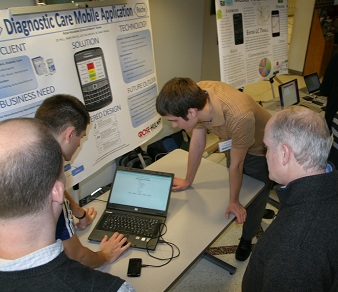
Left — Here's a senior project being demo'ed at our winter term Expo, 2010-11. It was done for Roche Diagnostics. The project allowed managers to have real-time manufacturing statistics available on various devices.
Sabbatical: During the 2009-10 school year, Steve was
Visiting Academic Administrator for the EPICS Pro gram at Purdue. This
was a step toward getting an EPICS-type program going at Rose-Hulman. It was
great fun managing 90 projects for 30 teams with different non-profit clients!
gram at Purdue. This
was a step toward getting an EPICS-type program going at Rose-Hulman. It was
great fun managing 90 projects for 30 teams with different non-profit clients!
Masters of Science in Software Engineering program: Steve's taught most of the courses in this program, as well as teaching engineering management students requirements, and helping get a number of those students through their theses. He had fun in these, and a link to one of his MSSE courses is given above.
Right — Graduate software design class, fall, 2010, at Beckman-Coulter in Indianapolis. This is a much different learning environment: the students are working professionals. Every week's topic includes how this design practice would plug-and-play in their current development activity. The entire class gave push-back on "test first," because their systems involved hardware, legacy systems, or other such complications, making for delayed test opportunities and outcomes.
But not really — here's a bunch-o'-other-courses & gigs!
Steve did those, too, and enjoyed them! Think chocolate cake. He sits in on almost the whole term of someone else's class, almost every term, to absorb both the material and their teaching style. And he's taught the CSSE courses which are prerequisites and follow-ups for the ones he usually teaches. Some prototypicals he got a charge out of:
|
|
 interest in.
Background
Where'd you come from?
 Steve's educational history sanctioning these interests includes a Ph.D.
in Computer Science and Engineering as well as an MBA from Wright State University in
Steve's educational history sanctioning these interests includes a Ph.D.
in Computer Science and Engineering as well as an MBA from Wright State University in
So, how do you get undergrads ready for a career doing such mind blowings? You have to pick the lessons, because it's truly a whole lifetime of learning.
Left — AT&T's Columbus Works was one of the wower places Steve worked. We made "operations systems" which ran networks. And we did everything from scratch — had our own version of Unix, one of the first to include transaction processing. The software troops had offices in the front of this building. The very large rear part was the factory. They used to bring cold rolled steel in one door, and ship completed telephone switches out another.2

One fun project Steve did: In NCR's retail marketing division, in the 1980's, Steve invented new business practices which could seduce our major retail customers to back entirely different kinds of products. For example, grocery stores then were losing business to fast food chains, as more families had two working parents. "How to make cooking both more efficient and more fun" could have slowed that trend.
The futuristic solution he proposed, called "Computerized Home Dining," impacted food stores in indirect ways. It centered around a PC for the kitchen that guided the food preparer more surely and swiftly as they cooked interesting meals. Which could cause them to buy more groceries, and more high-end ingredients, specifically. It could also have meant automated grocery ordering, as the home chef, building an upcoming dinner menu, clicked items needed for a recipe, which they were out of. The PC was tied to a laser disc to show cooking activities for the chef to follow — a pre-World Wide Web solution. |
Right — Nowadays, lots of us use such expanded cooking guides, but the suppliers of those have yet to make them a ready resource. At the site where this image was, Steve found complaints regarding the quality and variability of the instructions.
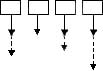
Another fun project Steve did: Patent for parallel processing
using competing algorithms — Assigned
to NCR, 1997. Works like this picture:
|
|
Different computers try to solve the same problem in varying ways at the same time. When one gets the solution, Great! — It might be the quitting point for everybody. (Some of the time chunks represented by the dashed arrows can be avoided, assuming you could not predict the shortest running algorithm to begin with.) |
 Yet another: In the late 1980's Steve consolidated the general trend for building software-based products, defining it as "Adaptive Business Systems." His proposal, to NCR's Corporate R&D, was to build modular models with clean interfaces, such that a given model could be replaced by real hardware or software, as these were constructed. But, the model defined the testing, so that the system tests were there when each peace finished unit testing. You could tell right away if you'd blown the model. Indeed, the model would work as a demo-able product, and might even be a first-out product.
It was just a concept, and the corporation figured they'd have to start over with development to implement it. Yet it represented a desirable direction, if and when it could be done. This proposal alone, Steve thought, most likely got him a job in the Corporate R&D division. Ten years later, at Lucent, he was able to see piecemeal model replacement in action, as software defined switches grew to be a mix of hardware and software, to provide the needed performance. These days, we have something like this in action on many software projects, with Continuous Integration and Continuous Delivery. At the start, we may be lacking the model to plug-and-play into, but we work around that. The idea of integrating and testing new pieces as they are done, tested against what's impeccable, is very powerful. As shown at left, the small changes to enhance and analyze provide a loop which can be completed very fast. "Release" of course is not done every day — you don't want to vary the user interface without notice, for instance. Maybe, where needed as a fix for Agile, opening with a replaceable model is next? |

Relevance: When Steve arrived at Rose-Hulman, he learned that Chauncey Rose had planned the school “for the intellectual and practical education of young men.” From the beginning, faculty included engineers with vocational experience, as well as academics. This is appropriate for us today, as well. Engineering is not the same as science. We would like to use first principles as much as possible, but the project must be delivered to the customer on Thursday, not wait for more research to happen some day. The job has to meet requirements for which scientific underpinnings may or may not be available. Engineers combine these principles with best practices, heuristics, and their own judgment, ethics and aesthetics, to create a product meeting the needs. Having experience wrestling with those situations, for at least some percentage of faculty, ensures that both aspects of engineering, the scientific and the pragmatic, are taught to our students. Steve was happy to be able to help build our resident base of expertise in the direction of real-world experience.
Besides being a mixture of science and non-science, there is a second dimension in which the academic world differs from engineering businesses. This is the temperament of being more exposed to market forces. For example, software engineers work on projects whose fortunes come and go. They either volunteer to move on, to tasks that look more promising, or are forced to do so. As shown in the famous New Yorker cartoon, at right, the world of turbulent change is much different from their crisp and stable college experience, and from ours as faculty.
In theory, we protect our young students from those harsh essences, but doing so too much is also a disservice — if we dump them out there without due preparation. The latest flavor of this "reality check" is our effort to increase students' "entrepreneurial mindset." Inventing, pivoting, and killing new ideas and businesses is as rough-and-tumble as it comes, short of being in a war zone. Most new inventions, of either sort, begin with vast expectations and don't last long. It benefits our students to have profs who've undergone that themselves, and who are willing to demonstrate it in action.
Special interests and preferences
This isn't exactly "what Steve does in his spare time" since a lot of it, as you'll see, is related to work.
Teaching observation
Is there really a back row in the classroom?
Steve thinks this activity provides useful, contrasting information on classroom activity, compared to the usual student performance measurements like grades, or to student-provided feedback like course evaluations. He enjoys doing it. He sits in the back and take lots of notes, so the teacher doing the work can see, afterwards, what was going on as they tried to get students to understand the new.
 If you want me to come try it in your class, just let him know!
We did this kind of intense watching at AT&T. It was enlightening to have someone playing a role akin to the reviewers we use for the articles we publish, but being that expert for our teaching.
AT&T indeed has a grand tradition of observational science, going back to the "Hawthorne Studies" of the early 1900's, which Harvard Business School got involved in. Here are relay assembly workers, around 1930, trying to keep their mind on their work, while Elton Mayo & Co. watch their responses to varied lighting conditions.
As noted in the final section on teaching, above, Steve regularly sits in on close to a whole class someone else is doing here, inside the department or not, so as to learn from that and also have other standards of comparison.
Learning from all directions
Resonating takes on life?
And, who knows?, you might cotton to the same growth preferences? —
Steve enjoys mismatched sorts of people's attempts to be practical or profound. As Shawn noted once, you can't just watch Fox news, or MSNBC, and expect to know more than verisimilitude. Trying to understand what discrepant folk say, from where they stand, is such a challenge. Here's a variety for your consideration:
- We are already one. But we imagine that we are not. And what we have to recover is our original unity. What we have to be is what we are. — Thomas Merton
- Never give a metaphor to a bureaucrat. — Jerry Weinberg, author of The Psychology of Computer Programming
- Genet led a full, rich life of crime. — Jean-Paul Sartre, in Saint Genet
- All problems in computer science can be solved by another level of indirection. — David Wheeler [Ok, you knew that one. But how'd he think it up?]
- For the first time, I felt the "hate stare." — John Howard Griffin, in Black Like Me
- Every day is a journey, and the journey itself is home. — Matsuo Bashō [He uses this quote in his email .sig]
- What fresh hell is this? — Dorothy Parker's standard phone greeting
- — And, from a chain of famous folks, as noted to the left of this image:
| The image is a photograph of African villagers in front of a hut. This post card was sent by Pablo Picasso to Salvador Dali. Dali believed that the photo was of a Picasso face (you have to turn your head counterclockwise 90° to see that — ouch). He showed the picture to Andre Breton, the leader of the Surrealist movement, who thought it was a picture of the Marquis de Sade, the notorious, who interested him. Dali rationalized that the individual’s mind gives an image the desired characteristics. He used the image as a model for his 1935 painting, Paranoiac Visage, which includes a like illusion.1 |  |
|---|
Feel free to join-in such explorations. The goal is not to explain away these quotes, from your own position. That would be too easy!
 Creative problem solving
Is anything really new?
 As a practitioner of group
creativity methods, Steve recommends Synectics,
Ned Herrmann and the Creative Problem Solving Institute as
fruitful resources. These methods fit well with critical team activities on
software projects.
As a practitioner of group
creativity methods, Steve recommends Synectics,
Ned Herrmann and the Creative Problem Solving Institute as
fruitful resources. These methods fit well with critical team activities on
software projects.
Just lately He's gotten into Idea Keg, which he loves. You grow thinking around a metaphor, then return to relate it to the problem you are working on. It's a cool flavor of "excurting," a word he invented at Synectics.
The link to Steve's favorite brainstorming methods is at the top of this document, under Hot Topics. There's no reason we didn't just duplicate it here, is there?
Left — Peculiarly, the problem does exist, of hackers being too ingrained in a constant software development work environment. It's the opposite of what our undergraduate students face. The over-experienced view creates issues when they need to build the novel. Here are systems architects in Steve's class at Lucent Technologies, circa 1998, doing a Rube Goldberg exercise to break out of their mindsets.
Right — The seeming environment for undergrad is depicted. Again, existing knowledge overwhelms the new, and unnecessarily so. This is an old "Bloom County" cartoon. How about a change of pace?
Making change
Need: M L King's "courage, compassion and creativity" are for Steve a pragmatic combination with which to make things syncopate that need syncopation. Other people like this combo, too — for example Judith V Jordan's ideas of how to make vulnerable social groups less so. In computer science we need to be working on such topics like crazy! Say, we keep driving the women out of the profession (fewer in it now than 30 years ago), and we seem not to know why, while also not trying much that's new. (See graph in the table, toward the bottom.) Reminiscent of how the majority used to feel with respect to race relations, when we were unwilling to admit the inequities could possibly relate to our own actions, yet no one had the guts to try anything more drastic. To get effective engineering teams on which divergent views are equally valued, we're going to have to give up a lot — like patriarchal organizations.
The most rewarding, and treacherous, distortions are transformational ones. They involve shifts in beliefs, needs and values. The leaders of such revolutions tend to act as visionary, moral agents seeking converts. Shared leadership and very well organized, dedicated teams are tools used to pull off such difficult, institutional elevations.
|
What about turning our engineering students into shift agents?? We can provide skills and experience at leadership and teamwork. We can coach them to be trustworthy and purposeful, to look for the unique contributions each individual can make, and the of handling problems at the lowest possible level in flat organizations. But, as Bass and Avolio say, there is a constant interplay between leadership and culture — each affects the other.
What are your odds, in a hierarchy? We used to play with this concept at NCR, which had a good-sized pile going until Jerre Stead flew in. If you had to get 5 levels of managers' approvals for a project, going up, and 5 levels of actually implementing it coming back down, and you had a 50-50 chance at each level just because it was a new idea, they were playing the "telephone game," and the proposal could sit forever in anyone's in-box, then overall your odds were 1 in 1024.
Inadvertent change: To accompany the wider influence of today's engineering, especially software products, we are discovering that too many of those building the products and services still adhere to the outdated view that they are only responsible for profits, not for any adverse consequences bound to those. This historical convenience can no longer be taken to be ethical. They need to engage in systems thinking, on what they are up to, using a broad brush on an expansive canvas. Engineering students should engage, as well, in the inverse of pushing ideas out into the world. Namely, absorbing more of what's going on around them — the receiving end. |
Sowing the seeds: Being a part of our MACH effort (see above) is an expression of this. Academics are in an enviable position of promoting tampering, technical and social, of staying ahead of the industries they serve, and of leading their society intellectually. Our role is not just to reflect the values of the groups we serve, though they surely have the right to critique us when we don't do that. The Stanford 2025 brainstorm proposes that the university weave in and out of a student's life at critical points, providing longitudinal backing for their careers. This is a forward-thinking initiative, for a new relationship with students' employers. Will those employers like that, or will they rebel? In any case, change is always upsetting; it causes friction in fresh ways; and it has unreliable results.
Right— The Selma-to-Montgomery March, 1965. Would we have had a transformation of US segregation laws, if we had talked but nobody actually protested? In the South, whites felt such actions to be strongly antisocial. Being a flux capacitor: Rocking the boat is also part and parcel of academia, whether or not it is successful in causing technical or social innovation. This is why we have shared governance and secure jobs. We take a chance that having our diverse ideas heard is almost always better than covering our ears. Even hopeless causes or senseless verbal attacks on cherished ideas have a place here. That strength-through-multiformity has been a part of universities forever; it mimics natural selection in a way. We grow by having more than one gene set.
Some of what Steve does plays in that domain of social innovation. It is an inventive process with communal repercussions, to help our students achieve new kinds of growth. |


Trendy stuff
This is where Steve unashamedly latches onto what's happening...
> Revived interest — STEM → STEAM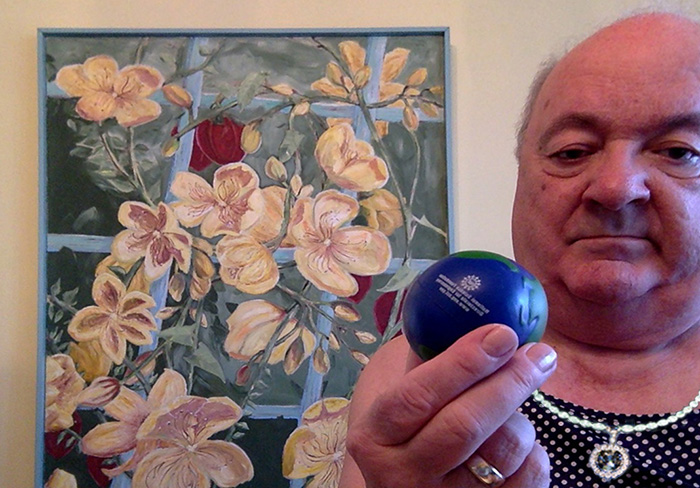
Our myth that the technical alone does it?
When Steve switched from industry to academia, he considered both engineering and liberal arts schools. The place for serious engineering is in the world, after all, so both make sense. Lately, the STEAM idea has taken off: Adding Arts to STEM as the curriculum for engineers. This makes great sense to Steve! We would love to be designing unique and beautiful bridges that look like Calatrava did them. We also recognize, as scientists, that designs based solely on common practice are likely to be optimal only in cost, and this on account of they can be created and effected based on the most well-worn expectations for the way that goes. Not that enriching.
Some definitions of engineering don't include the artistic part, but others do. like,"The creative application of scientific principles to design or develop structures, machines, apparatus, or manufacturing processes, …," from "Canons of Ethics for Engineers." Engineers' Council for Professional Development, 1947.
STEM endeavors like product design naturally involve art, whether or not appearance is the primary purpose. Coming from the other side, use of new technologies and techniques can advance the cause of art. And, artists cognizant of engineering practices have a larger playground to work in.
Steve believes the same arguments can be made for literature, and for the combination of art and literature. As in, this web page. Which is about engineering and its students. And, analogously, from history and the behavioral sciences. Engineering already does history, in the sense of Henry Petroski's books, the most famous of which emulates Steve's Tacoma Narrows picture on its cover. The similar horror stories from software hinge on social interaction issues, like lying over progress. Why would they do that?
Throw the L in for Literature, and you can make METALS, among other anagrams. Then add history, you get HAMLETS. Add psychology for THE PSALM. Performing arts, anyone? Add dance for PATHS MELD. Add culinary school for CALM DEPTHS.
Now, the goals of the STEAM movement are to put more K-12 emphasis and money behind Art as well as the STEM fields. And to add art and design to STEM research. And to influence employers to hire those with more artistic qualities on top of technical ones, so that everything we build has greater social value. Turn the ticky-tacky USA into France, perhaps, where dinner isn't dinner just because of the nutrients, and we begrudgingly chow down. Why not move beyond Learning from Las Vegas?
What do we want the artifacts of the 21st Century to look like? And how will they be integrated into our culture? It's worth watering down the drive for better STEM education, to do it with the ingredients we'll want to live with.
Above, right — To symbolize the linkages, Steve sits in his dining room, in front of an oil he co-painted, which shows a modest engineering structure, a wide-mesh lattice, being used to hold-up flowers. Without the flowers, you've got nothing here.
The painting was a two-person effort, a process rarely used in these arts, but common in engineering.
Steve's holding the world in his hand, executive squeeze ball version, courtesy of the NSF Directorate for Engineering, the kind of folks we need backing STEAM, or METALS, or HAMLETS, or THE PSALM, or PATHS MELD, or CALM DEPTHS. He believes US government could favor making our infrastructure culturally advancing as well as non-crumbly. One sign shown, that they are "in," letting Steve wear the Hope Diamond around the house, as a sign of good faith. In this dreamed partial solution, our doler of prime funding for science and engineering was willing to give an item of value to include the arts, so long as the value pool it came from was another government department, and didn't create the feared mission creep.
-> Recent interest — Real studies of how people act
Can we add it all up in our heads?
Daniel Kahneman's ideas
on the irrationality of acts we think we do rationally — pretty intriguing. E.g., his
"experiencing self" versus the "remembering self," who
don't seem to know  much of each other! This theory has direct application to
the things Steve does. How about, we teach heavily experiential classes in
software engineering, then expect to measure our success by what students
remember, on an exam, or on a course evaluation??
much of each other! This theory has direct application to
the things Steve does. How about, we teach heavily experiential classes in
software engineering, then expect to measure our success by what students
remember, on an exam, or on a course evaluation??
Software projects themselves have problems with these two selves; that helps explain, say, our persistent inability to estimate how long the next project will take. How can engineers under-guess the time and difficulty of projects, over and over? Kahneman's answer — they remember them wrong, over and over.
Left — Steve introduces the next activity in a junior software engineering course, fall, 2008 — how to evaluate results of an interaction design study. We use a scaffolding system which begins with us as the role model. Expected flow in such studio classes — See by example how to solve it first, and try it first as someone goes around to help, during the class. Then they reify it in individual homework and group projects. An exam perhaps acts as a final knowledge swell.
What can the students do when it's time for that term project or exam? Probably the works they did when they were exerting the most effort — this will be what's most in play for them, as the new experience reminds them of specific prior experiences.
Asking the same students to evaluate the learning process — this causes a whole alternate set of neurons to fire, and, in Kahneman's view, it would be difficult to make this trustworthy: It is categorically different from the thinking they did to accomplish the work. For example, events will stand out like homework, where students pushed themselves maximally. So you might hear, "I could have learned this on my own," and it is a good sign. Or the very recent fact that their project demo failed, leading to, "I didn't learn anything," but because they tried very hard, they indeed learned a lot.
--> Recenter interest — Distance learning
Can we put the Rose experience "out there"?
 It's the growth area
for schools like Rose. How else can we reach our alums to give "lifelong
learning," for one thing?? Even for undergrads, we need to rethink the
right mix of pedagogy and self-taught ("autogogy"?). Steve did a lot of
self-instruction courses for NCR, and it worked pretty well if there was
sufficient motivation on the student's part. B F Skinner was our hero.
It's the growth area
for schools like Rose. How else can we reach our alums to give "lifelong
learning," for one thing?? Even for undergrads, we need to rethink the
right mix of pedagogy and self-taught ("autogogy"?). Steve did a lot of
self-instruction courses for NCR, and it worked pretty well if there was
sufficient motivation on the student's part. B F Skinner was our hero.
The perfect hybrid model for our future, Steve thinks, is students moving to industry as soon as possible, looking through their work to us, as shown, when they need our help, and getting it instantly. For software developers, the most obvious competition is not Kahn Academy but StackOverflow. It's free, it's direct, it's crowd sourced, and it's comprehensive.
As he writes this, Steve had a dream last night of riding a bike on an errand, using a Garmin-like system for navigation to find a destination out in the country. In the dream, he ended up not at the right location, and the guidance had conked out, so he realized he also could not get back home. This is the irritating regular predicament of software developers, living out Sartre's characterization of how we are aware of the world — it nauseates us and we react. In our profession, a bug is in your system, and you have to smack it. Or, you have to build onto it in an unknown way to get it to handle a new customer request. At some point in each development, your ability to rely on specific guidance, such as Stack Overflow might give, runs out, and you are on your own.
 Left - The moment in a project when you wake up to the fact nothing looks familiar and you don't know what to do next. You already have invested a lot in this ride, but you suddenly have no idea if you are close to a solution. You would like to turn to someone else for easy guidance, but they also seem confused. Just having bull-headed confidence to keep going in the same direction may not help.
Steve thinks students have been taught that they shouldn't get into this predicament, and that the smart profs they listen to for advice somehow magically avoid it. This is not so; we just hate to admit it. If you have a Nobel prize, it turns out it's ok to tell that this is just how life is. See Feynman's video.
This, Steve thinks, is where we would like our distance learner, above, to call his old professors, and describe the problem that's inescapably got him, as best he can. If we can provide general guidance, to help him work his way out of the specific situation, then that affirms our message and he regains his confidence by remaining the prime mover.
So, how do we build such connections to our alums, to improve the quality of the groundwork we provide, so it solves their hardest problems later on? And, even more, we're able to continue being helpful?
At Rose, we've resisted the sea change toward online by believing, without testing our theory, that online couldn't possibly be as good. When Steve came to Rose, we wouldn't even accept online courses for transfer credit! Thomas Kuhn's image would float by, above Steve's head. He had just come from Lucent Technologies, who almost went bankrupt based on the shared truth that Voice over IP, which was not as high quality as the telephone networks they produced, could never be a serious threat. Fortunately, things are starting to change. The Phoenix is rising, but so are we.
---> Recentest — Evidence-based teaching
Wait... Didn't we already have this, somehow??
Steve should preface this discussion by noting that his department is one of the finest around, as measured by who hires our grads and how well they do in those places. And Rose is #1 in undergraduate engineering schools. He works for a mighty good operation and appreciates that. We like the fact our engineering is based on science. What about the teaching itself? Can we learn from studying it more systematically? Does the delivery of value to students need a similar depth of underpinnings? If so, why aren't we doing that already? |
We live within a social structure, in each of our institutions, and within higher ed in general. As Edgar Schein says, such a culture has "A pattern of shared basic assumptions learned by a group as it solved its problems of external adaptation and internal integration ... a product of joint learning." The artifacts, espoused beliefs and values, and those assumptions, are taken for granted as part of the deal. Successful organizations have this mutual reality; they thus have trouble perceiving problems in any other way, like improving on sticky spots which aren't built into their thinking to improve. Steve worked for industry leaders who almost went out of business on account of they were great at what ended up becoming an attackable position, and couldn't believe trouble was coming. |
Since we don't try to explore, deeply and objectively, each aspect of how our own business of higher education is done, it's a reasonable guess that there is room for improvement — by somebody! Evidence-based teaching is an attempt to approach this by testing every possible assumption, in a careful and ongoing manner, to uncover what causes effective learning to occur, and what doesn't. Steve supposes that we don't necessarily already know every bit of this, "just because," like Steve's own expressed opinion at the start of this discussion, we think we do, using reasons already buried in our culture.
|
It's easiest to divert here, to find fault with those we don't actually identify with. Could we get a quorum of faculty at teaching schools, say, to conclude the worst teaching offenders in higher ed are at research schools, due to their having the most status to protect, with the least opportunity to reflect on deficiencies? They are busier with the research. Don't some profs there feel that, if you are a good researcher, you plausibly can rely on your instincts to enlighten students, as well? Excuse me, researchers — There are no research studies endorsing that, and isn't it just a little bit self-serving? You are not innately better people. You have to expend energy and resources to make that research-to-teaching link work. See Prince, et al., 2007. |
Yet — maybe we have no right to critique them. Isn't the above paragraph pulled from our own assumptions? Where are actual studies showing we faculty at teaching schools are more effective than they are? So as not to have researchers feel picked on, Steve thinks it's fair to say that we teaching-school profs could brainstorm sizable evidence holes in what we ourselves do and what we value. Or, beyond that, what we all do in teaching, regardless of our school's points of emphasis. Chew on these colorful research questions:
- Do we know enough concerning the graduates we produce?? The whole point of an undergraduate education, at most schools, is to turn out grads who are not the same as when they came in. In particular, they should be more prepared for some role in society. Viewing this as a system, we know a lot more on the inputs than we do about the outputs. We see the students who arrived from high schools, pretty regularly for four years, and we test them on their progress.
But that progress isn't necessarily aligned with their lives as alums. We trust that alignment based on a much shakier level of knowledge, by reason that they disappear into society. For example, we may grade them down severely for being only a little late turning-in assignments. Is that verifiably a test of how much they know? Will it be like their lives after college? How close is the act of having to apply recently acquired knowledge in an hour-long test?
Above, right — Rose commencement procession in action. Every couple years we ask them for information on their lives afterwards, and some return for events like Homecoming. Yet this is surely not the same as the ongoing flow of information we have for the students who arrived from high school. Is what we need, instead, perhaps a notion like the persistent contact proposed in Stanford 2025?
- Is stratifying students a bona fide good idea, to promote learning?? We got our Ph. D.'s by virtue of the usual grading system, so it's like a country club with entry rules we'd rather not question. We tend to reward students who are like us, not paying as much attention to those who actually need more help. The evidence-based teaching movement is on top of this one.
- Are grades really a good idea? Steve did a study, with Rose's assessment corps, of how well our grades correlated with students' self-assessment (rating the quality of their learning, on the course evaluation). R-squared turned out surprisingly low. In another study, exiting software engineering seniors marked how well they believed they had achieved the program objectives. There was not a particularly significant relationship with their GPA. So, why do employers use this crunched number to decide who gets jobs? While both these were internal studies, not intended for publication, we would appreciate anyone else trying to replicate the results at their schools.
Right — Homework for the teacher — Steve grades exams, at his Terre Haute apartment. His usual goal — return them for the next class so as to max-out the impact of the feedback. While you are doing this, you wonder over the long-term value to the student and to their employer.
- Are course evaluations legitimately a good idea?? Schools advertise their overall ratings on these to attract new students. But there's never been a study that, say, higher teacher ratings produced better engineers. Philip Stark's 2014 critique re-surveys earlier work and claims this instrument "does not measure teaching effectiveness," recommending it be used formatively, not summatively. And asking deeper, more course-specific questions has more face validity, as W. Lee Hansen recently wrote. So, why are we still employing the thing for tenure and promotion decisions? How about a proposed Iowa law to fire professors who don't meet certain minimum ratings?
- Are the required courses for a major actually important?? We have little logic dances we do in our heads to prove how crucial each course is in our packed engineering curricula. If this is true, however, we ought to be able to show it in stronger ways. Recently, we used our full-year capstone design projects as a surrogate for success in industry, which is what it is supposed to be, and compared student success here versus each of those required courses. Some had little correlation! Hmm...
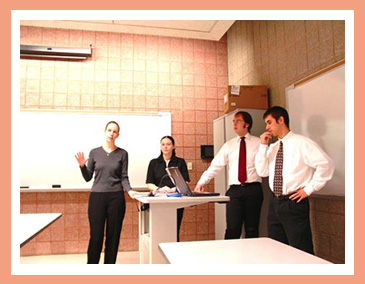
- Are students better off if we treat them like customers?? Evidence-based teaching shares the ongoing interest in being learner-focused. This movement also uses Deci and Ryan's emphasis on building competence, autonomy, and psychological relatedness. But treating students like they were customers, in the traditional business fashion, isn't the same as discovering ways to improve their learning, even when that discovery includes asking students what they want.
Steve supposes stimulating intrinsic motivation doesn't necessitate entitlement, in the sense of students dictating the terms or outcomes of their education, just due to paying for them. Good selling, on the other hand, does pretend to allow this in straightforward exchanges, such as most retailing — "The customer is always right," except when they don't pay. This is since paying is the main expectation, of what comes from a customer, in the business transaction. When that's not the case, say, when the customer has to do work to go with what they bought, then they are held to performing that work. For example, if a customer buying a new software app has agreed to do the data conversion from their old app, or to upgrade their underlying software.
There are many significant differences between buying a shirt and buying an education. In the business world, customers aren't usually required to change their behavior, the way we anticipate college students will mature, nor are they threatened with bad grades for non-performance, while the company serving them still expects an uninterrupted relationship.
Above, right — Rose is known for providing rigorous engineering training, and this includes making it as close as we can to real life. Here, another team in Steve's first Rose class does the "final exam" on software requirements, a presentation describing their results in apprehending those and developing a prototype. Do they look concerned? Their unfeigned client was in the room, asking questions. If Steve moved more in the direction of treating students as customers, would he put them through that, at the start of their junior year?
Also consider that clientship is blurred in higher ed. The student isn't the only customer:
- The underlying client for higher education, perhaps, is society. Certainly, for engineering, the world expects us to produce those qualified to maintain and enhance infrastructure. And, at least in public universities, they help pay to get this.
- Or is the client an undergrad's parents, who usually pay more than the student themselves? Their higher priorities may be maturity, citizenship, and a worthy career for their child, not that she has a good time and easy courses.
- Or is it alumni and other contributors, "paying forward" for the improvement of society through current students?
- Or is the traditional model right, that it's the student who needs to satisfy the instructor, in earning a grade? And only this reversed-clientship model will guarantee higher ed's social role of generating progressive improvements? "Who should call the shots" is just bisected, in education, from "who pays," on account of that institutional role. The teacher invests time in the student, and the student demonstrates that this time investment has paid off.
 There are instances we can point to, in students' own realm of experience, where the simple consumer idea doesn't hold. Suppose they buy a challenging computer game; they could become rather unhappy with it if they don't exert a lot of effort to become a skilled player. And this is not the game's fault.
 - The underlying client for higher education, perhaps, is society. Certainly, for engineering, the world expects us to produce those qualified to maintain and enhance infrastructure. And, at least in public universities, they help pay to get this.
- Left — Example of a messy strategy game — Hearts of Iron, in which you create an alternate history; you have to plan your grand design for World War II, arrange alliances, build initial defenses without collapsing your economy, decide how to improve your forces, and keep consumers happy, before the hostilities even start! It was banned in China because it depicted disputed territories such as Tibet and Taiwan as independent nations.
Student as customer — Challenge # 1: Wouldn't it be tantalizing, to find a school where the student-customer model was more actively pursued, and one where it was less so, and try to compare the success of learning in equivalent courses? Maybe we're wrong, and this marketing motion doesn't have a downside? Maybe it just threatens our egos? Or, it's inevitable, based on the pressure to acquire students, and we need to fold it into our assumptions of how lessons are going to be in the classroom? Or, it's the big win we've been hoping for, in getting students to assume an internal "locus of control" as they grow during their undergrad career. And there are bound to be some excesses in such a proffered power shift. "So, Justin, what do you plan to study today, and what are the benefits you see?" asks the curious instructor.
Student as customer — Challenge # 2: At present, the debate over students becoming "customers" feels highly emotional. The associated term "entitlement" uniquely is given a negative meaning, when used with regard to students, in work covering this academic status change. See Kopp, et al. A typical discussion: "This high self-regard then translates into the narcissistic individual feeling entitled to certain privileges and rewards because of their superiority over others. Narcissistic individuals view themselves as 'better' than others, so they are entitled to 'better' things in life." The same analysis is not often seen for uppity professors. But it's fair to ask if having had autocratic teachers might be a model for students acting entitled now, in the same way children strongly mimic their parents' styles. This sounds hard to study, yet it's an enchanting hypothesis.
Right — Not every student wants to be treated as a customer. Here, in the Philippines, 2014, they march against commercialization of education, against deregulation of tuition fees , and for the allocation of at least 6% of the country's gross national product to education.
Student as customer — Challenge # 3: Both evidence-based teaching and treating students like customers have the underlying assumption that "what's being taught" can and should be altered based on situational variables you may not be aware of until they are encountered. Like, you show up and discover three of your students are from Cambodia, where they had a different set of experiences regarding how teamwork is best done. This is not the same as how traditional curricula have been developed, mostly up-front, with some begrudging later accommodation of special individuals and groups.
For evidence-based teaching, it's not exactly that you want to please these students, per se. You just want to serve them well. For customer-based teaching, you no doubt do want them to feel happy over it, in addition. But the idea that you have to adjust on-the-fly — that much is the same. There is a discovery process, probably student-by-student, and ongoing, of how well the course agenda is going for them. Steve proposes a research question here — How far can course customization be done, and have overall results still come out better than for less customization?? There has to be a limit, right? Flux is flux, and at a certain level it causes chaos.
Steve has a lot to learn from this movement, too. He loves to lecture, but there's no proof that produces learning, either. It works if you tie it to students practicing. But then, they might have learned just from the latter, too, as you went around answering questions, studio style.
Looking at our college teaching from a variety of such contradistinct directions, and doing serious studies on these topics, is going to be refreshing, Steve says!
There is no evidence, BTW, that changing font color improves reading comprehension. But, have there been any studies? It's like highlighting, but done by the author. Who thinks it's all good goodness, naturally. What's your view? Worse, or just unfamiliar?
----> Beyond recent — Ethnographic growth
How about, we step out of the Ivory Tower?
Steve loves being ahead of trends, as you can tell reading his past history. Here's a new one to latch onto... The need: To be effective, Steve's students must understand folks who are not like them. Different looks, different values, live in different places, eat different food. Trading in this commodity is not optional; if you choose a software job, the reality will be built-in, over your career. Customers, coworkers, investors, competitors, hackers, and the other affecting parties will be diverse, and they will need to be understood. Ethnocentrism won't cut it, in the job they are going to undertake.
Why it persists: Steve's thought on this ignorance of outside truths, which feels peculiarly endemic to coders. Maybe you have, too. "Agile" is an attempt to overcome that by having a customer representative essentially in-your-face constantly, and evaluating progress vs a releasable product, at frequent intervals. It's a start. What else do we need — maybe a video of the customer's clan using their existing system, playing in front of you, like the panoply of images at a sports bar, as you build the replacement? More on Agile, farther down.
The fix: Today the bar for involvement, to understand stakeholders of engineering projects, is ethnographic studies. These embrace a careful, active learning of groups and their institutions, exploring their situation and interactions, as if you were one of them.
And why it comes slowly: It is normal for every cohesive academic department to be its own "in group" with an esprit de corps and natural defenses against the outside; and for them to feel that their topics of study are special, in ways that other disciplines lack. After all, they coalesced over sharing a strong interest. The traditional core of computer science has been the theoretical part, and feelings of kinship revolve around that treasure. Resistance would be expected, to valuing equally the much less technical users of the products produced from our theory, valuing those who are in many ways not like us. If we graded them on knowledge, like we grade our own students, they would get F's. Shouldn't our sapience, on what they need, prevail? |
This is the evident test — whether that is women, racial and sexual minorities, "foreigners," or "stupid users." The ones most ignored, who actually make up a significant audience for software products, would be most profitable for students to know more on. Furthermore, studying those felt to be least like the student base, itself, would be a proper learning stretch — truly testing if they could empathize with and be taught by those they might not like. State of the art: Trying to learn the life of others who have reduced status, as we see them, is very challenging! The studies are time-consuming and require someone to be flexible enough, in Milton Bennett's terms, to identify with a target group. Alice Goffman's recent book On the Run: Fugitive Life in an American City is a perfect example from sociology. She studied and lived with black, low-level drug dealers in Philadelphia. She is currently a visiting faculty at the Institute for Advanced Study.
When Steve worked for NCR's retail division, he trained with new department store clerks, and then observed them in action, so as to try writing systems for them which would be categorically simpler to use. No one had done that before. Even this amount of effort, away from regular work, had to be explained in a special way.
|
In our patriarchal organizations, we are assumed to be paid for already knowing how to do the right thing. Everything should be crisp, like standing at attention. With engineering projects involving novelty, that pretense is patently false — there is a large amount of risk. Being paid to do work over again is worse than being paid to learn, ahead of time, what you don't know but could know. Liking lessers rubs off: To proponents of ethnographic studies, a part of the critique they get is based on the "courtesy stigma" problem. The person studying a stigmatized group tends to get the same treatment the group does, from their "betters." You see this effect when anyone in a social group opts-downward or otherwise becomes associated with lower status.
Looking at some of these Agile processes with hindsight, they dealt with the perpetual problem, of insufficient customer contact, by convincing at least one customer representative to dedicate a lot more time to the project as it is being developed. As the Mountain Goat Software site describes this for Scrum:
Above - See discussion in the next blue block, below. With Scrum, this representative, again, typically has generated user stories off-site, likely involving their users directly. But they often were left to explain these snippets to the developers, and to detail them as needed, or as creativity drove things. Dealing with legitimate users directly was left, again, as part of the process of verifying the regular output of the system. The developers showed it to the product owner, who may or may not show it to a significant number of real users, until the product is first released. Adding more user verification is often done, as noted, but it's outside the Scrum process and likely out of view of the developers. There's still translation going on, between two different worlds.
|
 Right—
 Above — Want to do a longitudinal study
 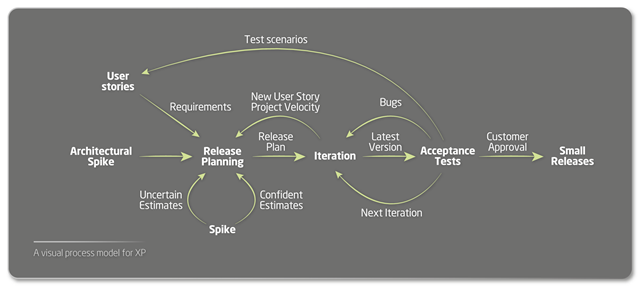 Are we already doing it? How well does software development pursue serious studies of the main stakeholders?? One could argue that Agile doesn't quite do this — Agile conveniently, if profitably, focuses on the client, the one who pays. Aren't they often another stuffed shirt, hoping to push a new way of doing their job onto the system's users? Now, there is this extra step you can do in Agile, one that many groups do, of keeping a larger circle of stakeholders involved as you develop. This is shown in the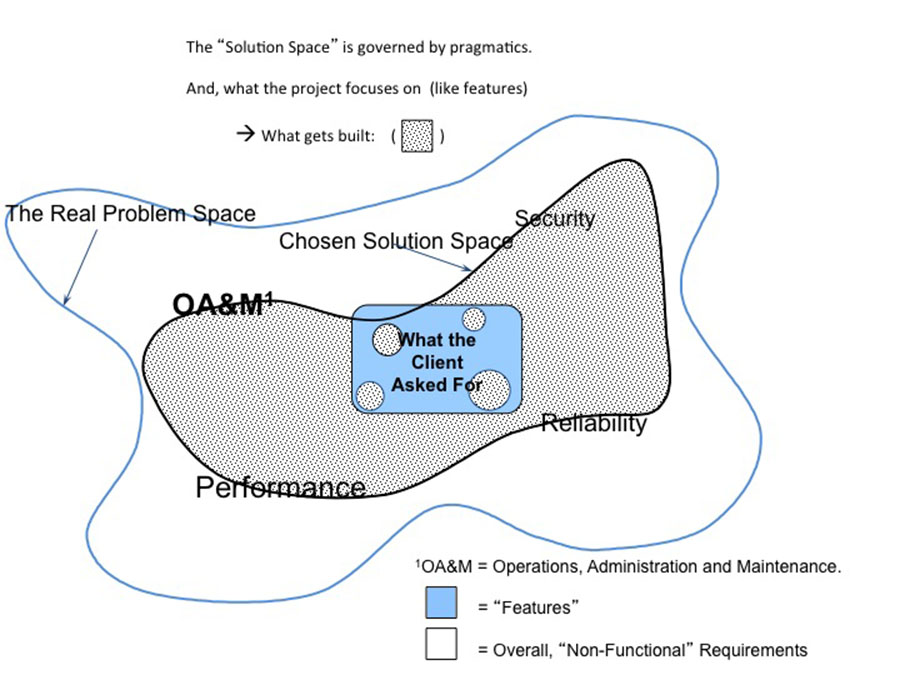
Wait, there's more growth to be had...
Meantime, here's an ethnic interlude, an instance of a student being thrust onto the world stage, in a culture clash, having to defend her design:
In 1979, the Vietnam war memorial, now on the Mall in Washington, DC, was designed by Maya Lin, then a 21-year-old architecture undergraduate. Her unorthodox, simple style won out over 1,400 competitors. It immediately came under fire — it clearly symbolized the loss America suffered in that war. It's an open wound in the ground, with the names of the deceased soldiers inscribed on its walls.
Many veterans, politicians, critics, and the general public read its refusal to explicitly glorify the war or frame the listed soldiers' sacrifice in heroic terms as an ideological statement, proof of Lin's — and the memorial's — anti-war position. Ronald Reagan's Secretary of the Interior, James Watt, was openly against it.
Opponents of the design also voiced objection because of Lin's Chinese ethnicity, because of her being female, and because of her lack of professional experience. The young architect had to go to Washington to defend her work in a public forum.
This rapid growing up she faced was unusual, but it did happen. Maya Lin didn't have to do an ethnographic study; the study came to her. If you were one of her professors, what would you have advised her to consider, and how would you have recommended she respond, in those circumstances?
The structure has since become an important pilgrimage site for relatives and friends of American military casualties in Vietnam. What you see pictured is a common occurrence there. In one single act, Maya Lin redefined, perhaps for all time, what a war memorial is.
So, someone like a Product Owner might be a true advocate for users, or not, but the developers' link to user knowledge was indirect. If you go back and review Ward Cunningham's video, of why he invented the term "technical debt," it was as a result of his group of developers, talking with clients, making assumptions about the actual use and needs, which they later had to work around.15As he says in the video, he is never in favor of making bad design decisions on purpose, even to get the product out fast. Technical debt is largely unintentional — the inverse of "YAGNI" — you don't know you're going to need it. Above right, in the prior column — Twenty years ago, at AT&T, we knew the issues of relying on one client representative explaining requirements to the development team. They only asked for the "Swiss cheese" in the middle, ignoring the rest that's in the large, surrounding Real Problem Space. Many of these missing needs, they expect to get anyway, for one reason or another. Clients often assume the developers have more familiarity with their world than is the case — a great argument for ethnographic studies. Or, they wish this to be so. Or, they just get tired of writing factoids down. As noted in the image, there also is a historical bias toward talking specific features, versus quality attributes. The OA&M was the telecom term for what it takes to help keep the system running — processes we now might try to manage more carefully with a cooperative DevOps effort. They tended to be left unspecified so much that we considered them non-functional attributes, versus features. Studies of systems we built showed they could represent half the development work. Impact: In sociology and anthropology, deep studies have been influential in changing minds regarding what Westerners think of minorities and people from far away. In Steve's generation, many of us read The Children of Sanchez: Autobiography of a Mexican Family, by Oscar Lewis, which told the daily lives of members of this family, in their own words. Studying stakeholders very deeply could have a large impact on software developers. The need to go all-out: You can't exactly dabble in ethnography. Taking on timid directions, to emulate and study, obviously is avoiding the problem of dealing essentially with difference. Which is, Steve thinks, a problem for computer science. For example, he has asked his teams to go visit non-profit clients of senior projects, in their natural surroundings, to understand what is valuable to them in their daily lives, which could lead to different decisions of what the students build. Getting them to do this is like pulling teeth. This absorption-of-values is soft learning, and it might be distracting; it doesn't fit their pressurized world of only doing what it takes to get a grade. While they do senior projects with more intrinsic umph, the request is still outside their normal boundaries. Is the solution to make them do that extra work? Above, right — Ethnic garb in action: This is a well-decorated, traditional tunic, punctuated with a Ganesha pendant, both immediately identifiable by everyone at Rose who is of South Asian heritage. The occasion was one of our career fairs, and rain was expected, so Steve considered, while still at his apartment here, and mostly for fun, how the garb would come off as he walked to and from the fair under his umbrella. An Indian student he'd not met before said, "Nice kurta," as the student came in the entrance to find a job.
|
More serious, on that occasion, was the question of reactions he would see from those there to employ Rose students. Got some thumbs-up, and some looks of astonishment. This is what Steve would describe as a "non-timid direction," in ethnographic studies. A direction where you feel the "courtesy stigma." Gains: Negotiating directly with a client, as is done in Agile processes, has improved the position of software engineers in their organizations — they have more power and prestige. For example, if a project is late, no longer is this a call for management to crack down on them. It is assumed, on the contrary, to mean that the original estimates must have been wrong. If, in addition, developers knew the needs of other stakeholders, especially users, as well as or better than the client, they would be in the best position to argue for the best solution. We see the latter in software companies, such as SAP, who know as much or more on "the business" as the customers they serve.
For our students, trying ethnographic work might be a rude shock at first. Some, after all, came wanting to write programs like games, which appear to give you almost full control over the whole product. Your own imagination and coding skills cause the app to arise. However, that is not the world of software development most need to learn about. Right — Setting-up students in situations outside school, in someone else's environment, could be even more stressful than what they undergo in their routine classes. Suppose the plebeians they are supposed to observe don't cooperate, but their grade depends on completing the study?? Intrinsic motivation turn For college students, stigma, or fear of stigma, is this regular companion anyway. As noted in an earlier section, one in four has a diagnosable mental illness, 40% of those do not seek help, and — oh! — 80% feel overwhelmed by their responsibilities. We stretch to be compassionate, but many factors work against connecting with students in trouble, including feeling inadequate to help and the constant pressure of our own work. "The system" we perpetuate here rewards high achievement, increased intellectual sophistication and ever-growing self-reliance; students thrive on achieving these goals. Conversely, misfiring on them puts you down, including professors giving you bad grades to make it official! It's your fault. If that isn't stigmatizing, what is? Steve thinks it will take time to learn how to pull off this broader social interaction, generating the desired impact on our students. We want to do it, and we want it to be a maturing experience. How do we know who's ready for it?? In our department at Rose, we've already experimented with giving students large, multi-team projects having outside clients their junior year, then pulled back for various reasons. You want to be on the forefront of preparing them for industry, but it is tricky business.
You will find interesting results, if you study a minority group, say, or a community not so good at software skills, hard enough and long enough that you identify with them. You might cringe, for example, whenever someone says, "The problem lies between the keyboard and the chair," and laughs. Or, you might feel dread when a colleague observes that students from a different society tend to cheat on exams, instead of nodding as if that were based on solid statistics.14 You might even come to question, for the first time, why you are living in the suburbs.
So, Steve believes the challenge is out there, to generate leaders for industry who can do this work. Which means confronting them, while they are still students, with the need to do it, so as to understand others they need to understand. His start on this is to represent outside groups himself, challenging his students to analyze why he would do that, and challenging them to think like someone else, too.
|
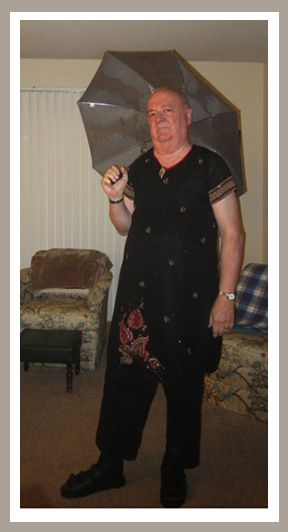 client may assume the system will be "lightning fast" and "never crash," without ever discussing these topics. What gets built then is this evolving system (the gray blob), which slowly incorporates the unspoken or unclear features and attributes, largely from feedback in the form of trouble tickets and change requests, up to the point of what's pragmatic or economical to build.
 s to mush.
-----> Far out! Make the "how" transparent
Even betterer,52 the Ivory Tower dissolves?
A big step above getting out more, Steve thinks, is bringing the out in.
Universities grew out of guilds in the Middle Ages. The guilds were there to solidify the position of local tradesmen, with elements of unions and secret societies, among other things. Many of our current operating philosophies, like academic freedom, go way back into this tradition. However, these traditions also tend to perpetuate our methods of operation as being de facto correct, without further investigation. Maybe that idea is at least worth revisiting, especially if there are alternatives waiting in the wings.
Here are some other choices now! They fall under the general category of making "how" we do what's needed, in a manner more obvious to various parties, such as our students and the companies who hire them:
Model your customers, to connect with them. This does not mean change everything wholesale. It does suggest that, if we have processes that are like our customers' processes, and organizations like our customers' organizations, and adopt best practices like our customers' best practices, then they are much more likely to find us and our products interesting. We speak their language, using "operational definitions." |
Steve supposes this model asks the question, "Who are our customers?" He thinks it would be a mistake, in this context, to say that is our students. Our factual goal isn't just to attract students, no matter what becomes of them. Modeling incoming students more seems a bit bonkers, too. Our larger role is to put them into roles of technical responsibility in society. Which makes society and the hiring companies our customer. In a fundamental way, we sell students as a product, into industries where they serve society as scientists and engineers. Students come here, and their parents send them here, increasingly, because we can do that.
If students are a product, why are they paying us, you ask? The student ends up as the major beneficiary of their education, including getting paid directly by the companies who hire them.
So, what if our default model, for processes, organizations, and best practices, was, "How do our customers, the hiring companies, do this??" There may be a good reason not to do the work that way. But, this seems in general to be a more valid default position than, "We have to do it that way since that's how they did it at University of Bologna in 1088."
 Around 1990, the idea of modeling customers became popular in the business world — it created intuitive links with them. Customers didn't need to ask what to call organizations they wanted to get in touch with at a supplier, or what they did, because the terminology and function was the same as in their company. Today, this notion has grown with Supply Chain Management (SCM) to become Business Process Integration. It involves "collaborative work between buyers and suppliers, joint product development, common systems, and shared information."
Left - An example, from Forrester, of business-centered integration with outside stakeholders. What inhabitants of your organization do, and how they interact, is tied to what these other parties do, and how, and it's made possible by underlying business systems.
For us, an example of this integration would be that our customers have a distributed database of possible candidates for positions in their technical organizations. This includes Rose students and alums, and current listings of their skills can be matched to these jobs. Making that work well takes an SCM approach.
An instance with more ripples is to model customers' business practices, in the teaching we do. If they are all over "lean" and "agile" types of engineering, wouldn't they love to know that students already are a part of such organizations in college? That would mean using a sharp knife to cut back on hoops you have to go through to get things done, say. And being able to show you found the most cost-effective way to deliver quality.
At Steve's January, 2016 "lightning talk," he proposed that new course developments include showing how steps had been taken to find existing materials elsewhere, or sharing the work with other institutions, before accepting that we had to do it ourselves.
Show students you model your customers: If we wish to teach our students best practices by demonstrating them, then "transparency" means including these in our academic activities. Our modeling of technical expertise is at the heart of students' believing they should grow in these areas. If we don't model the social skills we want them to have, what message does that send?? |
 Steve's example of choice is teamwork. We want our students to leave Rose showing exemplary teamwork. It's an advantage that they get more understanding and practice at that here. However, we do not usually demonstrate our doing it in our own work. If courses were developed collaboratively, it may have been done out of the sight of students. How many courses are team-taught? One might even conclude that we are less good at this skill than we ask our students to become. Why is teamwork not a priority over getting individual credit for academic work?
Right - Team teaching in the MBA program, at the University of Houston-Downtown: "Each course in each of the eight corporate driven concentrations/graduate certificates will be team taught. Along with one of our excellent College of Business professors, you will find a seasoned expert from the corporate community to team teach the entire class. Both of these talented professionals will be in the classroom for the entire class for each of the class meetings. Since the class is flipped, the lecture material will have previously been provided by the College of Business faculty member for each class. This allows the entire class meeting time to be devoted to ensuring the members of the class understand the application of the material."
Going agile at Rose: Steve's next extension of best industry practices to our college environment is to make course development "agile," like the software development our students do. How is this different? One big change is that, with agile course development, you would never wait to show the results to a customer until the courseware is done. That's out of the question. Instead, you show each piece of it, at regular intervals, to some sampling of customers, as well as getting their advice just prior to doing an iteration. |
In other words, students would get to peek under the covers regularly, and advise us on how to build the next course for them. This is beyond typical "problem based learning." Knowing the problem at least some students want to solve precedes building the course.
Steve's first attempt at this was doing a course in Software Project Management, for which he enlisted working professionals as advisers, during the development. In the first iteration, which was done live at Raytheon, students selected topics for the rest of the course in the first class session, with fine-tuning at each succeeding session. Beyond this, after each class, students went to their colleagues to ask their opinions of the lesson, and returned to share that information the next week.
The follow-up version was online. Here, remote advisers were enlisted. Got some good feedback. Need to work on making that even more effective. For both undergrads and grads, there is a question of getting their attention often enough. This also is true in software development, regarding keeping the customer in the loop. Steve has some strategies in mind, to help this along.
 In industry, the traditional course development model we use is called ADDIE, which stands for analysis, design, development, implementation, and evaluation. Sound familiar? But this model is analogous to the Waterfall engineering model, which is fading in popularity, especially for software. There already are initiatives for switching to the leaner.
Here's an example, from "Bottom-Line Performance." Note the cycles of verification, with the client, as the course is being developed. Note also the name of the company, which derives from the commonly accepted high standard for proving that industrial training is effective — namely, "Can you prove it affects the bottom line?"
Non-trendy
And, not being afraid to try things that everyone else might say are bad ideas...
Glutton for punishment, and making what's harder happen
Whatever you do, don't burn yourself out?
 Steve's always willing to work on
novel and risky projects; knowing how to cut those risks early — he has faith! All the tough
work Six Sigma saved for later! This feels like why we have tenure. Let Steve know what you need help with!
Steve's always willing to work on
novel and risky projects; knowing how to cut those risks early — he has faith! All the tough
work Six Sigma saved for later! This feels like why we have tenure. Let Steve know what you need help with!
Left — Vern Law, a pitcher for the Pittsburgh Pirates, circa 1960 when he won the Cy Young award. Law famously played through injuries, and was known for saying, "Experience is a hard teacher because she gives the test first, the lesson afterward."
Strikingly, we now do that to students, to determine the true gap between what they know and what they need to know, tuning the lesson.
And, in the software world, this is now how we build systems. Our code inevitably fails the test, the first try.
Throwing the high hard one — Steve opened this home page with the Langley Aerodrome taking a big drink, and noting that academic engineering projects tend to be suspiciously crisp and limited to what's just been taught. Like Vern Law, he tries to pitch his best stuff every time, and seeing what undergrads are capable of — that's definitely in the mix. But, how do you do that? How do you make academic activities more realistically complex without coming up empty?? Here's chicanery Steve's tried, which he still believes have (has?) promise:
- Problem-based learning — Start instead with what students need to do for achieving more true-to-life, then show the relevance to learning one thing and another as you go. You'll discover that the thing needs durability, and then teach how to accomplish it.

- Interdisciplinary learning — This sort of learning is often inherently more authentic. And, it's critical that we have more who can think this way than we have now. See this article by Elazer Edelman about how that plays out in biomedical engineering, for one.
- Real clients — They want to solve heartfelt problems.
- Service learning projects — Their clients are among the best for undergraduate engineering projects. They actually want a solution they can use, not an academic exercise. And these are tough, considering they aren't technically sophisticated and don't have any money. Everyone feels more inspired to do these, because those with no power are at your mercy.
- Uncoupling from the academic cycle — You can give lots harder projects if it's ok to continue them after one student team has worked on them. What are the odds you'll be done solving some truly hard problem, in sync with Finals Week?
- Nebulosity — Real software problems are "wicked" in the traditional sense, lacking up-front problem-solving predictability. Blackslade Mire, in the UK's Moor, shown at right, is a dream in comparison. Go find one for your students! If you find the image depressing, it's rich in St. John's Wort.
More tips follow in the next section...
Students → Realities of Software Engineering
Is there a "beyond just getting a job" for getting a job?
Computer Science undergraduate curricula are almost fully founded on the premise that we can teach a foundation of theory, to make students as prepared as they can be for work in the software industry. Or, this is what's by far most important. Or, if a wider view is taught, it's for someone outside the department to do. Still today, you can't get more practical papers and workshops into the annual US conference on CS education — Steve's tried and gotten a reaction like, "If you could show how this industry-related topic could be worked into existing CS curricula without disturbing anything, we might give it another look..." The actual job students need to be prepared for is officially off the radar.
At odds with this convention is the fact 43% of current engineering jobs in the US are now in software, which wouldn't be the case unless a huge amount of the work were integral to larger concerns.10 A small percentage of the software industry work is just "about software itself" — like if you're fixing a compiler. The rest of the software engineers are building apps for smart phone users to do work outside the CS world, or the software layer for a device other engineers are building, or web pages in an IT organization, etc. And, most of these hackers will switch jobs frequently in their careers, moving from one vocational area to another, and from one knowledge base to another as they do that. Some will work for software consulting companies, where they will change to serving a different client with a new set of requirements, on a regular basis.
The real theme our students need to be ready for is sudden variance in what they are trying to accomplish, and how. Every new project they start, for every new customer, will serve-up a giant dose of novelty. It's like you come into work every day, to a plateful of Christmas crackers, a layer of undecidability Alan Turing never anticipated.
The inherent empiricism of software development work is at loggerheads with a school discipline which emerged from the math department, and values only rationalism.
 Our pedagogies to go with, founded on Vygotsky's "zone of proximal development," favor only slowly creeping away from fundamentals, creating a student mindset that everything new will be quickly made familiar. In their careers, this won't be so. In our curricula, we ooze from data structures outward, slowly but surely. Anything far afield is not to be trusted, by us or by our students. Both sides are timid over jumping into the new. Which is the major psychological event software developers need to be good at. When is your last observation of a professor intentionally put a problem on the board, which he didn't know how to solve?
Right — Here's our Depression-era model of how to build courses and curricula. The goal is to get to what's "out of reach" eventually, if it's in the scope of what should be taught. However, inching along, always staying in the safer areas, tends to have a Zeno's paradox effect, with everyone focused on what we "almost already know." It creates unrealistic expectations, and a false sense of security, studying an industry which, in truth, is always lunging into the unknown.
Steve believes it's time to rethink this formulation, of what an undergrad CS exposure should be like. He tries to cast students into the unfathomed directly, like fresh sailors into the deep water, so that they learn to survive there. Steve's office, appearance, and this web site are three examples of that.
 Left — Plane crash # 2 for this web page: 1918 metaphor for the most common test result with industrial software, unlike student projects, which are preset with a level of difficulty to let most be successful before the project is due.
Connecting to something completely different...
The image is from an article concerning dictionary compilers (people). The author was in fact lamenting the practice of making current usage the standard for acceptance of words. The word "aerodrome" had just been dropped from a dictionary he liked, using that criterion. Sounds like Zeno's incremental cousin, maybe, another way to creep curriculum growth?
Software architecture is uncommonly wrenching since we "live with" designs as long as possible; total redesigns happen infrequently enough that a team forgets how nebulous the experience is. In the Agile world, it's almost obligatory to start coding as soon as possible, and downplay the need for in-depth design first. This speed-to-show-code bent works for problems that are just slightly differential, or for school-sized projects, but not for majorly new projects. To convert your product to a service, glossing-over the design issues, and uttering "YAGNI" at every turn, leads only to redesign. Once again, we practice at developing the wrong set of hunches and expectations.
Now, you may be thinking, this predictable, incremental, comfortable learning is what our students expect, coming to Rose from high school. In the same way, it is not what they will be faced with in a competitive industry. Over their time with us, they need to be shifted, hard, toward the expected learning model of their next world.
What is the right rate for nudging baby birds out of the nest? A nice, slow transition over four years would be nice, in a way, wouldn't it? Yet there also is the problem that most of our students can't get industry-related summer internships for after their freshman year, and some for after their sophomore year. A part of that is because of the technical classes they do / don't have under their belts. But another factor is their "perceived maturity," by the hiring organizations. To the extent this is internal, brain maturation, we may not be able to speed it up. But, to the extent it is controllable factors, like learning to accommodate open-ended problems owing to our challenging them with these problems, let's help it along!
Extrapolated ethics
Or, beyond just getting paid to please a boss?
Role hopping: You cannot know what is ethical or just, to someone else, until you walk a mile in their shoes. After doing so, you may still disagree with them, but at least you know more on why they believe and act the way they do. Now, you can think of situations where you would not even pretend to see it their way. For instance, someone with greater power who is taking advantage of it. However, Steve feels that, the more we can try empathy, the more perspective we have in making engineering decisions. Working hard to understand everyone with less power than you, or less than their adversaries, has the aura of realities we should not ignore. Even striving to get an equal, who is just different, makes sense. It is hard to for us to see issues from an opposing perspective, when both sides have spent time building-up arguments against each other. We see this phenomenon most clearly in politics, or where money is at stake. A challenge to Steve's students would be to find a hot topic that you feel passionately about, then take the other side, honestly and sincerely, in an open debate. We have done such things at Rose. A short presentation: In the slide set on ethics in this directory, which you can click on via the link in the opening section of this web page, some examples are presented as discussion material. The slides are intended primarily for software engineers and their project managers, particularly for everyone making the transition from one to the other. The big picture looks different if you are officially responsible for the actions of a group. Many engineers don't understand that viewpoint. It is worth trying — for one thing, with flatter organizations, more team accountability is in play, at the expense of finger pointing. A great instance of an ethical choice, for an experienced engineer on a team, is whether to spend extra time and effort helping new team members, or whether to spend that getting the job done yourself. Sometimes the choice unfortunately comes down to whether or not you like the fresh herd. Here's a new engineering team checking out a fresh feature. If you were the person on the end, would you feel included? Bases for the codes of ethics: The slides also get at underlying values, those responsible for our official codes of ethics and such. Like IEEE and ACM. One of these generalities is that engineering is inherently altruistic, that we are there to do work for a larger group of mortals who cannot do that themselves, and they are the main party to whom we bear responsibilities, not just our employers. Another "metaethical" point, discussed in the slides, is whether decisions should, at the very core, be based on emotion or reason. Famous philosophers have come down on both sides of that. Living in a business world: For engineers, as professionals, a confrontation to your moral fabric comes when your company takes a one-sided point of view, on a public issue, which is clearly motivated by profits. Or, as the company would put it, an unjustified attack on its very existence. Suppose you worked for a coal producer, say. Would you dare to speak out in favor of international agreements to cut back on emissions? Such questions may require you to go back to a metaethical point you believe in, to decide what to do. To whom is your rightful obligation, and what sacrifice is that worth? Self-diagnosis: Steve's favorite ethical topic is "blind spots." These are places where we have always assumed we know the right thing to do, that decisions in these areas are just like others we know must be right; but actually we produce results that we wouldn't want, acting on those righteous premonitions. Or, we get unexpected resistance to our judgment call, in this particular case. The instance described in the slides is "gender considerations." Men in engineering tend to go with clear-cut rules for everything, believing that the rules stand above any one person's individual opinions or actions, or situational variables. It has never occurred to us that women in engineering might not believe quite the same way. Women may be more likely to step outside the rigid form of a rule set, allowing them to act more caringly within a given context. The fact men think much of what we do in engineering falls within a right-or-wrong context is, itself, a masculine way of approaching engineering. It's possible that men and women engineers, generally, tend to have blind spots in somewhat different ways.
|
Pointing the finger at someone else, regarding blind spots, is a dicey business. They may be aware of your blind spots, too, or feel provoked to come up with one. A greater personal challenge is to listen to their side, or to do an internal analysis of your own side, looking for imperfections and how to fix those. If you are a person in the US in Steve's age group who wants smaller government, do you dare to open with asking that Social Security be reduced first, the hand-out that you benefit from? If you want more government services, do you dare ask that your own taxes be raised first? On engineering teams, Steve saw blind spots all the time. Part of his job in industry was to evaluate the likely success of projects, prior to the time they had spent most of the money. Teams very much get into a habit of "group think" after they've been in motion for a while. They can be like technical Branch Davidians, or badly out-gunned armies, sharing very specific beliefs about how the universe is, and how they will end up, which almost no one on the outside would agree with. (Of course, sometimes the most internally synchronized groups are right and everyone else is wrong.) In recent times, the ethics has been questioned strongly, of continuing to do a project death march without regularly stepping back to get outside verification. In software development, the Agile message is constant revalidation of the effort. Left — There is advice out there about psychological blind-spots. This article was intended for leaders who might base their next actions on past successes, believing their premonitions will guide them correctly the next time, without double-checking those. Current experiments, of how we act, have shown that our shared wisdom in ethics may need more study. Duke University's Dan Ariely found that college students often cheat, given the opportunity, if they know they won't be caught. But most only cheat up to the point that they can still feel good about themselves. There has to be some saving grace. They were much more likely to cheat, for example, if they saw someone they identified with doing it first. And, reminding them of ethical obligations before an exam did prevent cheating. Steve believes such variables in behavior are not just true for college students — more likely for all of us. And, in particular, such things surely are true of practicing engineers. If we each started the work day reciting the IEEE Code, most likely we would occasionally make a different decision. Did you mean to do that? Stretching the realm of ethics even farther, we can consider people's "intent," in the same way the law does — or not. Did the engineer mean to cause that to happen, or was it an oversight? In a law suit, this is the difference between tort and negligence, when someone has gotten hurt. If you knew the ignition locks would break, with likely bad consequences, and you built the cars with them anyway, that's a tort. As a guide for personal behavior, however, this difference is more subtle. If you saw a system artifact that had a defect on it, noticed it at the time, but forgot about it, should you feel guilty of a sin? You didn't really intend to put out a defective product, or did you? In software development, we have passing thoughts on what could happen, and we dismiss a great many, as we switch to working on something else. In analyzing projects with a review team, Steve very often found that an issue, brought up by one of the reviewers, would get a response from the development team like, "Oh, right, we did discuss that at the time, but never did anything about it." So, there are many levels of consciousness of issues, including group memories of those, which vary all over the place. Somewhere in that fuzzy mangle of ideas, the question of "intent" may come up! Are you sure? If you start studying the unconscious mind, like Freud or Jung, such matters could drive you psycho. Stuff goes through our heads without our knowing it, and influences our behavior, occasionally bubbling to the surface enough that we become aware of it. A specimen here is how, when one of your parents accuses you of a defect, or even hints at it, you tend to believe, suddenly, you must be accountable for that. The same conclusion happens if, say, a high enough level executive in an organization allocates blame. At some level, thoughts along the lines they are suggesting might have occurred to you. Or, they might be planting these thoughts as you listen, deja vu like. It is impossible to know, because of the intense dynamics of the situation, and the way different trains of thought come and go for us. If this is how we in fact are, with only some control of what we do and what we remember of that at any given time, how do you exercise a clean personal code of ethics?? So, ethics is an area Steve explores regularly. You can't exactly call it "fun," since the stakes are so high.
|

Coding avocation
How deep is the craft we love to do?
Programming in Java. Like life, Java can be self-referential and so lovable — incorporating as it does such artifacts as good old loops, recursion in general, and inner classes operating on the methods defining them. Decent for searching, like puzzle solving. Biggest recent improvement is the ability to pass methods like objects. The AI crowd wanted this in Java from the beginning.
 Favorite used to be Lisp, but then
it slid out of fashion on a banana peel of right parentheses. Care for a lambda joke? Question: "Who had the best argument for the lambda expression?" Answer: "Don't know — the whole thing was anonymous!" Ok, that was an awful "funcall." Don't "evaluate" it.
Favorite used to be Lisp, but then
it slid out of fashion on a banana peel of right parentheses. Care for a lambda joke? Question: "Who had the best argument for the lambda expression?" Answer: "Don't know — the whole thing was anonymous!" Ok, that was an awful "funcall." Don't "evaluate" it.
Before that, Steve thrived on assembler, long ago when you had to. It was thrilling to create commands, stick them in place in front of you, and then fall into them, like a somersault, for the machine to execute.
Right - x86 assembler in action. This function divides an unsigned char by 61, faster than if you used the machine's divide command. A couple comments to that effect would be nice, huh. The lines shown would still run on a PC. See here for a short intro to the language.
What are we doing, really, when we code?? What blows Steve's mind over modern programming tools like Java, is that they are places where we define new language, continuously, extending what has meaning in our universe. Like, a new OO class you invent is surely a fresh semantic entity, which you can now use. This makes us coders "authors," of code versus "writers" or "scriptors," in the sense of some postmodern philosophy. But most of them objected to giving an author credit for tangible creation, by virtue that what we all do is as well based on the world we live in. Recall that OO intentionally is this — the original goal was modeling parts of the real world conceptually, in code. Our works are so a product of our time and culture. And the meaning changes as those factors advance. This web site's HTML could be critiqued for not using Flash, interactions with the reader like links to Twitter, and other new tools, say. More so as time goes on.
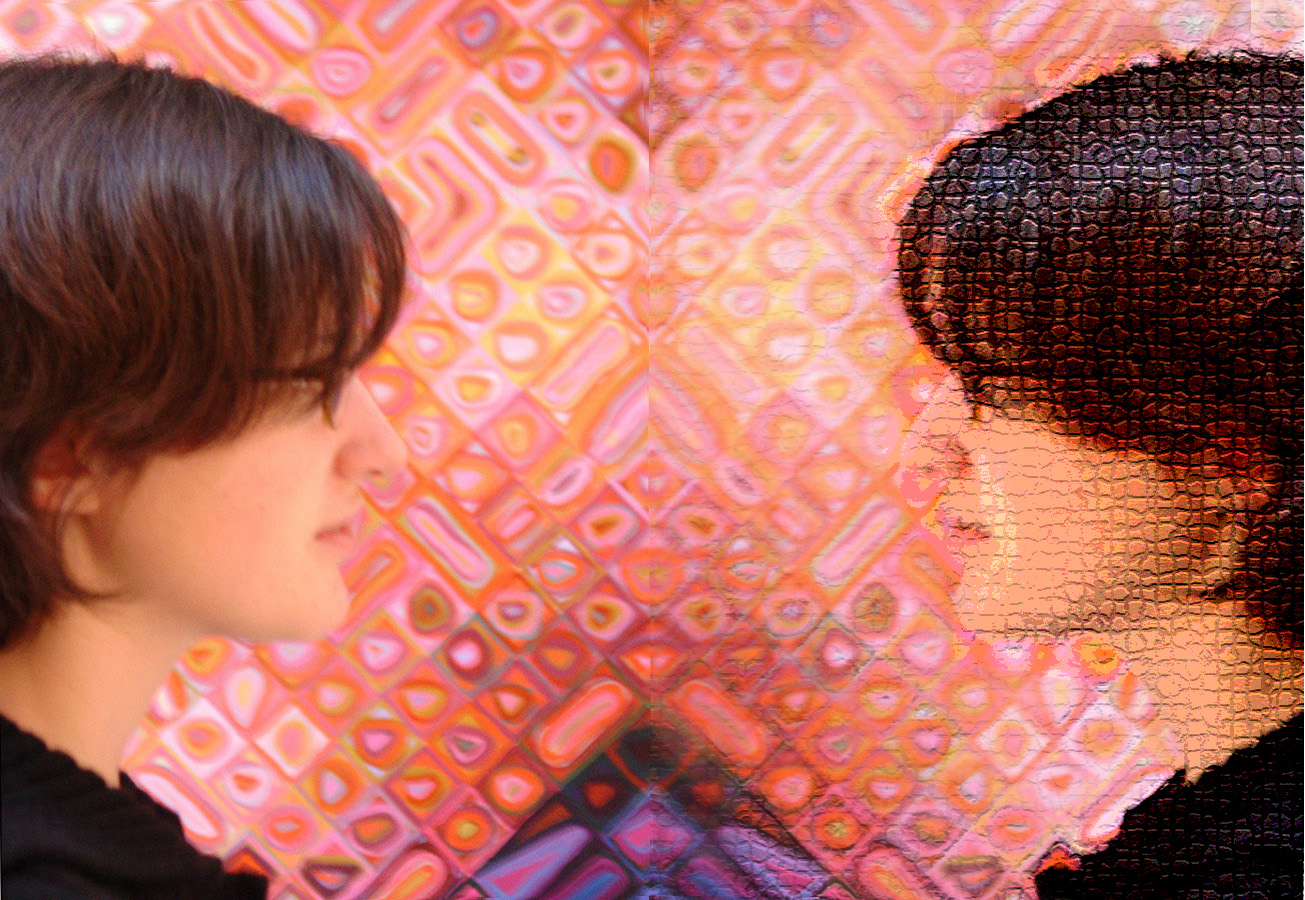 We also face the problem cited by Derrida, that the full meaning of what we do is deferred, depending on what happens in the machine, for us, and, usually, how humans react to that. Final outcomes typically are a surprise to us because they include faults and "user errors" we didn't foresee. Our "reader" who reinterprets a text, is that "user" of our systems. They are even more removed than readers of books or viewers of paintings; they don't even digest our code, as such, but react to what the system, that does read it, shows them.
To link our acts to philosophy even more, most of our software has very blurred authorship, making it almost impossible to infer intent and motives — we have to rely on just the text of the code itself, Barthes-like, in any later analysis. Some code is even crowd-sourced. You can't ask, the way you can for the single-authored painting Steve's daughter posed with, at left, "I wonder what he meant by that?"
Barthes emphasized how reading texts is a disjointed experience owing to their having incongruities, interruptions, and breaks. Now consider what the source code for Microsoft Word, started in 1981, must look like by now. Like, what code fires when you back-space? It can't be simple. If Word just inserted formatting or whatever, automatically, it takes that out instead of undoing what the user just did. But it didn't used to do that, so there might be some hacks they keep living with. One of our department's alums maintains that code, and has described, to current students, these issues in trying to recapture the intent as he makes fixes and changes.
In his 1969 essay, "What is an Author?" Michel Foucault raised the question of a work having validity because of who it is attributed to, disagreeing with Barthes' position that this doesn't make a lot of difference. In scientific publications, we rely heavily on the identity of the author, in inferring value. In music they do the same reputation preservation: If Mozart wrote it, an orchestra will play it, and they will try hard to play it well. Isn't it peculiar that, for code, which has to be written so correctly to run correctly, we aren't as fussy about the identity of the coder? Whatever the reason for it, is it the same underlying reasoning which causes software, largely, to reject the notion of certifying individuals as worthy to code? Like, other engineers have FE and PE exams, and licenses. IEEE does have certification programs for software engineers, but few employers demand them.
Above, left — Too Close for comfort? Steve's older daughter poses in front of Chuck Close art work at the Boston Museum of Fine Arts. The whole painting, broken into a fine grid, is a portrait of Paul Cadmus, who also was a painter. On the right, Steve gives his daughter herself, deconstructed, to study, on the left. Which is appropriate since she is a deconstructionist by trade. In particular, providing new ways of looking at Renaissance texts. In the image, she investigates her own meaning, from an external perspective, resulting in new value from each element, as it is pulled from the whole, akin to inspecting the parts forming the painting's background.
The idea of deconstruction is not just a closer analysis in the usual ways, but understanding how ideas were intended to be interpreted, and how they are or could be interpreted and related in an alternate frame of reference, including looking at underlying assumptions and finding unavoidable contradictions, incongruities, interruptions, and breaks. It's a great activity for "stepping back" from anything.
As an example, our ideas of hot and cold are supposed to be simplified temperature opposites. But in practice they are interdependent judgment calls, relative to the situation. They are often invoked to mean, instead, "too hot" or "too cold," as in more than regular hot or cold, conflicting with their own pure meaning. As part of a social greeting assessing the weather, they are surrogates for demonstrating agreement about our world view, and much more. Other languages have varying terms for gradations like "cool" and "warm." There is no absolute meaning for this contrast. But you have to be exposed to alternative cultures to know that, and the usages also vary over time. In mid-fall, freezing temperatures would feel cold. At the end of winter, you might describe them as a warming sign of spring and push back the hood of your parka. The possibilities for meaning are open, at any moment, in the play of differences and relationships one perceives. The point is that, as in the image at right, t we want hot and cold to be absolute, contending opposites to choose from, and thus have undeniable clarity in our communications with others, as if we were speaking from on high, but they aren't that way.
Like others, Foucault brought up the issue that writing is a way of immortalizing yourself. Steve feels this cause also transfers to writing code. You move on to the next project, but what you did on a successful one could live a long time beyond when you worked on it. Code slinging is a way for us to amplify and extend our effect on the world. You see this in the way we are proud of, and protective of, programs they wrote.
It is curious to read these Post-Modern essays, considering software as an example of the "texts" they discuss, as you capture the intent of the philosophers' own "texts." After inventing deconstruction, they realized that it could be used to soften any rigid argument, including the liberal causes they mostly favored. Yet it's not a tool to fear; it gives you ways to laugh at your own artifacts and beliefs. Say, the code you just proudly slang.
Favorite knowledge-gathering & development tool: Use cases
Is there a runner-up to code, in valuable artifacts?
These literally deliver the goods as a paradigm you can start a project with, then design with, then use to verify that the resulting system meets the requirements. And preserve as business knowledge everyone can comprehend, for the next system. See for example Alistair Cockburn's doc describing how to accomplish this. We did forms like use cases in the 1970's, but we made the mistake of trying to grasp them in complete detail the first try. Use cases are closer to an artifact you can write both integration and acceptance tests from, in comparison to user stories. Indeed, maybe they are indistinguishable from a decent test plan?
Steve was once asked to evolve the C-code for a system that semi-automated this end-to-end flow-through from requirements to test cases. Then he heard it was Kernhigan's code, and pictured how intricate that C was likely to be!
 It's odd how process tools like use cases become trusted, then distrusted as development process styles morph. See the picture, below, of Steve's students ten years ago, still not sure on the subject of this new-fangled tool. Now it's peaked, then fallen to # 2 in popularity. The way Steve employed them in industry was close to optimal, finding knowledge experts who actually could say a preferred sequence for things to be done, as well as the nugget of what had to be done, when they knew this from a business or technical process vantage point. Like, he got the master of network diagnostics at Lucent to explain how the analysis should flow for a new node to go in that system. The current idea, that you shouldn't write this down first in English, for them to verify, but only in code to show them, though trendy, may not always be best. Steve had to take days on the expert's clock to capture the info just described, because nobody had done it in English before; it just existed in other machines, written in other languages. There was no shared IP.
Gotta agree it makes sense to go for user stories first. But, especially if you want to be a player in a particular "business" or type of system, it also makes sense to have a sharable version of the most specific set of real business rules. You can easily write and rewrite MVC "controllers," for instance. You can more quickly educate the new developers. And, if this is just a one-use job, still, why have the client or user tell one team member how the work needs to flow in detail, and you try to keep that in your head, later expressing what you remember in code. Only a part of that will be visible to them in demos? How do they know "you got it"? How do you know you bagged the complete exception handling you and they discussed? In the one-time-use case, you don't care about returning to maintain the document. In the multi-use case, keeping the docs up-to-date adds value.
Cockburn's intro to textual use cases is great starting point.
Above, right — Every representation of requirements has some advantages over every other one. This UML-style image of the use cases, for a part of a system, clearly depicts how they relate, something you won't get as well from a set of text descriptions, of either use cases or user stories.
Post-modern students
Who's learning this stuff, anyway?
This is untrendy because it is hard to capture as just a trend. Probably more like a permanent change in what college students are like. Unlike us at their age, they are not strictly autonomous, rational "selves" out to discover the grand plan for the world and for their lives. They may not even be trying for a meaningful personal philosophy. Reality can be virtual reality — not necessarily real as we know it.
Ok, they are a bit idealistic, because they are late adolescent / early adult. But they are more liquid in their interests, with those lower attention spans and all. They shift with changes in technologies and with social and political events. They are sensitive to people who have been marginalized by the way processes have been done; they understand new ways of seeing equality and justice. They would agree they can only get incomplete pictures of what's going on. They are in the flow, if they can be, connecting and reforming. They love doing things, vs just knowing things — a big advantage for those who want to be engineers. They like being creators vs just consumers, also a plus for building gizmos. And they want to know "why."
The students Steve sees are, as Pew Research says, economically stressed yet politically liberal or independent. Dedicated to social media, not to official organizations. Fully networked. They are engaged, if not necessarily to their lessons. They tend to admit they have faults such as being self-absorbed. They have high expectations, perhaps due to being treated so nicely by their helicopter parents. They also feel pressure to succeed, and at the same time love opportunities for that, like school assignments they believe they can pull off, special skills to develop, internships and other ways to stand out. Steve agrees with Strauss and Howe that many are civic-minded, and often jump at opportunities to be involved in service projects. And, they are better team players than we were. They like being a part of the campus community.
Steve agrees with his students that confidence and tolerance are important personal traits. They will be working and living in an ever closer world, of people with marked differences.
Steve believes his students are wrong, who think wealth has deep personal value. This isn't a matter of opinion, exactly, because you can ask rich people how happy they are, as they go about their day, and they aren't. (Economists have done exactly that. Expectations for changing emotional fortunes don't pan out. Dan Gilbert found that, a year later, people who became paraplegics were equally as happy as lottery winners.)
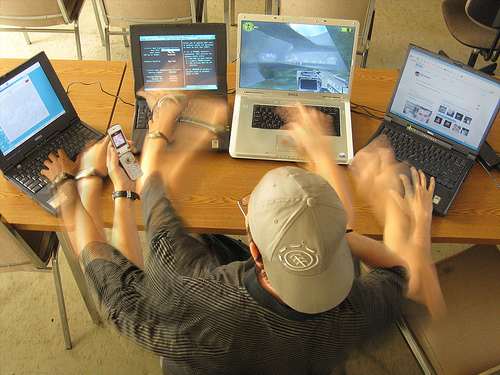 Steve's pretty sure students are wrong about being able to multitask well. Studies of this also show otherwise. Goldratt's ideas on project management apply as effective strategies, that constant switching keeps all tasks from being done, and carries its own time and energy cost. We profs see this, in trying to advance teaching and research at the same time. Hard even to do an hour of this and an hour of that, when both are serious activities. Steve gets that doing what's pictured here gives you a sense of unity over your life that serial accomplishments do not. Thus, this web page.
Right — What is the right amount of multitasking, and can you control it so as to make it in your best interest? Do you agree your parents should have trained you better about handling this?
Students now may be the worst procrastinators ever. They don't like delays. Today, as he writes this, Steve was sitting in another prof's class. The prof asked how many students had finished the homework, due tomorrow. One lifted his hand. How many had started? A few more raised hands. And it's a great class that the students all like.
How many hours a week are they on their smartphones? Guess first, then look!
Is such talk overly general? Of course! Steve's students are individuals. He enjoys finding out what's unusual about each, but, once in a while, is tempted to put together a larger picture such as here.
If you are one of his students, you already knew all this, huh.
Steve's a bit torn on more accommodating ways to approach post-modern students. For one thing, there is a trend of "gamifying" education, to make it draw the above student's attention more thoroughly. The problem with this is that it does not model how the problems we're preparing them for will be presented in the "real world," by making it resemble Grand Theft Auto. Where are the nuanced issues? Entertainment overrides those with a steamroller of fast-paced emotional engagements. Swat the next villain who pops up by writing user-friendly interfaces? Is adrenaline our only reliable appeal? To Steve, the thought of exposing students more to the outside world has promise. If this actually resembles video games, then fine. Students aren't learning this stuff just because we trick them into that. We're giving them what's important to their next role in life.
The fact Rose emphasizes small group experiences, and doing vs listening-to, very likely keeps us attractive and valuable to our current student audience. Grab a friend and go take action on that!
Un-grammar habits
Beyond trendy-or-not, these are characteristic ways Steve likes to do things, over a good long time now. Here's the first one now. Alias,
Is it ok to scramble text and context, on the way to fresh ideas?
1. Steve uses exploratory syntax and other druthers in his personal writing, which doesn't convert him to a poet. You can wonder how close he comes, doing endeavors technical, with this verbal example to model?
Engineering: Why would pattern tomfoolery add value —
In the great engineering tradition,
Open poetry is an example of his style experiments.
Too bad you won't have a chance to see that!
|
Poetry: Free verse isn't that far off, he claims.
You want the intense awareness, the mindfullness, or, is there just one "l" in that?
Here's a peerless example, so you can contrast with Steve's debris at left:
A Noiseless Patient Spider And you O my soul where you stand, |
 2. Chomsky did nice work on formal grammars, but his idea of forcing a universal grammar flips Steve out, so sometimes he journals not using those rules, on purpose, or for Noam apparent reason. After all, the difference between writers and authors is the latter's willingness to invent language. Chomsky's about what's proper and what's not, so he can build evidence that language mechanisms are innate. "Who do you think Jack will kiss first?" is grammatical, while "Who so you think will kiss Jill first?" isn't. So you think?, Chomsky? Can't you make heads or tails out of this? Holy rationality... Or a ration of it.
What th! Quite a few of Steve's sentences on this page don't have a noun phrase, or don't have a verb phrase. Don't have to. Many, he thinks. Claiming that's a matter of linguistic competence is up there with, oh, his critiquing colleagues for inelegant use of subjunctive mood. What's wrong with, "Man the bit sandwich the." If we understand it? Are the new structures, being invented world over for texting, following Chomsky-esque rules? Not IMHO. With oral speech, we might go a long while talking, without ever attempting a proper sentence. Without ever. And we get it.
Steve writes to pull unplanned meaning out later. Can't you do that careful being!
He crawled out the input slot to Searle's Chinese Room a some time ago. Clarity has its place. So do gods made out of language. He could draw you a picture. Ok, he will. It's at left.
No, wait, will you. Download this Medieval woodcut and continue coloring it, or whatever, to taste. Steve Photoshop, himself like.5
 3. Graphical writing — Visit a system architect's office and you'll see a white board with a picture of their current system, which they use to explain their view to those on the project. Often it's informal, like arrows connecting things, or a bubble chart showing flow. Sign language is images, and is more expressive in certain ways. Why not write this way? Being ingenious on it yourself could be a key, finding that which feels natural.
Left — Mind mapping is an example of graphical writing. Here's a famous one of those, which could be useful for studying or any other place where you feel a time crunch. Say, for improving the efficiency of your own coding. Note the clashing kinds of alternatives, which the available space begs you to try for, graphically. Versus trying to write these time-saving ideas on lines of paper, which puts on you a pressure to sequence and relate your thoughts properly as you first invent those thoughts. If you'd tried to write this in the usual way, would you have thought of off-shooting ideas like "monitoring" to make use of reflection? Would you have considered "let go"? Like, just do less? How about asking for help?3
One area where graphical writing is widely practiced is "graphical organizers," kind of a reverse of mind mapping, since they force relationships in particular ways.
4. Alts for diff media — Another thng Steve loves is abbrev wrds when wrtg, smthng that makes less sense if you're spkg. This also randmly lvs rm for varying mng upon rdg it bk. Unless you're showing a new proof for Zorn's Lemma, this can be fine. Svs lotsa X when comb with symbols — see next.
5. Symbol use — beyond emojis. As with many journalers and texters, Steve uses shortcut symbols as he pleases. Like emojis, his can carry a fuzzy meaning that the reader needs to speculate on. He does this so that he in truth has trouble interpreting what he said, on the fly, when he was writing stream-of-consciousness. Lets him feel like another person trying to get what Steve said. So, instead of rereading for "What he meant," he rereads for "What it could now mean." Basic examples of his symbols:
| symbol | possible interpretations | general sense |
|---|---|---|
| α | could be "any" or "at" | almost a quantifier |
| θ | could be "thinks" or "thought" or "imagines" or "hypothesizes" | cogitation |
| ϕ | could be "feels" or "finds" or "nothing" or "few" or "senses" | sensation, emotion, lack |
| σ | could be "some" or "so" or "such" or "same" or "at times" | not quite indefinite |
| X | could be "time" or "times" or multiplication or stretching | duration |
| > | could be "greater" or "more" or "even more" | comparison |
| >> | could be "lots more" or "dominates greatly" | significance |
 |
could be 'implies" or "points to" or "proves" or "suggests" | cause & effect |
 |
could be "says" or "said" or "talked" or "spoke" or "expresses" | verbalization |
 |
could be "heard" or "hears" or "listens" | attention paid |
 |
could be "see" or "sees" or "saw" or "envisions" | observation |
 |
could be "shows" or "showed" or "demonstrated" | displays |
6. Creative punctuation and formatting — In Steve's own journaling, he gave up on chapters, paragraphs, and margins long ago. He writes on oversized, blank pages so that he's not always thinking what goes on the next line. And most pages end up with multiple columns of varying sizes. Using "exploratory syntax" (idea # 1, above), you can make each line end where a thought ends, not where the margin bell dings or Word decides to do a Return. There's more freedom writing by hand, so you're not messing with formatting, just doing whatever feels natural.
Like many other authors who hand-write, he discovered new forms of punctuation. Like, isn't it interesting to put a question in the middle of a sentence,? like this, only you could just put a comma under the hook of the question mark, instead of a period. Steve's first recollection of seeing someone else try punctuation combinations was Henry Murray, the psychologist, who used inventions like commas with dashes to clarify his sometimes complex sentence structure, in treatises on personality theory. Then he heard from other journalers that this is what many fall into.
There is guidance on the web in regard to creative punctuation, including Steve's combo question mark. The problem, usually, is the limitations of the typing tools we use.
7. Getting lost in seemingly normal syntax — Not infrequently Steve tries to go for Language Log's "Trent Reznor prize for tricky embedding," which was based on the following quote:
When I look at people that I would like to feel have been a mentor or an inspiring kind of archetype of what I'd love to see my career eventually be mentioned as a footnote for in the same paragraph, it would be, like, Bowie.
If you write stream-of-consciousness, you turn out more superstrings than untestable physics theories.
Add strong use of pronouns, properly referring to the right actor in a sentence, but possibly used in a competing way, at least momentarily, and you can present the reader with glorious ambiguities. You'll see some of that who-done-it knottiness on this home page.
And you can play with tense to enable alternative interpretations, or Steve shan't have said that.
8. Mixing images with text — You can already tell Steve stirs these together. A picture tells a thousand words, and more — they inspire new directions which can be explored in words. The scenario that's next is one instance. So are the 24 examples in the table below that. Are these best done electronically or with hand-written documents? You should try both, and decide.
9. Scissors and paste — Novelists pioneered this, like Burroughs in Naked Lunch, and isn't it time we started, in technical writing? The idea is to mix snippets of different threads, because then they interact with each other. Versus a nice, neat flow of chapters. You can get the idea from Steve's flow of musings in the table, below. Like, try to guess how each is connected to the ones around it, as you read through them. This challenge also relates to the middle "C" — Connections — in the KEEN process for entrepreneurial mindset: "Discoveries, however, are not enough. Information only yields insight when connected with other information. We must teach our students to habitually pursue knowledge and integrate it with their own discoveries to reveal innovative solutions." And, you see these relationships by bringing that "other information" closer — weave it in.
A direct application — have web help pages that can be presented in different sequences, depending on the associated action being done. And let your users "crowd source" new sequences that meet their needs, and explain them to the user base.
Or, constructing pipe-and-filter applications, very much in vogue these days for processing "Big data." At right we see the flow for Microsoft Azure, where the "Activity" can be composed of a variety of stages, varied to taste, such as using different data analysis or machine learning algorithms and their associated helpers.
10. Go postmodern! The prior tip is only one of many devices and styles recent novelists and other authors have used to reveal otherwise hidden content and value in new ways. Italo Calvino's 1979 novel If on a winter's night a traveler is a story of a reader trying to read a book, which of course is also presented, woven into this. Applying the notion — You can show a video of a person trying to use your system, to get other needy users to do the same thing. And, in fact, this is done a lot — with You Tube videos demo'ing successful use. To start down this path, try the Wikipedia article.
The whole postmodern production is revealing unintended meaning for both the reader and the writer. So, devices like fragmentation, paradox, and having an unreliable narrator fit right in. Think this has nothing to do with building software? The Agile m ovement presumes that the client is exactly an unreliable narrator, who doesn't know how the story will turn out, when it starts.
11. Practicing writing scenarios — This one goes beyond grammar, so he saved it for last. Suppose you are about to start on a project with a customer or user you don't know very well. Write a story of how you think this will go, including fictional characters interacting, doing things like you imagine will happen. Or, like how they act now, which needs fixing with whatever you're being paid to do. Among other benefits, this exposes your own assumptions on the upcoming work. You can step back and see what you might actually have said to the customer, as if you'd already done that. Even if you still ask them the same questions or propose the same solution, you have now done this twice, fiction and for real. It's like a "pre-reflection." In writing such notes, Steve makes use of the blurring tricks just described. This way, he can read more into the action — unintended meanings — when he goes back to review it.
Left — Here's a scenario, complete with dialog, that NCR colleague Amy Danielski (Hogan) and Steve did 20 years ago, where a game-like enticement could teach kids to be good banking customers, in a retail environment. This is a step above today's use of "personas" to focus engineers on underlying user needs — it expands their task toward the imaginative and long-term.
You can analyze this if you want, like "how well it held up over time," but don't forget that your end goal is to practice synthesizing them, yourself. As with story boards, a typical use is to stimulate further thinking. Maybe your own? Maybe for all those involved in strategizing, or in creating a new product?
Due to "Bobby's Kid Card" being for a wide audience, and we weren't necessarily present to interpret things when they read it, we did go more for readability here, than if this were being written for personal brainstorming.
Returning to the grammar and style topic, he stopped using quotation marks in dialog, when he writes stories, because this lets you blur, in any reader's mind, who said what. Even in your own mind, later. It's a little puzzle you / they have to figure out, and it's delightful when it might be seen in distinct ways.
→ But, of course, these 11 practices may make no sense to you, so make up your own!
Active humility
What's the opposite of strutting your stuff?
This is a pretty long discussion, close to 20 k words, or like 40 pages single-spaced. An essay not particularly intended for you to brave through all at once. Feel free to read a bit at a time, write to Steve telling him he's full of it, or whatever, and then continue. If you have suggestions, Steve will be happy to make it even longer with those!
Atoning first: At the beginning of this page, Steve copped a plea for being non-sequential, since that messes with the nation wanting to understand the contents in a flow of logic. If you don't insist on that linearity, this page may have been the kind of presentation you've been looking for, in contrast. It's just a matter of your personal style.
He apologizes more profusely for this final significant section. It's even more like that.
He discusses bits of arguments, returning to them, on account of the whole mess is interrelated. It's being open to understanding other folks, a state which can't be defined clearly, without making you think of it in a certain way, which bias could detract from the act of that comprehension, of anyone who puts reality together divergently. Being open doesn't mean you've finally found a framework within which to insert anyone else's universe you happen upon. Thought frameworks are like software frameworks, in that any one of them is better for some tasks than others. And the whole art of "getting" others could be an illusion, anyway. Maybe they are not fixed enough that we can do that; it just seems as if we can.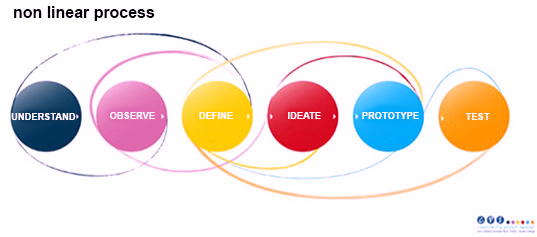
At any rate, trying to make the discussion clearer would be synonymous with making it conform to some particular perspective, the opposite of the goal.
Right — Do only nutty rifraff think non-linearly? No, this illustration is taken from a lecture on how to do design thinking. You circle the territory in different ways. And acting on all this is in the loop, as well as cogitating over them. Revisiting ideas is a key to success.
Origins: This behavioral initiative opened in 2006 with wondering over two aspects of what Steve saw going on:
- The problem of engineers needing to be open to a design process like pictured above. The start of design requires a certain self-abasement because you are fumbling in all six of those areas. Trial-and-error is a skill he felt he didn't see done intentionally, among undergraduate CS students. Instead, there was a sort of pecking order of pride, based getting the right answer the fastest. This audacity was mostly due to coding skills and, probably, nudged along by the way students were differentiated in their classes. Software students jumped into the nearest seemingly applicable solution mode, five minutes after hearing what the task was. Coincidentally, they didn't do much design of realistic products until their senior years, at which point they often failed to come up with anything with value, as seen from different directions. Like, say, the customer's direction. They hadn't had a chance to fail, on the way there, unless they weren't doing well academically. And,
- The issue of inclusion of more kinds of hoi polloi into his field, software development. Our diversity is not great, and this could be associated with the reception women and minorities get when they try for a late start into programming, as first year students, merged into the social hierarchy of those with existing expertise. We also are not attracting citizens into software development who want to do this for some other reason. These people who have a broader range of interest would greatly benefit our core students, whose highly focused interest is just programming.
 Left — Software design is like any other engineering or artistic design, in that you start out lost in a maze of expressed requirements and ideas, trying ideas that might work. See the rolled-up alternatives on her right?
Steve began to think it’s almost impossible to fix these problems, so long as we faculty are members of the already successful, “in” group of software engineers. Indeed, don't professors have the most pride of all, in a CS department's Platonic scale of worthiness? When admissions officers introduce us to potential new students, they darn near whisper our names to them. Might we be part of these two problems?
Ten years ago, Steve guessed one has to discover how it feels to be “down and out” in order to be helpful in solving the problems. One must adopt the self-abnegation desired in students, to change these traits. For problem 1, they had to see it demonstrated by us, for it to be believable. For problem 2, it also could be instructive to see first-hand how one is treated by the rest of the elite who value criticality above all else. What had we been missing, in our lofty role, as kings of the ivory tower? What's the opposite of a semi-deity?
Putting the awareness issue another way, Foucault says, "...since Kant, the role of philosophy is to prevent reason from going beyond the limits of what is given in experience." Computer science professors are there largely for their supreme rationality. So, they are among the most likely to not be concerned on things outside their personal experience. That includes being women, minorities, or poor students of computer science. It might sweep in, as well, dealing with messy, irrational, product-style software issues, if they are pure academics.
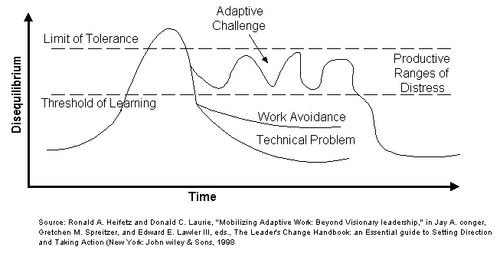 Because Rose is a good teaching school, we believe that deep learning by our students has to be experiential, not just told-to. The same is true about the insights we come into as faculty.
Keeping students' careers first: Steve already had dabbled severely in teaching that was very good for students, but they may or may not appreciate it at the time, and often took that out on him for not following their expected, transactional flow of educational experiences. Steve already wrote of team teaching, in his section called "Make the 'how' transparent," above. Having two or more sages in the room, commenting differently on a subject, ruins the smooth flow of learning that leads to success on the mid-term exam. It makes them stop and decide for themselves.
Right — Here we see the different mindset required to produce transformational change vs transactional change. In Ronald Heifetz's The Practice of Adaptive Leadership (Harvard University Press, 2009), these are characterized as Adaptive Challenges, vs Technical Problems. If students are accustomed to the lower amount of disequilibrium created by solving routine technical problems, but the threshold of learning for social change requires a much higher level, they're going to be grumpy, especially since the latter persists for a very long time, not following the expected tail-off. Their opinion of a professor who instills this in them will vary all over the map, and not necessarily be high if it's an unusual experience for them.
Part of the lumpiness, in the progress curve for adaptive challenges, is since you are trying new twists, as in using a fresh technology — that fact makes a "technical" problem into one of these! Part of it is because the solution relies on those outside your control, say, a new customer. The worst mistake, for a leader, is treating an adaptive challenge as if it could be made into one that's merely technical. Like, "Let's just build a system for that." Sound familiar?
The "work avoidance" tail shown in the graph refers to the ways we try to escape the disequilibrium of adaptive challenges, in the curve above. Tricks invoked for that ploy include "denial, scapegoating, pretending the problem is technical, or attacking individuals rather than issues." Sound familiar?
Since he does this humility gig regularly, here are three more examples, before we return to problems 1 and 2, above. They tie-in with Steve's long-term teaching philsophy, already sketched.
An earlier experiment in mortification — "solution researching"
In his first few years at Rose, Steve already had tried emulating the struggling student, showing how to work through seemingly insurmountable technical problems by trying different paths with tenacity. This first exploration had had notable outcomes:.
- In class, some of the more advanced students assumed it had to mean the teacher didn't know how to work the problem, even though the eventual outcome of trial-and-error, suspiciously, was almost always a success. The only game they knew, apparently, was proof of excellence by seemingly effortless problem solving. Some tried to rush the flow along by contributing the right ideas immediately, even when asked to hold back. Possibly this was worse in that the US definition of "smart" leaves out tenaciousness in favor of instant arrival of the right idea. Grit is not required for glory.
A memorable childhood experience! — In grade school Steve found the two step process of "borrowing," in subtraction of fractions with the same denominator, to be awkward, and searched for an alternative to first adding the denominator to the numerator of the minuend, then deducting the numerator of the subtrahend.
Playing stupid about it, by ignoring the already-known way to solve it, he discovered you always got the same result, if you first subtracted the two numerators the wrong way, then subtracted that from the denominator. This was technically easier because you worked with smaller numbers at each step, and both operations were subtraction. Example:
5 4/11 - 1 7/11.
First do 7 - 4 = 3. Then subtract that from 11 = 8. So the 11ths part is 8/11. The rest of the problem is done like usual. You can easily write a proof that this inevitably works.
Result of describing this success to his teacher was a parent conference where everyone was advised to stick to the standard ways of doing math.
- Those actually in need of such help benefited. If they were in fact interested in the subject, at least. If they were only in it for a grade, they were waiting for the final way to "plug and chug."
It was fascinating — as if the whole system here was designed to turn out humankind with ready expertise on solving known problems! The speed at which material was delivered didn't help. Nor did everyone's reluctance to include reflection in the technical curriculum. Understanding deeply how you had gotten the right answer was not as important as the act of having done it.
Steve extended this "solution researchng" style for another reason — so as to make students aware of how it feels to problem-solve in the world of building legitimate products. In a summary of that effort, which he once put in an email to his department head (and reverting to first person for that quote):
I’ve always taught so as to show my own real problem solving in class, the way I want my students to model thinking of doing that on tough problems. And I pose questions which are curious and important, even when I don’t know more than an informed opinion about the answer. This leads students also to work as they truly
would on the job, taking on novel things the way we usually do in new software projects. It contrasts with doing only points in class at which we have full expertise, having students trying to model a teacher who appears to know almost everything. Since half of software projects still fail, the first way is very realistic. But, it also leaves students with the same lack of certainty over the class that they will have about their work, throughout their careers. My thinking is that Rose properly ought to have at least one person who acts this way in class, so students are ready for it, even if their professors don’t want to risk that.
Steve doesn't give up on good ideas easily, regardless of the reception. The pin board by his office door currently features a "Let's be incompetent" poster, dangling the idea out there as "the path to learn new stuff!" Helpful quotes on it are taken from Ronald Hefietz's book, already cited. The associated image is Forrest Gump.
The name "solution researching" was morphed from William M. Peña's Problem Seeking book, which we used widely at AT&T, as a guide to building large systems. It comes from the architectural world in the building trades, and Peña was a leading designer at what is now HOK. His book name hints that knowing what the problem is is an art form, not what the client writes down and hands to you. The "function, form, economy, and time" dimensions of a problem, which we still teach at Rose, are in that book.
Also contributing to this choice of terminology, Steve's dissertation was in AI Search, where finding an ideal solution typically takes exponential time.
Left — Heifetz and Laurie's methodology, for handling difficult problems, is shown. Note how, in contrast to solving a simpler, "technical" problem, the response for an adaptive one is a step taken under risk, not a direct accomplishment of "the solution." In some ways, the proper direction is the opposite from what you'd do in simpler situations, such as exposing the organization, rather than protecting it.
A second pedagogical trial — Gestalt
Since arriving, Steve has been teaching at Rose with a more Gestalt style, akin to what we just described here for design, and for the reasons noted. This fit with Steve's announced teaching philosophy (described toward the top of this home page). It also fit with his own preferred learning styles, shown below, right. Note the value on the last scale. Finally, the approach fit with complaints by spokespeople for the software engineering industry, like Tom DeMarco, that we needed many more global thinkers in the business.
As one dimension of this trial, visuals used in class did not necessarily resemble PowerPoint slides with bullet points, but, instead, puzzles with knowledge coming from multiple sides. The "How do we make new stuff?" image, under "Philosophy in Motion?" toward the top of this web page is typical. The goal was to explain the more complex systems and relationships which are in the nature of design work. Some students got this readily, some did not. Taking such combinations slowly helped those accustomed to six ordered thoughts on every slide. Edward Tufte was Steve's model. Another example is the "Swiss cheese" visual, under "Ethnographic growth." You can deduce the issues of having a vast problem space, including aspects not discussed much with a client, from just staring at the image. At left, here's an additional example!
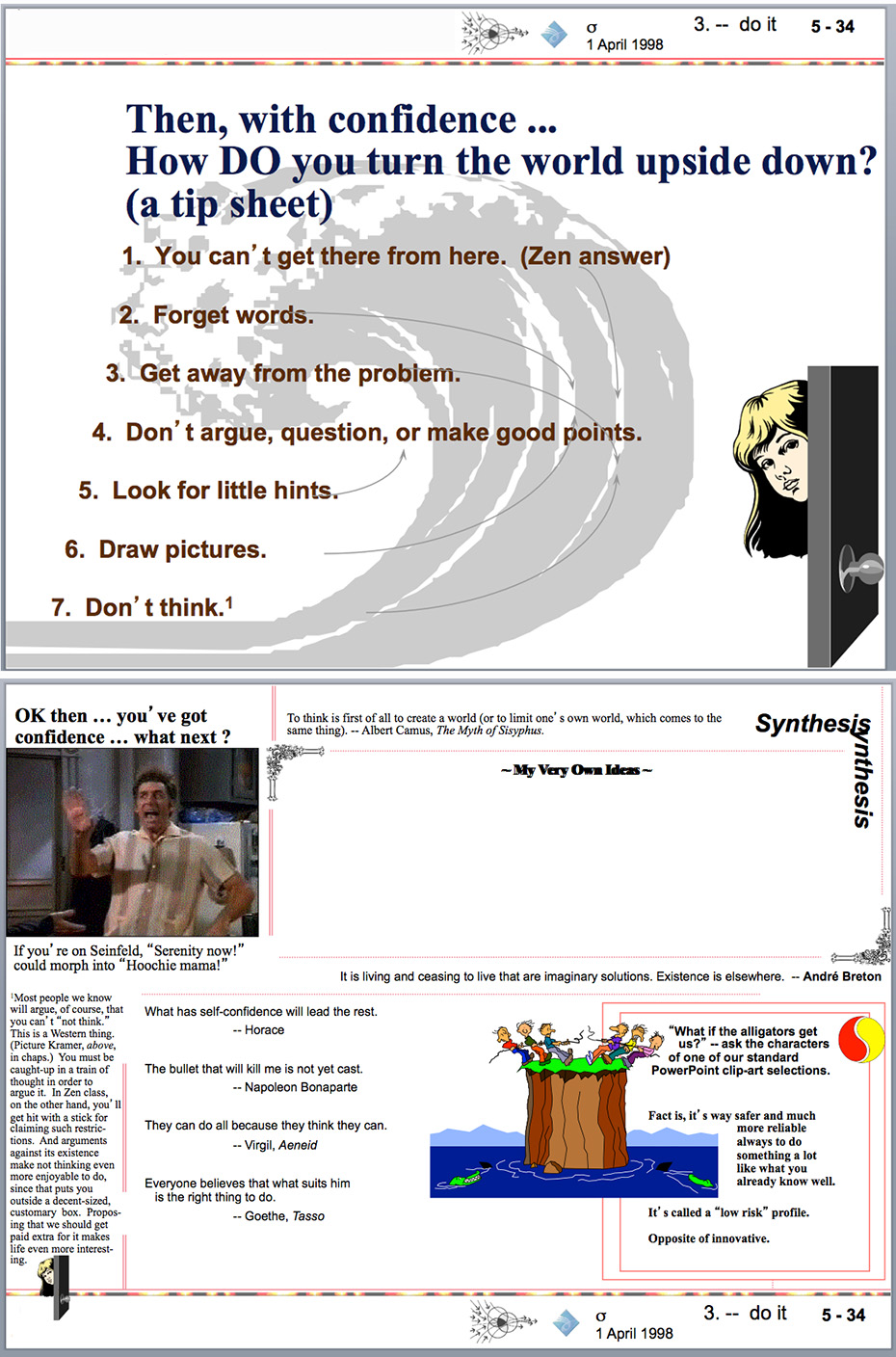 |
| Above — a more ambitious holistic try at visual empowering of class activity is shown above, from Steve's more Lucent days. He and colleagues decided they didn't have enough real estate on regular PowerPoint slides, and so included, in student handouts, a highly decorated notes page to go with each slide. Like you see, these were set up so as to be facing, as the class went through the material. The notes page included a place for the students to contribute their own ideas, explanations of some of the slide points, as shown, and extensions of those points. The presentation intentionally violated the regular rules for slides, such as avoiding clutter, sticking to one concept per slide, and designing them to make the flow of discussion obvious. |
One outcome of this was that students, on average, regularly marked him significantly lower on, "The professor used teaching methods which helped me learn," on course eva
luations. This often was accompanied by comments about how they didn't care for circling the territory during class discussions, like shown in the non-linear design process, above. As usual, that spilled over as an influencer on other comments. In the readout he's looking at while typing this, one student lauds the professor's enthusiasm and caring over their learning, while the next calls him boring. This is the type of reaction you would expect with an abrupt change from what students are used to.
Which does not mean, Steve maintains, that such adventures are wrong, particularly if they help move students from the high school / math class methods of learning to the more abrupt, discovery-oriented ways they will have to learn new material while working in the software business. Preferred learning styles, like shown for Steve in the figure, tend to vary over time, depending on what you are doing. We do adapt, and need to. Students have to grow out of the sequential-thinking mode of coding, into design thinking. That's what they will be getting paid the most for.
One of Ronald Heifetz's favorite expressions, for solving hard problems, is "Get on the balcony." I.e., Go for a bigger picture of what's happening, and spend time just observing.
 The overall look and feel, financial bottom line, and other strategic advantages of a product are what clients pay for in products we engineers create. Learning to understand them at that level, versus at the level of individual pieces, is crucial to Rose graduates' having greater value in the industries they serve. They need to wax holistic.
Left — Landing page for Interactive Intelligence, a major employer of Rose's CSSE graduates. How do the products and services they help build for IN-IN contribute to the overall image and value delivered by the company? How do these look like they are a part of the same tool set as what others are working on at the same time? Or, indeed, what strategies are used to ensure easy interoperation? This is Gestalt stuff, not a checklist.
A third dip into humility — "fail fast"
Steve follows the recommendations of employers like Google and of today’s leadership theorists and educators (e.g., Kouzes & Posner, or Stanford’s Tina Seelig); he focuses on teaching students to fail gracefully at risky projects, and learn from that. You can do this in many ways. Shouldn't we exchange notes on it??
In CSSE 375, Software Construction and Evolution, Steve and Tori Wenger (who was then a Visiting Professor, from Rockwell Collins) gave seven teams of three students opportunities to contribute to SourceForge projects. The goal was to get changes accepted back into the code base. All began optimistically, with very sizeable plans. These were progressively reduced as time went on. In the end, one team had gotten down to the level of adding comments to the existing code. All had underestimated the difficulty of getting their changes accepted, and only one was successful. Tori called it "the best experience they'll have here at Rose," and the students hated it for the sake that they had not been able to complete the targeted projects.
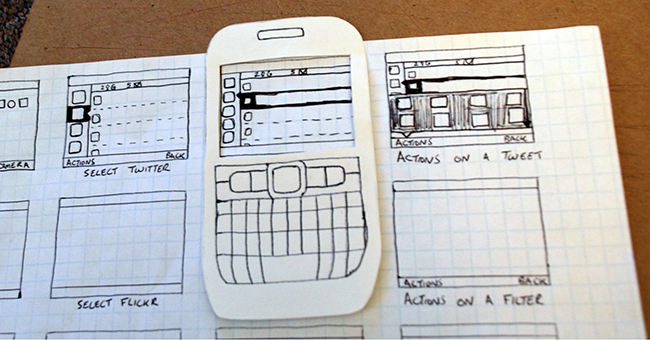 There’s absolutely no guarantee students are going to say they liked such "non-Rose way" difficulties immediately, even though they will come back, years later, and agree with Tori. Steve doesn’t expect to see a 4 out of 5 on course evaluations for such endeavors, no matter how effective the teaching was.
Our students’ whole educational history has been to equate learning with success, not with a flop. Their equation is not true, but they’ve been taught over and over that it’s true. Their hunches and feelings are tuned that way. Even mixed or indeterminate project results, like they get throughout the year in their junior and senior projects, don’t feel good to them. They don’t like fuzzy outcomes. They came to a Rose-Hulman where, as one local politician put it, “Every question has one right answer.”
A part of "solution researching," failing fast also is an art form. It has to be done carefully, because each trial does cost you time and resources. Experience helps you gain smarts on doing it. For an engineer, building that experience while in school is a huge edge. As one alum from SEP said, observing us providing this in a class, "You mean, they don't have to wait and mess-up the first time, while we're paying them?"
Right — Paper prototypes are a great tool to "fail fast," and are now a standard for initially showing smart-phone-based app ideas to customers.
During the time Steve first taught this to a dubious class, a dozen years ago, he had an alum come talk to them the same week. One student's question for him was, "I bet you don't use paper prototypes, do you!?"
As with Heifetz's recommendations, at the heart is picking smart risks to take, and having disciplined ways to assess these. In software, prototypes try to verify first that the hardest parts to do are feasible, such as that a chosen technology will work for a planned application. In Steve's software architecture courses, the "project" usually was a series of such tests, to improve a given system familiar to a team of students, based on the theories and heuristics presented in the class. Teams rarely achieved every gain they set out for, but they knew why their chosen approach worked or not.
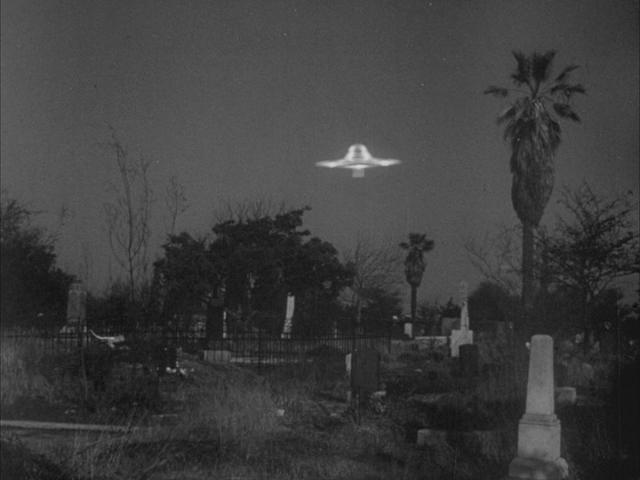 |
| Above — Saucer hovers over a graveyard in Plan 9 from Outer Space, widely regarded as the worst movie of all time. |
The new initiative — enter class via the exosphere
In all three of these earlier cases, it was more important, to try learning approaches that students needed to begin understanding, than to cater to their existing preferences. Little doses of humility were involved
And, Steve thought of a similar angle (to wax geometric), a crutch to help see problems 1 and 2 from the other side.
Another school tussle from Steve's youth — His fourth grade teacher was trying to lead a discussion by calling on students, and one protested he knew the answer but wasn't able to put it in words. The teacher chided him, saying that, if you couldn't at least get this far, you weren't even thinking. The thing distinguishing us from animals was our use of words, and nothing else counted. To her, we thought in words. Even then, Steve guessed he was more visual than verbal, like you see in the above image of his survey results. What about the other business going through our heads, like those images, or intuitions and emotions, or figuring out how to do a back flip? Did Rembrandt have to use words to paint? Should Steve feel inferior for not verbalizing every Gestalt recognition? How do you tell your fourth grade teacher she's wrong? That's the point where Steve got stuck, on this problem. |
He set up an experiment, using himself as the test subject. He guessed that he could invent a minority, one that hasn’t been very visible to us at Rose before, but which, just by diverging, would become the point of criticism by engineering students (and maybe colleagues). Someone floundering for acceptance. He made progressively more serious tries at this. He was betting that he could become an object of controversy, at least, and perchance scorn, just by being different enough, even if it’s in ways that were new to everyone else. In summary, he was hypothesizing that simply "being different" would be enough to cause shunning. And students would invent reasons for doing so.
Why something novel? For one thing, as a designer, this was appealing to him personally. He also was curious how students would react to "one of their own," a geeky professor, taking on attributes of other groups. The opposite of those who come here from dissimilar cultures, and try very hard to look and act like us. Why do they have to do that? Surely, it's not entirely voluntary. Was the gauge for acceptance here so narrow that all sorts of divergences would be rejected out-of-hand?
He came to recognize, in trying this, that, most importantly, not walking around as an easily saluted sage on the stage would have one additional benefit. It would leave him open to understanding more of his students generally. Like his intentionally fumbling with problem solving, he could connect to the ones who don't get it, since they thus carry a lowly status. Or to those also tagged as social misfits, including students with diagnosable mental issues. We would have the rejection in common.
One of Steve's students just dropped out with a condition that prevented him from studying. He talked to his advisor and to Steve, the day he left. He had trouble discussing his situation, as often is the case, but he was getting help. Social issues complicated the academic ones, as usual. He had let down teams he was working with. We are not psychologists, but it does help if we have a way to empathize. We have to come down off our professor perch to do that. Already being there helps make you accessible.
It opened with a hunch
Back in 2006, Steve felt that if, out of that self-deprecation and whatever associated hassle, he was able to lead more successful, realistic-looking student projects in his classes, eventually the existing, socially stratified recipients, based on their goodness at solving closed-ended problems, might get it, an improvement for problem 1.
He'd gain from this personally, because he'd be able to feel what it’s like to be on the other side, not in the “geek” in-group. He'd very likely understand a lot more of why we aren’t attracting and keeping other kinds of people in CS. It could be an advance on problem 2.
You might ask, is it possible to teach useful junk successfully if you are playing a non-traditional role??
Well, yeah! We see this all the time. Engineering students will claim it's a problem, and they might not give you high course evaluations, but their learning is most likely to be the same as if you were a standard-issue geek, on account of so many other factors are in play shaping learning.
It's not clear, as well, that asking students for their generalized opinion on this is useful for analysis — their response to the teaching environment over a full course. And this is what we do in end-of-term course evaluations. As always in episodic recollections, the one most vivid memory colors comments in respect to value.
Steve has tested this theory, of the equivalent goodness of diversity, in classes where he and someone else taught parallel sections, used the same testing instruments and a shared grading system. Students will actually listen to someone they don't like or approve of; they are motivated to discover an open channel for their own learning, and they accommodate. We see analogies to this often, like with students who initially don't understand a professor's accent, but work through that.
More enlightenment from high school teachers? — In geometry class Steve danced through the theorems, going along with the program, till he got to Euclid's "Exterior angle theorem." Steve went to the teacher, complaining that there appeared to be an unstated assumption on how the figure looked. Based on prior experience with such challenges, he wasn't too sure about the outcome.
Above — Euclid's proof starts out well, constructing triangle ECF, which can be shown congruent to EAB. But the claim that angle x is larger than angle ECF is based on "observation."
The teacher laughed and said that this problem was what started non-Euclidian geometry, and that he'd bring it up in class. As a student, you never know what kind of mileage you're going to get when you speed after the dogma.
Presenting students with a cultural hurdle is for sure in quality of teaching's "environment" category; it could be accused of going against a positive and supportive one which builds trust. But it is far from being the only ingredient of the environment. Student engagement is generated from setting a wide range of variables in a class. If the teacher and course are otherwise offering many opportunities to dig in, students will respond. Teaching methods, work sequence and load, the style of assignments, tailoring for student needs, interactions with other students, links to long-range goals and interests, etc., all impact whether student learning will be surface or deep.
Steve has observed, in being the point of difference when interacting with students, that they often appear to have heightened awareness because of the off-kilter factor, and he imagines they are learning more, not less, on average. It's like watching Richard Linklater's docu-fiction movie Waking Life, with unforgettable visuals driving what's essentially a philosophical discussion, so that the whole business hangs on the imagery.
There are so many factors at play here, surely the effects vary on diverse students. E.g., Do encounters with strangers raise their glucocorticoids too much, or to just the right level for better problem solving? Only Yerkes and Dodson know for sure!
The literature of what produces transformational learning is ongoing. Depicting an alternative world view to students is certainly in the running. It negates the usual fitting of material into an existing reference frame. Boyd felt an emotional/kinesthetic component has to be there to leverage student change, not just rationality, and you get that with a varying classroom presence. He also believed we need to take the lead in showing willingness to change. To go with it, Steve agrees with Taylor (and Boyd) that the emphasis needs to be on providing the student with a compassionate environment in which to do their own new explorations. The point is their reaction and development. As Mezirow said, the environment has to be "free from coercion, have equal opportunity to assume various roles, can become critically reflective of assumptions, ... and are willing to search for common ground or synthesis of different points of view." Representing fresh alternatives each day keeps that variable mix in the stir.
Prepping them for real social complexity: Steve's "hunch," that working with lower status would improve learning, also tied to the very unrealistic higher ed factor, versus industry, of having an ever-reliable professor in the room. Occasionally in their careers they will run into a know-it-all boss, but everyone understands we just put up with them, even if it's Steve Jobs. Why wouldn't they learn as well by working with someone who appears just slightly ahead of them, like a productive tennis partner? Today's software teams are truly flat; anyone on the team can be "the expert" in some aspect of it and can question seriously the judgment of the nominal leaders. Our students will be used to hearing gospel when they arrive at Rose, but they equally must be ready for this contrasting social arrangement when they emerge into the software world. We needed to model what those lesser high-up leaders are like, so our students would grow into them!
Left — Here's the first image that came up, on Googling for "standup meeting." This is the daily dose of shared leadership for Scrum. Can you even tell who the "Scrum master" or "Product owner" are?
Again, Rose students would not be used to this switcheroo, yet it would be good for them. It might be essential to their future success. After all, other schools believe they can "punt" on social skills like teamwork, and we know they are wrong.
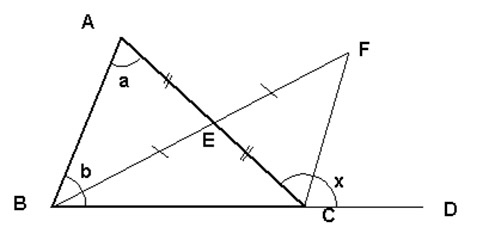
Does all this make Steve's initiative "authentic" for students?
Let's explore...
Sidebar — Is it "Authentic"?
The idea of Authentic is so in vogue that everyone resonates when you just say it. And, perhaps, we agree on some of what that means. For example, when you travel to Thailand, a native dance done by a tribe out in the country feels more authentic than one done in the lobby of the Bangkok Hilton. Or, the food from a mom-and-pop diner is more authentic than the food from the next-door McDonald's. And some students choose to go to a smaller college where they will get more personal attention, and the experience thus promises to be more authentic to them.
So, the term is used both to characterize the nature of experiences and also the nature of the what's producing them.
The original meaning was legal, like was this somebody's true last-will-and-testament? Or, was that an original Vermeer hanging in the museum? In the 20th Century, existential philosophers took over the term authentic — more on them, next column.
Above, right — Tim Jenison stands next to the painting he did, to prove his theories of how Vermeer achieved such realism. Does that make it "authentic"? In a way...
One has to be careful to distinguish between the feeling of authenticity, of being touched genuinely, and the authenticity of the thing you are experiencing. For example, a great pianist or singer may be conveying a very emotional message to their audience, which is felt to your roots, but that does not mean, at the time, that this is what the musician is feeling, even though it looks that way. With acting, this is even more obvious. Marlon Brando, who felt like a corporeal gangster in "The Godfather," was a "method actor," trained in how to do that. So, maybe they are feeling what you feel on the other end, or maybe they are just good at knowing how to make you feel that way. Musicians, actors, and teachers argue over which is better.
In engineering education, a part of the authenticity argument is "How much the instructor needs to know the jobs they are preparing students to do?" As in, do they have to have done it themselves?
Another piece for us is, "How much does the subject you are teaching have to be based on first principles?" to be authentic in that sense.
And, the question of being personal to the student has a special edge for us, too. Society, whom engineers serve, does not care so much that you get high personal value out of your four years becoming qualified, as they care that you thereby know how to build tools correctly which they will use!
This is a specialized version of the general question, regarding how much college students should be allowed to be anti-social in some sense, on the way to "finding themselves." We tend to have different views of that, depending on whether they are acting out against our mores and folkways, versus doing so in China or Iran.
The companies who hire our grads have their own view of authenticity. To them, the grads are much more desirable if they have "intrinsic motivation" to do the work, as opposed to just wanting to do it as a job. So, the companies look for traits like our students doing coding projects on their own time, not due to its being for a grade or for money.
The authenticity question comes up with regard to humility, like, "Could Gandhi essentially be famous and humble at the same time?" We address what it takes to be gentle, below.
Or, if being authentic means being true to yourself, can you be unpretentious at the same time as that? Sounds like you are asserting yourself, in what could be seen as an obnoxious way, the opposite of servile!
So, what do we do with students who come to Rose for a more heart-felt education?
Steve argues that the trendy goal of authenticity isn't achieved by giving learners more of what they are used to, even if they believe it is and feel more comfortable with the respectable. When stuff is familiar, we make assumptions that it means everything we've already internalized on that sort of incarnation. We don't give it a second thought. True learning is about rethinking, way down there. Enjoying your studies, because they fit well into your existing world, is a different and likely confounding goal. Too bad that's what we often measure as "quality."
Presenting students with realities which shake their world, in contrast, goes right to the delivery of personal authenticity to them. By challenging what they already are and know, they have to dig to find new resolutions. We want where they end up also to be personal, not just some replacement script we've written for them. But, we can provide the lever to start them down a new path that lets them find a better ending spot.
In that light, the idea with jolting students, by confronting them with social realities they will face in their careers, fits right into an authenticity agenda.
Watch out — Honest sages on stages:
Before it became a marketing fashion, authenticity was an existentialists' term for being true to your own spirit. Let's pick an example...
Consider for a moment some religious path which differs from your own, one that you would feel strongly is not the authentic word of God, say. See if you can agree with Sartre on why that is the case:
Sartre used "authentic" as the opposite of "bad faith," something he saw religious tenets as being guilty of — talking yourself into believing contrivances you actually know are unlikely to be true. Sound like the religion you just chose to discount? Did they found it on "miracles" to separate this shared belief from others, miracles which, somehow, are always out of reach of being disprovable, and often are revealed only to those with sufficient conviction? And, perhaps, trying to justify the framework by talking others into it, too, and by walling-off rabble who disagree with you? If they beat you at a game, is it owing to their being blessed?
Now, since this isn't your own religion, such arguments are easy to see. But, since most of the existentialists were atheists, they would have applied them to your religion, as well. They saw the techniques described as means of spreading propaganda, generally, not excepting the particular religion you yourself favored.
"Bad faith" starts by lying to yourself; then it goes from there. The psychic system letting you know when you are lying is annihilated by the person, to make this whole path possible. You have to become not conscious of it. "It apprehends me positively as courageous when I am not so."
If you doubt that parents can make their children totally believe things which aren't true, the easy path for transmitting absolutes, try Santa Claus on for size. The children, who want to please their parents, help it along with their own explanations. In time, everybody knows the truth, but doesn't.
Of course, Søren Kierkegaard, the father of existentialism, was a Christian, and so was Paul Tillich. But the religious ones wanted to carve out a very personal version, not "adhere" to a standard, demonstrating fealty in the normally accepted way.
This is not to pick on religion, exactly, but to use it as this example. Existentialists would have equally harsh remarks regarding politics and other social institutions — pretty much anything that presses itself pitilessly, from the outside, upon the individual, expecting them to conform, limiting their ability to be "authentic" in a more personal way. Indeed, thinkers like Erich Fromm felt authenticity derived from understanding yourself versus just going along with the wisdom of society as to who you are. The existential movement would have dismissed today's figment that marketing could be "authentic," because it's a definition of forcing values onto people. In general, what is popular is therefore pushed, and would be unlikely to fit the philosophers' tests for authenticity.
In this sense, the greatest authenticity, in a formal education, could be derived by shaking students out of accepting truths at face value. Giving them places to test their thinking anew.
Quite clearly the existentialists were on the side of the individual, versus society, when it comes to "what's valid" for that individual. You might be saying to yourself, "You can't run a society that way!" They would respond, that we don't have to be made to believe socially acceptable versions of truths, and how to behave, are somehow "true" in an absolute sense, when, in fact, almost nobody consistently treats them that way. We just talk a great story and delude ourselves into thinking it's so. Try to invoke fear.
For an engineering school, the pictured example shown here might be considered an almost ideal compromise? Students are doing something engaging closely with society, while being personal about it.
Right — The Edutopia article this image came from cites engagement in real-world problems as a way to achieve authentic learning. Service learning is recommended, seeping value all the way to what you can measure in the community.
How do you know you made a class authentic? You might want to look at Steve's discussion of course evaluations vs grades, up in the section on Evidence-based teaching. There seems not to be a strong correlation between whether students believe they learned a lot in a course, and their teachers think they learned a lot.
It's possible that students have a point, ones who believe they don't learn as well from teachers who look or act differently from the students' current expectations, say. And thus the grading systems we use, which contrarily report they actually do learn well in those situations, including getting deep learning, are messed up.
But the reverse also might be the case — Daniel Kahneman's point regarding episodic memory being inherently faulty could be the truth of the matter, and students are poor judges at summarizing their quality of learning. They are too involved in the process to say what's authentic.
Maybe the jury is still out, on how we even measure authenticity and value.
Steve would relish doing a research study with someone, to throw more light on this!??
And, does it "need" to be authentic? As part of conventional society, what we'd like is that we can get the same intensity of personal experience through normal, acceptable channels, as they would achieve through doing anything antisocial. Or, well, some of us, of course, simply would prefer that they behave, whether they get that or not. So we're divided on the authenticity count, as the existentialists would define it.
Indeed, one view of engineering is that we are predictable cogs in the system, above all else. Goes with the accountabilities to society, described in the left-hand column, above.
It's unlikely, however, that most Rose students come here with the sole goal of ending up in a job with no personal value.
Giving them a wider view, with many examples and options to choose from, makes more sense. Giving them cultural hurdles to consider, among those, fits into a richer plan.
Steve argues that you have to revisit your own underlying psyche to decide who you are, and what you want to do. Having the unexpected be a part of the education is a way to stimulate such revisiting. Is it the only way??
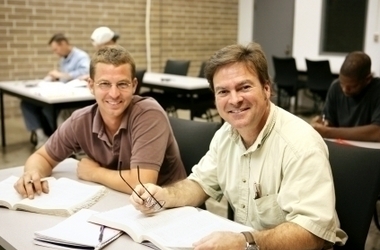 Left — A further experiment, beyond being a non-traditional teacher, is to have non-traditional students. At Rose, they are sparse. How about stirring some older, working students into every engineering class? This could reduce the far-off answers, to how tasks are actually done in the work place, down to turning around and asking a fellow student.
In Steve's department, we are considering a flavor of this: Have an on-campus and online masters in software engineering which would blend young and old.
These two also look like typical engineers, which Steve comments on, below.
In engineering, we've been so intent on toeing the line, in order to ensure durability, that it transferred into our social lives, creating "group think." At many organizations, you wouldn't value anyone who didn't resemble the two gentlemen, above. One guy's doing the standard polo shirt, and the other is only in need of a pocket protector to complete the classic dress shirt version.
At Bell Labs, we engineers didn't even trust our own "suits," since management was known to bring along a contrasting set of values that they tried to enforce. And the feeling was mutual. The managers referred to us members of technical staff generically as THCY's — Technical Head Count Years. Named for our average cost. In a mixed class Steve was teaching, one manager announced the sole reason for company success was their brilliant supervision of the engineers. (Was he taking credit for the eight Nobel Prizes and 32,000 patents?) Steve played some Van Halen for him on the classroom speaker system, in response.
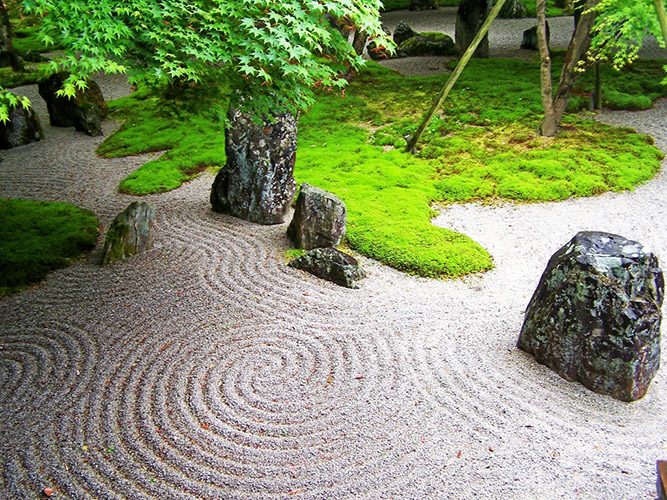 Like in this personal history, divergence of looks alone, Steve thought, would be enough for him to be felt unsound, for a change. I.e., to be considered inauthentic, while actually building new value, getting us to think differently and breaking the "bad faith" cycle inherent in blind acceptance.
As in the vocation itself, in engineering education we discover the whole process is interwoven and bizarrely interdependent. Steps not logically necessary to produce the desired result are clung to. Participants, students as well as faculty and staff, are being tuned to a matching frequency by their daily interactions. It has the good side of everyone being able to act habitually, and magically the work gets done. The bad side is the extreme resistance to change — has to be recognizably the same work, done by the same assortment of people, every time. If someone doesn't turn in a course plan before they start teaching, the whole department could have a fit, even if they never actually review those plans. What's truly important is buried in our long, complex history. Things which show on the surface draw our attention.
Back in 2006, Steve felt there would surely be a lesson in trying to be different. He'd keep a journal. Maybe there would be a paper in it — who knew? Because this was counter-cultural, he'd need a little luck!
Right — A Zen garden "in action," invading Western culture. In this case, on the IFanBoy comic book site, posted by a guy who identifies himself as a scientist. Where once we were careful to pick interests and values blending well with our place of work, our neighborhood, or our church, now, courtesy of the Internet, we can be "in harmony with nature" via this delicate representation dating back to 8th Century Japan. Our students will be that diverse.
Getting to do what you want in college — Steve was fortunate to have profs willing to share their research efforts with undergrad students, and he enjoys now being at a place where profs do this, too. One of Steve's math profs, Donald Silberger, was into finite sequences of symbols. He turned Steve loose on those. Steve proved that if you can write such a sequence, call it a, as both bc and cb, for some nonempty subsequences b and c, then a also can be written as a repeating subsequence, like ddd...d . It's lots of fun knowing you discovered some new math, even when, stepping back from it, the result looks like it should be true!40 Indeed, on reviewing the whole area of finite sequences, Prof. Silberger said it looked like things that should have been proven long ago, but weren't. To invent your own theorems, you can't just make a beeline through known math and then decide, when you fall off the end, what to do next. You must be curious the whole way through, looking for angles that aren't part of the standard stream. You can work such territory using a lot of ego, as you may have noticed, but you also can do it via doubting everything, including yourself. Steve thinks working on situations that aren't already known is where many students would like to be. And this is the nature of what we do building software! |
Why do it, then?
Dealing with the issue of pridefullness goes way back in recorded history. It's not easy to keep from being gratified from accomplishments, or plain old grand over who we are. And, maybe just as bad, waxing majestic over our humility, if this is a trait we're taught to hold in esteem. Monastics and other devout religious folks wrestle with the attitude dilemma. So do those who want to learn about others at a deep level, and who recognize it defeats the goal for you to reside comfortably in what you yourself are. Many of us find that a task as simple as sharing love with a spouse requires detuning our own sense of importance. The job of understanding folks from other cultures demands it. So does the engineering role of knowing, in depth, the non-engineers we serve — the users and clients of systems we build, and the even more varied people affected by those systems. We professors need to grasp our wide range of students at deep levels to transform them via some learning process.
The deal is, understanding and appreciating those who're different, even better than you have been doing, takes more than just concentration.
You have to try to think like them, or act like them, in the same way you might get involved in the characters in a good book or movie. Which requires letting down your own defenses, especially here since this is live, not pretend. That's where the self-abnegation comes in. "Trying harder" for this goal is more like letting up.
But can you do it? It's really hard to be perfect on meekness! Or even good at it. Steve knows he isn't, but he does try, creatively.
 |
| Above — How far would you be willing to go, erasing what you now cling onto, in order to learn bits of personal wisdom normally denied to you? We saw beggars in this very pose in Florence in 2015. She is from the Roma minority, and other Romanian immigrants in Italy are angry that this racially distinct group is giving them a bad name. Lowest of the low. |
One could study for a lifetime how to pull this off. Maybe it's impossible in general, just too slippery an assignment. And high standards are out there as challenges —
- So as to be open and forthcoming toward all, can we get it down to owning only a few possessions, ourselves, like Gandhi? Or,
- Pass along most of what we get as income, to those who have less? (Jesus recommended this one, as recorded in Matthew 19:21. More recently, Bill Gates and Warren Buffett.) Or,
- Give up striving and achieve Zen "satori," to clear our minds as an opener. It is poverty of spirit. You're not elevated; you fall through a hole.
What? Why would you do any such things!?
Well, think about it. You can't just go slumming into other folks' worlds, like Marcello Mastroianni in "La Dolce Vita," and expect to learn much. Giving up what you value now, for the privilege of opening that void to understandings of those people, is much more likely to succeed. Poverty of the soul, or "beginner mind," lets you refill the empty glass with essence learned from them.
Youngsters are bombarded with such tantalizing challenges, by moral sources in places of worship or at home or in school.
At the same time they see models around them who don't act anything like saints, including friends, relatives, and other adults. Those whose pretentious influence, as we know, tends to cancel-out those admonitions to reduce your wants and demands. Less room for the charitable ingredients in our consciousness.
Even here at Rose, it's a tussle of mixed messages, as to how deep into humility is proper: Can we be deferential entrepreneurs? Or, even chief engineers? When we graduate, if we are unguarded, will we get in trouble for telling a customer the unvarnished truth? Servant leadership, where you listen a lot to individuals working for you, does fit in with exerting more influence in engineering, but it's only one of many competing management models.
Steve believes that young people do test how far they can go toward making their lives ego-free, in our college environment bombarding them with messages from all sides. They try to provide for others with service work, giving their time, which is defensibly their most valuable resource?? They have a negative income flow, so the second bullet point, above, arguably doesn't apply. And they make strong efforts toward spiritual goals, searching for answers more than most.
Kahneman and Deaton (2010) found that, contrary to prototypical portrayals of the American dream, we are not happier by making more money. We might think we are happier, but careful reporting on that showed it wasn't the case. It's like people from the West Coast believe they are happier than people from the Midwest, but actual studies disprove it. Applying this knowledge, our students who get high paying jobs aren't necessarily happier, even on average. Out of the gate, they are close to Kahneman's level above which it makes no difference — emotional well-being peaks at $ 75k. So, there's lots of room in the engineer's world to work on other values. Say, humility.
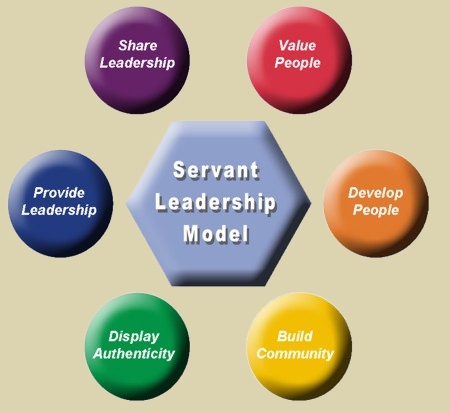 Left — Good aspects in the Servant Leadership model, a role where you can at least be somewhat humble. Looks a lot like a Scrum Master, huh. Yet, a manager doesn't have full control over their persona; they have to play to expectations, from both the top and the bottom.
Finally, there's an ironic puzzlement that everyone else does not appreciate having more sheepish characters around.
They are a pain. Being chums with someone is based on sharing values and perceptions, especially social ones. If someone in your group cracks a joke, you are supposed to laugh, showing you share the bias of the joke. How can you do that social closure, share their conclusion about someone else, say, and leave you still just as open on seeing the someone else in a new light? You are a party pooper. If you go far enough down the Gandhi path of valuing the whole of humanity, you're likely to be shunned by some former friends. You kind of have to choose — Is greater insight, if you even get it, worth that?
Background
Steve used to go to the Quaker (as a child) and Mennonite (as an adult) churches, where members actively seek to lead simple lives, even if this brings on a disagreeable reaction from everyone else. Indeed, to them, one test of whether they are doing that is getting such a reaction from time to time. They see value in doing what they think is more modest, even if they might be persecuted severely. The Mennonites were chased around Europe for a couple centuries; both faiths were among the religious groups coming to America as a refuge. So, Steve has seen quite a number of examples of humans who were willing to make measurable sacrifices, actively avoiding positions of social fame and power, and to maintain attitudes that accompany a more lowly status. Most famously, both these groups were responsible for the idea of separation of church and state; many of their members refused to serve in government jobs, which they saw as de facto positions of control, or to fight in wars for any government, which they saw as the most vicious form of putting yourself on top. They were uncomfortable in many lines of work we take for granted as part of the fabric of society.
In Steve's heritage, trying to be especially humble, for good reason, was not an idea stuck in your head somewhere, or artificially cut off by the need to act in what everyone else deemed to be common sense ways. Moral reasoning went past Kohlberg's Stage 4 (Law and order) straight to Stage 6 (Universal ethical principles).
Right — Mennonites today are split on whether to look odd to the world, as a way to emphasize their divergent values. The long, mostly plain, cape dresses featured here are home made. Every such group is heavily steeped in tradition. Mennonite congregations learned to sing in four-part harmony in the 19th Century, using hymnals with shape notes, and they have never forgotten how. Music is a major part of a service, without the help of a choir. Some groups also have no professional clergy. They try to avoid loci of influence, the director here not withstanding. (They aren't paying much attention to him.)
They are not us: The monk's motto of "poverty, chastity and obedience" is no accident. Self-reminders could be key. It is much tougher to be wielding influence, or even maintaining status, and still see the world from the monk's less clouded perspective.
We should admit that we higher-ups on the social scale also resent the behavioral discrepancies of holy types, in the same way we point out discordances in others down the food chain. Can't the friars just see themselves clear to have one drink with us? Maybe they are the uppity ones!
Good that they are in a protected group, like behind the walls of a monastery. Those intentionally not conforming are considered flakes or renegades, for opting to take a less-accepted role. If there's more than one, they are a gang or a cult. Those in charge are fearful of them, even when they are not an immediate threat; we can imagine this being the case in the future. Being ignored or laughed at is not as bad as this can get for those veering off.
Now, we don't sit around worrying over holy-acting types constantly, that's true. But our lives intersect only occasionally with them. The question is, what do we think when we do encounter them, or when they come up in conversations? Same as for immigrants, lower classes, and other races, and people in faraway places. The more removed we are from them, the easier it is to believe folklore about them.
Teaching social knowledge
We fool one another that social knowledge exists like knowledge of the physical world, especially our own firm opinions, but it's not so. Indeed, in William Perry's growth stages, which we hope our students evolve through while here, they end up at "constructed knowledge," where social sides are knowingly integrated as an intentional act, based on a variety of sources. Now consider how these idea concoctions work in a stratified society. The combination of holding the reins and human imagination is a wonder to behold. You've heard it from your parents, who are charged with your destiny: "Zip up your jacket. You'll catch pneumonia." And, when we butt heads, the masquerade of absolute social truth intensifies.
 |
Above — This is F J Bertuch's depiction of the legendary Phoenix, which rises from its own ashes. The Greeks, or maybe the Egyptians, first envisioned this rooster. It's Steve's exemplar for learning via creative destruction, as opposed to our accustomed sense of incremental building of understanding. Let Bloom fly out the window. Thus the flipped notions presented here, of using humility as a tool for unexpected gains. Learning emerges on its own; you're fully open to it. You got rid of personal impediments, including trying to control what happens. Could the discoveries be any more authentic? |
Disruption of expectations is an especially good example of pride's blindness, in that it produces such strong reactions. We want things to remain as we feel they are supposed to be. Consider the law suits by Caucasians who were denied entry to a college, while someone of color got in. And, in some cases, the US Supreme Court backed them up. A favorite ploy of the powerful is to blame the dissenters for causing them to get angry. Everything has to be the fault of the less capable side, so those in place can continue to feel good about themselves. Foucault wrote a book on it. See here, for an intro. As an example, Foucault asserts that dominance does not like to show itself for what it is. It responds, instead, to the actions of those it seeks to control, substituting reasons for doing so.
A worst-case may be seen in obvious power flipping, away from a social ranking that's comfortable: If you don't like having a black President, you instead ferociously go after everything he does, the whole while claiming that's not why. 'The principle of nested opposition suggests that a suppressed conceptual contention will usually reappear in a new guise." There is an imagined dependence, in this case upon the larger framework of the President's race. It lends unwarranted plausibility to every possible argument against his actions.
You like enough can think of other situations where those with leverage deflect arguments that are to that point, seriously claiming this can't be it. Does everyone do this when they are in charge? Probably! It's part of the test that you are calling the shots, to make up a story and see if it flies.
Picking sides, somehow: If that sample feels too one-sided or political, consider the following alternative: For a long time the metaphorical characterization of an easy college course has been "basket weaving." Or, sometimes "bead stringing." You might ask yourself if it is just a coincidence that both examples are more associated with tribal societies, Native Americans in particular, than they are with your own heritage. Stepping up from that specific, we see all the time the sides Foucault was describing. The social group who feels in charge invents oblique ways to critique the rest, building a case for why the others are persecuted without having to say so in a way that would generate guilt. If one group really is dominant, they can make those views stick, by being in control of resulting actions and communications. Insults for the downtrodden become embedded in the culture, while those issuing them can disclaim responsibility for bias.
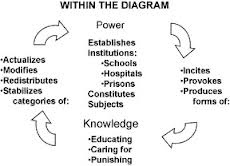 Left — In Foucault's theory, knowledge leads to power, as with Francis Bacon, long ago, but the loop continues around, back to knowledge. Every social group has its own invented version of the truth, but the powerful enforce their version through institutions.
You could argue that inferring motives for those you disagree with could be used by anyone anywhere, and that's so.
If, say, you don't consider racism or sexism a problem in the US, then every bit of reinterpretation of social events, into a racial or sexual formulation, will be seen as an improper transcribing for no good end. Like lawyer Johnny Cochran "playing the race card" at O.J. Simpson's murder trial. There is no position which can't be critiqued from an opposing one.
It also is true that no complex system can explain itself.27 You have to step outside of it to justify it. Which means you must in fact have another system up your sleeve, possibly even messier, which itself isn't validated. For active humility, that larger, riskier system is to listen to what other people think and feel, trying to walk a mile in their shoes. It's an almost vacuous frame of reference within which change is possible.
Understanding how less favored groups are held back, if you are a member of the elite, is very difficult. It requires second-guessing how happenings are explained to function, by clan similar to yourself whom you usually trust. The rulers will rebuff that any reinterpretation of their actions has validity. If you are Caucasian, and a Republican, Steve's example, restating conservative criticism of the US Presidency, is utter nonsense, certainly motivated by something sinister. Or worse.
Wait — This is much easier to see in someone else's culture:
To us, propaganda from contrary countries is ridiculous, and it's hard for us to picture anyone believing it. From the inside, though, it's a different story. For example, Steve's daughter who reads the Russian media noticed that, in a poll, 90% of the citizens in Russia believed that the Malaysian airliner shot down over Ukraine was targeted by the Ukrainians themselves, because they believed Vladimir Putin was on board. Basically, the privileged group is free to make up stories for why results are that way, and to cover for any problems. When at war, like Russia and Ukraine kind of are, the truth takes a holiday.
Which opportunity to laugh at Russians actually comes home to haunt us —We do the same kinds of things, believing what fits into our cultural model, but we simply are not aware of it. One has to step back to another position to see that, a position not just switching to a competing point of view exactly, but a spot where you can see your own frame and others at the same time. That's more of a state of mind than a rigorous intellectual framework. Moves you toward being reserved as to your current assumptions and actions.
Right — Rich and poor in New York City. A typical ignorance of the lesser is depicted. Actor Richard Gere emphasized his awareness of this treatment, when he walked the streets of New York as a homeless person, practicing for his role in the movie "Time Out of Mi nd." In an NPR interview he said,
I could see from two to three blocks away that people were making a certainly unconscious, sometimes conscious, decision that ‘there is a panhandler, he’s going to be bothering me, he’s going to want money, I don’t want to give him any money, I feel guilty for not giving him any money, why’s he making me feel guilty that I’m not giving him any money, I don’t like this guy.’ I could feel all this anger, this swirling of emotions. And, I think on a deeper unconscious level, I could see people react to me like I was a black hole that they would be sucked into, that there was a black hole of failure.
The home field situation
In computer science departments, it is very likely that the dominant group — the professors and their TA's and their star students, exert influence which makes the demographics of the student base what it is. Or, certainly they stir recruitment in service courses, and they impact retention. (Otherwise, you have to argue, Steve thinks, that we are the strongest influence but everyone somehow makes decisions outside of that influence.) This is the start of software careers for our students. We are their encouragement, or the reverse.
Colleen Lewis, of Harvey Mudd, studied the apparent difference between men's and women's achievement in the Berkeley data structures class. She discovered that the sex-based difference could be explained fully by prior experience. Yet, in academia, there is a strong bent toward rewarding and attending to the students who shine the brightest. The stronger data structures students get A's and smiles. Maybe special assignments. Maybe a chance to talk research with us. And, subconsciously, we're not disappointed that the most promising looking ones are men who remind us of ourselves at their age. That gives us more to share. What we have in CS, perhaps, is a heavy veneer of programming logic over a good-old-boys' club. If it is a natural tendency for us to mix academic evaluation with approving feelings and an exclusive group identity, how do we ever break out of that??
 Steve saw modeling other groups as a key to understanding why they are such a small percentage of the CS community.
It's an example of an extreme measure. If he could be one of those rarely seen in the midst of coders, he might find out more on those people's plight when they try to join. And, more broadly, he could discover how it feels to be on the outside of the circle he'd been inside for many moons, in the software business. Being treated as a non-member makes you feel pretty quickly like a non-member.
Any first thoughts of such change likely won't be very gutsy. Say, talking with a Brooklyn accent, or refusing to cooperate on Rose's "Tie Tuesday,"30 or Steve acting more autistic than he really is. Some might not even notice. Gotta go for broke.
A dissertation based on doubt! — Steve's thesis began with the observation that one commonly held belief in AI search was apparently wrong. Namely, that you couldn't in general find optimal solutions without encountering exponential complexity. Despite some well-known theory fitting that belief, when you actually tried heuristic searches, this sometimes happened and sometimes not. Steve and his adviser, Henry Davis, picked the A* algorithm as a target. They were able to show that more aggressive, non-admissible heuristics could provably find an optimal solution in polynomial time. It depended on how accurate they were. Now, that accuracy would have to be pretty high, which sounds discouraging. But, if optimal solutions were plentiful in the search space, this could be pictured as a useful approach. Dr. Davis and his thesis student Anna Bramanti-Gregor went on to extend these encouraging results to finding near-optimal solutions.41 In practical heuristic searches, of course, ones like the underlying algorithms to find web pages for you, "close counts." Optimality isn't entirely required, or even wanted — speed of delivery is equally valued. So, more aggressive searches work pretty well! Steve and his adviser had to fight "city hall" a long time, in this view of how to search, and their theory demonstrating that. One journal rejection, written by a strong proponent of the commonly-held belief, began, "Trivially, ..." |
Due to the sex bias in computer science, Steve feels one of the most interesting positions to learn about in this field is what that looks like from the flip side. (See the graph of the downward trend of participation by women, toward the end of Steve's "And more" table, below.) We men in CS believe that we are sensitive to the issue, doing everything we can, but that's a typical rationalization for the group calling the shots.
While you cannot essentially become a member of some other group very easily, you can push back every possible barrier and give it a try. If you do enough that you can evoke "not one of us" reactions from the dominant group, you'll gain some wisdom of it. You'll know you've crossed important lines when you get dissed, ignored, and discriminated against.
Left — Heading down the modesty path to Milton Bennett's Level Six, Integration of Difference, "a person who is not defined in terms of any one culture," via a sustained effort to become competent in a world others endure. You are always "in process," riffing the ability to do constructive contact among divergent groups.
As depicted metaphorically, you have to empty the shelves of your usual role, to fill them up with alternative content.
Steve did the split image to show that there are no firm bounds of how involvements can be stirred-together. Symbolically on the left, the look is male and hip hop, with a Coogi shirt, and also showing why portly men don't wear horizontal stripes. Symbolically on the right, it's female and Chinese, a straight, Qian Ya Li design featuring birds in flight. As Bennett would put it, these are all "constructs maintained by self-reflexive consciousness."
A close analogy for understanding very different folk is speaking multiple languages. Is that better than knowing one language well? It's hard to say that, because you often think of what you want to say, but in the wrong language, and such. However, you do consider the semantically conflicting choices, which would never occur to the monolinguist. If you are in situations where you benefit from that breadth, say, teaching classes with widely varying people as students, then it's a big help.
Steve's point is to unprescribe the way he teaches students, reaching more of them at a deeper level, especially those who aren't inherently like he is. Finding out more on them is a start.
How it's going now
The ruse of looking different has worked pretty well over several years. It's not easy to summarize the impacts, on Steve or on his students; that varies with the look and with the observer. At some point there's going to be a curious book out of the experiment, but he's still toying with variations, and also wanting to see how student takes will mature over time. It's occurred to Steve that there are benefits which could be verified in some way — student growth from coping with unscripted individual differences, within our protected school environment. Or from nullifying naïve assumptions, based on prior limited experience, that all good software engineers are roughly like them. It's knotty research to verify impacts like that, but he can envision ways.
Suppose it were you doing this...
You can try this flavor of his program, without much risk: If you look just enough different, from your usual and from most of your peers, that it is recognizable, you'll get corrective responses. Like, why are you doing that? You are still in the club, but you are being "dressed down" for having a spot on your uniform. You get a chance to be a little bit humiliated, but not too bad.
Having an acceptable image is part of a subtle sport we all play. We regulate each other’s behavior via surveillance and the internalization of that. In our society, men see themselves as the subject, the actor, versus being the object acted upon. Any reversal of this position is uncomfortable, and all it takes is what Jacques Lacan called “the gaze” of someone else to threaten our male autonomy. Men also use the gaze semi-consciously on women – we objectify them (and women do this to each other). We do it all the time and deny that we do so.
Even humilitier — If you are sufficiently daring to go after a different culture or subculture, you'll see some more amazing reactions.
Stronger departures or idiosyncratic expressions are treated with displays of greater scrutiny and disapproval. And the gazers can become befuddled by truly unfamiliar cultural or individual messages displayed by a wearer. Steve knows he has that effect on many passers-by.
Your home group will assume you're doing it for a special occasion. "Just get back from India?" Etc. If it's clear you are doing it to honor the alternate group, you will get compliments from those whose origins are there. Most students from the majority group will appear to pay no attention at all. They actually are noticing, but they don't know what to say. Since they model what we faculty do on a regular basis, in their heads, they are trying actively to exclude this from that automatic action, since it's too far out. Or, a lot of them are. You can tell from conversations with students you know well. Like, they might remark why they decided not to travel abroad, as they look at you.
You could ask yourself, as you take on a cultural appearance, that question of why most people from far away places don't continue to wear their ethnic clothes while at a university in the US. It could be a sensitive subject, but it's worth asking! Or, for that matter, why many of these immigrants and visitors take an Anglicized name, instead of insisting we learn their bona fide name. If you are modeling their civilization, they might tell you the real reason they are modeling ours.
Above, right — Steve's abaya causes enough office tilt that Hagia Sophia drifts into the lower right-hand corner, reminding him of how intermixed Muslim and Judeo-Christian peoples have been, ever since Muhammad arguably married into Jewish and Christian-related families? The beautiful Byzantine church / Ottoman mosque / Turkish museum symbolizes that continual cultural blending. Unlike Steve's room door for orderly physical entry, ideas from other places can spring from out of nowhere like this. So what if it's orthogonal? Why would a majority anywhere hold that richness back? Can we ever overcome the fear? Larycia Hawkins, a tenured professor, just got leveraged abruptly out of Wheaton College, for wearing a hijab and agreeing with Pope Francis that we worship the same God.
When you assume an inner city look, like Steve did in the left half of the split image, you'll see a slightly different phenomenon. Students who are from there often will delight in it. The Caucasian, middle class majority will simply look past it. What they have learned in school is to not react at all to subcultural differences, perhaps because any reaction is suspect from some quarter, including from their own? Fear of political correctness and in-group critique, all at once.
In the silence you feel a lot, but you have to probe others to discover the unexpressed reactions. Put folks in a setting less formal than the classroom, and they'll say more.
Below, left — Calling Carl Jung! In a dress covered with floating archetypal images, Steve wonders if he can pull off representing conflicting cultural values as well as those universal ones. While working on this web site, and awaiting the next student. He's in motion, you can tell.
Jung was a psychotherapist; like most, if not all, he believed getting patients in touch with hidden thoughts and memories was a key to helping them. A perfect example is his famous Golden scarab story, in which an irrational b ut irrefutable event, presented to a patient, "punctured the desired hole in her rationalism and broke the ice of her intellectual resistance. The treatment could now be continued with satisfactory results."
While learning of the physical world requires heavy doses of systematic reason, learning about others, and yourself, is aided by these incongruous flashes, awakening you to what's going on underneath. Jung markedly favored visual stimuli, like what Steve's wearing here, as openers to latent thoughts, leading to personal growth. Why do some of those shapes look strange yet familiar? Reaching for that has to reveal something! Steve would argue most college students come for the foundational surprises as well as for those step-wise deductions. Students want their education to be "authentic," which surely means discovery of their own interests and desires, not just elaborating on what's in their surface consciousness.
Humilitiest — The jackpot, which surely gets you disgraced, is cross dressing.
Women do it all the time in our society, usually with no marked effects. Say, social commentator Fran Lebowitz. When men do it, you get an extreme reaction. Marjorie Garber wrote why this is, back in the 90's. In a nutshell, it evokes an uncanny reflex, in men especially, which brings to top-of-mind what is otherwise repressed material rolling around in their heads. A lot of reactions you'll get are uncontrollable; it's like you have just become a combination of unicorn and scum of the earth.
To get this point, you have to believe that we do a lot of social acts semi-consciously, that we glom onto individuals as models, and the reverse, at levels we're often not even aware of. You don't have to like Freud's or Jungs' philosophies to think this is the case. Consider dual process theory, as an alternative. When we think and act habitually, stuff just falls into place for us. This also is true of stereotyping. We classify people, and either draw things in from them, or push them away, without much thought about the ethics of doing that. Groups of folks we've been taught are forbidden get these auto-reactions from us, rather intensely.
As an example, think on how many of the "white" crowd in the US, when walking down a sidewalk, pass other "white" people on the right, who are coming the other way, but pass "black" people on the left. To them, it's only semi-conscious at best, and those who do it would deny it's prejudicial. But, to the "black" person, it's surely felt as a conscious sign that you are wary of their difference. This is a prejudicial rejection of the other person, strong enough we feel compelled to express it to them even just in passing. And we can do it all without being "aware." The "white" person continues feeling good over themselves, and still gets to perform this dismissal.49
Men who can keep a handle on their emotional charge, from just mild differences in others, and have practiced looking unaffected by those mild fluctuations, will instead respond in some blurted verbal or visible way to cross dressing. Demanding to know "why you are doing that" is not uncommon. You get to see the exclusionary machinery practiced on you, much more openly than is usually the case.
When you feel the feedback coming at you, it becomes more obvious why women and minorities have trouble being accepted by these very men. You're getting a souped-up version of the same. We men love forming closed groups where the rules and senses of membership are tight. "Who's worthy" is synonymous with passing some test and their feeling a kinship with you. Those they don't get don't make the cut.
So, this is the bonus round of active humility, which must be reinforced by more reactions or it wears off, rather like parents think children need intermittent reprimands on general principles. You, the unmistakable outsider, will be treated in ways that help keep you feeling at the desired level, the level of searching to understand others and their actions, cold-shouldered for no reason beyond your low status. For an honored professor, it's a refreshing rebirth. Cuts to the chase faster than swearing in the classroom.28
In the notes on reactions to it, which Steve's now taken over several years, there is a perceptible link between the status of a person he engages, and their likelihood of using that as an opportunity to dismiss him out of hand. Like, if you walk along Washington Street by Meridian in Indianapolis, you'll get some nods and hellos. The snarky swipes will come, from teenagers if they are in a group, but mostly from the street people hoping for handouts. You are the one person passing by them, all day, who's in an even lower caste. Donate, and it'll go easier on you.
Possible theory? Those who are more secure are more welcoming.
As with wholehearted modeling of minorities, which they appreciate, modeling women, in earnest, mostly gathers a friendly acknowledgment and positive interchange with them. Men keep women down via disallowing them positions of authority, and by refusing to absorb traits from them. If it's what women do, we're not doing it, right down to how you walk and how you hold a glass of water. It is disguised discrimination by directing it at your own group. In the US, men lash out at each other for crossing this line, starting at a young age and unrelenting thereafter. We then pretend that this is not in fact a message intended for women, when it's clearly that they are not worthy to be imprinted.31 Women tend to get this gag completely. They appreciate seeing a man not go along with it, for a change.
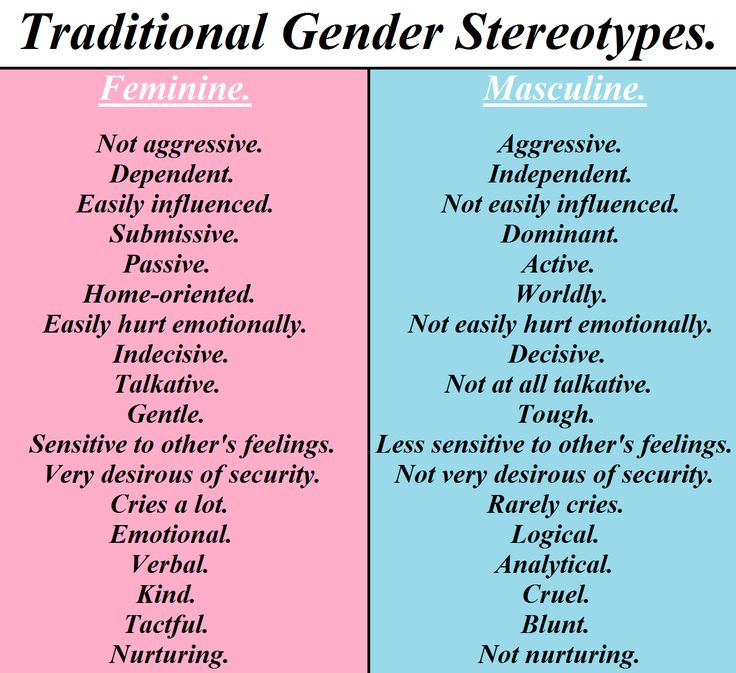 There's one paradoxical group of women who don't catch on, to the reality that the attack on effeminate men is a more excusable way of being vicious toward women. Opportunistically, they will join in, treating you bitingly, as if you didn't deserve the Geneva Convention on civility. A typical first comment would be a sarcastic suggestion as to how to look even more feminine, like what to do with the two hairs on top of Steve's head. It's a pure role reversal; they get to play the man, for once in their lives? Which makes Steve realize how they must be treated, themselves. Does he do that to women, or look the other way when someone does?
What today's adult women were taught, was that they had their own world, especially protected from men, which gave them some dominion, and how they looked was a big part of that. As in, women executives who still list "losing weight" as the major accomplishment of their lives. The fact they didn't have as much power in their traditional role, as men did in theirs, was notwithstanding — they owned something. It was a sexual version of "separate but equal." Steve recognizes that cross dressing invades their turf. Yet it's rather like when men became more responsible on child care. Over time, having more for contrasting groups to share is rarely a bad thing. If men, finally, are allowed to be more like women, perhaps we've crossed another bridge toward equality??
Right— Traditional role attributes for US men and women, which are of course exaggerations. Yet, how far toward the left, even today, can men go before being called out for non-conformance? Or, the reverse, for women? Then ask, which traits are more esteemed in engineering? Or, for that matter, in business generally? Can a woman be valued in these roles, and still valued as a woman?
 This opportunity to create on-campus change clearly supports the LGBT community. It may be the most blatant possible open affirmation that sex role differences exist. A direct provoker of more meaningful discussions, in that it makes conscious the underlying feelings and assumptions of others. Like taking our safe zone signs, such as at left, and flying them as school flags.
It's still a new act. It's a time to board the bus behind Rosa Parks.
A little advice on this particular way to shrink your head —
Cross dressing is so misrepresented and misunderstood in our society that, ironically, it's not a game for sissies. The media play to popular caricatures of it, so, naturally enough, this's most folks' first take on you, that it's some kind of show, say. Their reach for your cubbyhole is bolstered by the fact they can't imagine why anyone would do it seriously. It's that far outside their own realm of allowable experience. And their subconscious is bubbling up as they observe you, because it's a taboo.
We in the US were brought-up to believe that everything sex was binary, or should be binary. The logic, and ignorance of human essence, led to a conclusion that anyone else must be an unnatural freak. Not "authentic." Some feigned to know of a related Bible teaching, backing up purity of sexual image, though few looked it up — it's fairly folkloric.33
Given the wall-of-silence they faced, what a stunner that LGBT people have made so much progress in the West, in the past 20 years! Surely, their heroic decision to go public was the driver. One of the last obstacles to fall is to the in-your-face blurring of sex portrayals by men, aspects of appearance or behavior which cannot be overlooked by everyone else as they interact with you. Men are used to bullying one another, and suspicion of this exact thing (of your not being a binary number) is one of their favored rationales.
Is it the only example of a sex role factor that's been vehemently disavowed by most of the population, based on a commonly shared ideology? Not by a long shot. In Victorian times, only lower-class women were believed to have a sexual interest, particularly prostitutes: "During this time even male doctors were persuaded that women had no sex drive. When a woman did express sexual desire, it was seen as a disease that needed to be taken care of immediately and with drastic measures such as removing sex organs." Sound familiar?
For Steve, the harmless wardrobe unthinkable is the role of choice, to explore how others treat someone whom they have been taught from childhood can't be worth much. You will be the black man of 1950 in their eyes. Or the unveiled woman in Saudi Arabia. But, it's only a time, for this much fortitude, considering you are one of the pioneers making it so.
If you do it at work, as Steve does, which is a non-frivolous environment, eventually large numbers of us figure they must have got it wrong, and become curious about what you are about. Even other men. But...
You have to wait for that — the process takes time and endurance. There's a whole litany of realities for others to try adjusting to, starting with the fact you're like a Buzz Lightyear beyond any men's dress code, a role feature they enjoy supervising. They are ready to play the corporate superego card, worrying over what other people will think. Say, customers — We don't usually second-guess their values, because they pay us money. "I don't have any objection, but... [some actual or imagined person] might." It's like you are tasked to lift-up the whole world's collective unconscious.
If you are protected by your organization's policies, such as Title IX for US colleges, those seriously threatened will squirt their way toward alternative methods and reasons, for taking exception to you, driven by that energy. Amazing to watch the subliminal in its recognizable yet deniable actions. You suddenly realize how fictitious the concept of a "harmless joke" is: The surprise revelation inherent in humor becomes a way for bigots to disconnect underlying intent from the overt message. "Nice outfit. You should wear a sash with it."
Today, as he writes, while getting lunch in the faculty cafeteria, a staff colleague admitted to Steve, with a grin, that she participated in an email list reporting on what he was wearing. She didn't have to spell out that it was for giggles. Steve just listened. She quoted the subject line, which feminized Steve's name.
Heading back after lunch, a student he didn't know complimented him openly on the day's Aztec skirt pattern, and they moved to a discussion of final exams. His difference was a friendly introduction.
So, one didn't get it, but one did. Steve's in this for the long haul. See the green box, below, for what he journaled on this mid-day adventure.The food line event reminded him immediately of an AT&T sensitivity training session a couple decades ago. Some of the attendees had been sent for perpetrating incidents within the company; they were mixed in with those of us there to promote progress.
It was in the era when US corporations were finally making it clear that predatory sexual practices by managers were intolerable, not defensible with he said / she said. (The controversial Clarence Thomas Supreme Court nomination hearings had occurred not long before.)
One man in this session announced very proudly that, when forwarding rude jokes about women, he always made sure no women would be recipients. He also grinned. But, on being questioned by the facilitators, it was clear he felt this was enlightened. The man happened to be black, which kind of led to how being part of one persecuted group didn't prevent you from unthinkingly joining the attack on another.
Above, right — Slowly but surely, attitudes toward gender roles are changing in the US, as this New York Times Magazine cover attests. It appears our ages-old gender expression rigidity was driven by concerns that are going away, like parental beliefs that they could control whether their child turned out gay, and fixed vocational roles for men and women. With lower pressure to conform, from parents who want their children to be successful in life, it turns out that the kids do try more options from the opposite sex. The article, with the cover shown, describes individual families’ experiences in this trend. See also Kristen Howerton’s “Gender fluidity as the new normal.” As these children get to college, they will need role models, like every other minority.
Let's take an outside-in look at Steve's commissary experience:
To critique a difference, or not critique a difference...
Roles: We humans are a funny lot. The way stuff is, at any given time, feels "normal" and change does not. Consider that, 100 years ago in the US, women weren't allowed to vote, and that was justified, somehow, by the cigar-smoking men of the era. At any given time, those who can do so make up gospel truths, to accredit the favorable position they have fallen into. Or, so it seems to everyone not identifying with them. Severe critiques also can be bestowed on us who supposedly are members of the top group, but fall out of line. They have to continue acting like they deserve to be there, or pretend to act that way, or claim it, at a minimum. Or, equally effective, they punish you for pointing that out.
In this encounter, the role differences were male/female and faculty/staff. We were in the same age group. She's worked here longer. Lined up to get food is a leveling factor because you are standing there to
gether, doing the same things.
_______________________________________________
Signifiers: The context was a relatively unoccupied faculty cafeteria queue. In particular, no one else likely within earshot except the person behind the counter, who may have been a target audience. We were picking salad ingredients.
The two of us do exchange pleasantries regularly, but we don't often interact substantively.
Steve wore the outfit shown here; with the tribal-looking beads and long, straight, Aztec-patterned37 skirt which drew positive comments from a student, not long after. The gold top is not an effort to blend-in with Lisa Vanderpump's crowd, but to offer a contrasting print, to intrigue the observer's eye into resolving the fine vs bold designs, as an intuitive redefinition of what "matching" means.38 His lunch line critic had on a plainer top and pants.
Staring at Steve, she first said, "I have a couple wigs you could have to go with that." He said, "I like being identifiable as who I am." She said, "Oh, you're identifiable, all right. I read 'What's Stephanie wearing today?'" Steve interpreted her smile as personal enjoyment.
_______________________________________________
Signified: This conversation is a flurry of signs being exchanged. After years of practice, Steve has a decent vocabulary for decoding such rendezvous: 39
a. Rhetorical options:
When you are an outlier, should the majority still be well-mannered above all, or may they be politely questioning, or can they just say what you mean to them, and not listen to your version? A propriety lesson instead? Throwing insults, perhaps? Or muttering?
A less vicious declaration of snubbery is via intensive ignorance, like studying your cell phone in response to a "hello." Acts which send such an eschewable message are popular — no guilt, and the blurred volition snips-off any in-kind response.
Steve gets all those reverberations, luckily with positive ones as much as negative.
His most obvious purpose, provoking a fashion discussion, is caught onto by many students, faculty and staff. Every day, some step valiantly past respectful into curious.
Many, he thinks, recognize his underlying motivation, to build acceptance for individuality and diversity, preeminently challenging students to work with social realities before they start a career. These reaction choices didn't make the cut here.
b. Too bad we don't have an accounting from the other side.
To Steve, the whole interaction felt like a tussle over who had a right to define who he was. Some key pieces, deconstructing the encounter, follow:
c. The tagging thing:
Isn't it a signal, how the nonconformer had to be misnamed, pushed intentionally into a more exaggerated position, perhaps so that abuse could feel more justified as it came into full swing? This is not a worst-case example of dehumanization, but the intent to erase was there, particularly as a direct response to his request to be himself.
The majority's effort to define social boundaries, Durkheim style, had to gain a nonexistent clarity, it felt like.
(Consider the analogy of political candidates who first obviously misrepresent their opponent's stance to push it out-of-bounds, then critique that as if it were the truth.)
Above — On "Saturday Night Live," Tommy glorifies how well the show is doing, back during a cycle when it was actually having major problems.
d. The wig is a metonymy, in semiotic terms.
Wigs are a classic part of disguises and, specifically, a symbolic part of the costume for a man trying to pass as a woman. In the stark world of binary sex roles, real shades of gray, or colors, when encountered, are simplified so as to make more sense. A man taking on some attributes of a woman must be trying to transmute into one, versus just the blend you actually see. A 1 who doesn't fit that mold has to be a 0.
The existentialists' objection, to conventionality being authentic experience, is that you feel compelled to do these fittings, ever alert to press readymade molds onto each object, whether they fit well or not. The wig offer exemplifies that. To Sartre, we are all Tommy Flanagan, making propositions up, without ever admitting it, to shape the world the way we claim it to be.
e. The directness vs indirectness:
We see an awesome display of contrasts in "authentic" here.
- On Steve's scale, that's measured by trying to be open and sharing who you are.
- On the other person's scale, he believes " authentic" means the conventional roles you were supposed to assume; offenders deserve to be critiqued and censured.
The two actors, and the invoked email persona, played to these corresponding parts (or so says Steve):
He was being as lucid and simple as possible regarding himself, including his motive for not taking-up her offer, asking in effect for her learning about him.
(For a social divergency, this is the opposite of, say, a criminal crossing the line but trying not to get caught.)
The other person started with her assumption of his intent (in the wig offer), then denied his stated essence, overriding it with knowledge from the email exchange, presumably involving people who speak for existing standards.
The email list, already in place, must have been a rallying point for those standards. In her interaction, she employed it as a tool, to become a more immediate if still inaccessible threat. The semantics of those mystery spokespeople are requisitioned as the dominant culture's version of who Steve is.
Steve would have argued, had he been asked, that the common view of his behavior is founded in myth and media — indirect and unprincipled sources.
He elected, instead, to try to capture all of this story in his head — to max out on observation.
_______________________________________________
Above — For comparison, let's translate this role-play deconstruction to an adjacent domain, the classroom. If you are in a role with more authority, you're inclined to use it, perhaps even wisely. Can you change anyone's strongly-held expectations? How about, as a goal, getting students to split their achievements, vs copping the glory for themselves, in a course where the latter has been the tradition? In this class, Steve used his professor-power to inch students toward better collaborating.
Dec 5, 2003, and the left half of Steve's first AI class pauses for a serious picture before getting on with the business of learning intelligent search. It was the first week of this popular, senior-level elective, known as a test of individual algorithmic skills. A chance to show off your coding in an infinitely deep subject. Swagger was in order, as you can see. Diversity? The one Hispanic student sits alone in front, the one woman alone in the back. It's a somewhat single-sourced crowd.
On the first project, which required inserting pieces gingerly into the middle of Scheme lists, Steve helped debug one of these students' programs, and earned the quip that he "wasn't as useless" as the student had expected. Steve knew the student knew he was new. An opportunistic try at a power ploy.
Amid all these saucy looks, above, can you find the less certain person who cashed-in their chips, mid-term, transferring to Purdue to study management?
A bad setting: The tiered, Old-Olin classroom was a boom box at the time, designed for the truth to emanate from the front, with reverberation, and not for sharing it in simultaneous chat. Even so, we formed teams over the tops of those sharp metal partitions, to substantiate Steve's teacher maxims via joint activities, and to generate mixed opinions on how to go after doing that.
Teamwork signifiers: We had a team debate on AI ethics, and we had team presentations where they got extra points from challenging other teams. Steve made the term project finding every software engineering program on the Internet. Something useful and fuzzier than usual. Several teams discovered ones the faculty didn't know about.
Even the mandatory competitive class game was done as a cooperative process, which was new. Reference the image of the winners, toward the top of this web page, and compare their late-term expressions to these. So, the students didn't get much personal glory out of this, after all.
Some liked it, some not. The 2003 students were not as accustomed to partnering as our current crop. More whose best effort was "parallel play." A few were termed wastoids by teammates. Did they feel the same animosity as if peers were making them do it? Probably some, like the student offering his "useless" thank-you. Most were comfortable with the student/teacher ropes.
The coaxing signs here were all the ways Steve employed teamwork in the class. They worked even though the students' past history and this class's past history posted their own contrary signs.
Conclusions: It's possible to nudge cultural values by this kind of repeated, goal-driven immersion in a new way of doing things, but it takes clarity, dedication, and extra effort on your part! Expect multifarious outcomes, even in situations like this, where you supposedly are in charge.
Pragmatics: Such power tries to disguise itself in alternate forms, which then justify the underlying desire to control, as Foucault said. The anonymity of the list vastly enriches the tactic of opening a gossip channel and, even more, of exposing the victim to it. Their end justifies the means. Or, so it seems to the deviant.
The slippery turf, in the above analysis, is that, since those in control don't want to be direct and revealing, Steve had to second-guess the version of their intent which you just read!
Which, to him, implies they should be more forthcoming.
To them, he bets, the bottom line is that he just should be more normal, and must know that, and so is just being difficult. If aligned better with their proper values, he would feel familiar with those; common values would not feel devious.
Everyone actually gets discriminated against by someone, based on our group memberships, so we each have felt such tricks being played on us. What was your most recent experience?
And, we all play the judgment role as well, sizing up others and what they say. Isn't that "what academia is all about"? In grading, aren't we faculty still in loco parentis?
_______________________________________________
Back to roles: Those involved in the email distribution are likely to be mostly women, reacting to their lifetimes of treatment from men, by dissing a man not adhering to the regular agenda of their "uppers." Steve may even have been among those not treating them with full value, in his normal role. If so, he would be glad to atone. People in the enforcer role vary from being unaware they are doing it, to disclaiming any ill effects.
Since the woman was a staff member, it's also possible the email listing is a crew passtime, a justified balancing of the world from their perspective, having to put up constantly with faculty and managers. Steve suspects this one can't be their only artifact like a blog. Who gives them even more trouble?
Did either of us gain anything from the interaction? Mmm... You be the judge! In a peer-to-peer situation, we like to give advice, but not necessarily take it. In contrast to the setting described at right, nobody's undeniably packing enough punch to shape the other person.
_______________________________________________
A magically contrasting story: Is it possible for we who are mistreated to gain wisdom from it, versus just passing it on, like Dr. Seuss's Cat-in-the-hat spot? Yes! An example of a more reflective response, which Steve observed in a student, related to one of the numerous sexually non-traditional majors in our department. The two were on the same senior project team, and the first student admitted, in a team meeting, that he had never previously been able to call his teammate by her name, but he was going to start doing that. In his eyes, she had emerged from being an "it" to a real person, via their team interactions.
Whatever the source, of his own reluctance to see others as equals, he had stopped the chain reaction of rankings.
_______________________________________________
Comparing contexts: So, the cafeteria deconstruction, above, and the ancillary one for leading a classroom to new values, at right, illlustrate ways that we can use signs to guide thought:
- In the main discussion, a work associate was attempting to provide Steve with guidance via negative reinforcement for what he was doing; but without much luck.
- In the AI class story, Steve was in more of a position of authority to create change-of-mind, without most of the targets feeling overly imposed upon.
While all of the variations between these two settings made a difference in the outcome, the presumed roles of the participants were felt strongly, as the action played out in both cases. In the classroom, the ideology of teamwork was congruent with the structures of power, even though Steve's goal was to teach teamwork, not exemplify it. In the lunch line, however, everyone is on a break from work, and the world is flat. This gave Steve's staff colleague an opportunity to say her peace, but it didn't lead to effective change on Steve's part.
In the magically contrasting story, sketched just above here, we had a student with a prejudicial view of a classmate, feeling compelled to soften that because they were now team mates. He announced that in front of the rest of the team, except for the person themselves who was different, likely so as to hear their reactions. Since it was in Steve's office, that might have helped give him the courage to change his view.
This is the sort of reflective log Steve keeps, recording the history of his novel undertaking.
We learn, in building a superego as children, not only what is right and valued, and therefore expected of us, but also how to treat those considered not to be right, or seen to be less desirable. As in, deserving of punishment, labeling, taking advantage of, and every other form of "dissing." Changing company guidelines, for adults, doesn't cleanse you of all that history, or of the ways you naturally select the unworthy and feel justified in doing so.
Strong side-benefits for Steve: Explorations in humility give you a swarm of ideas:

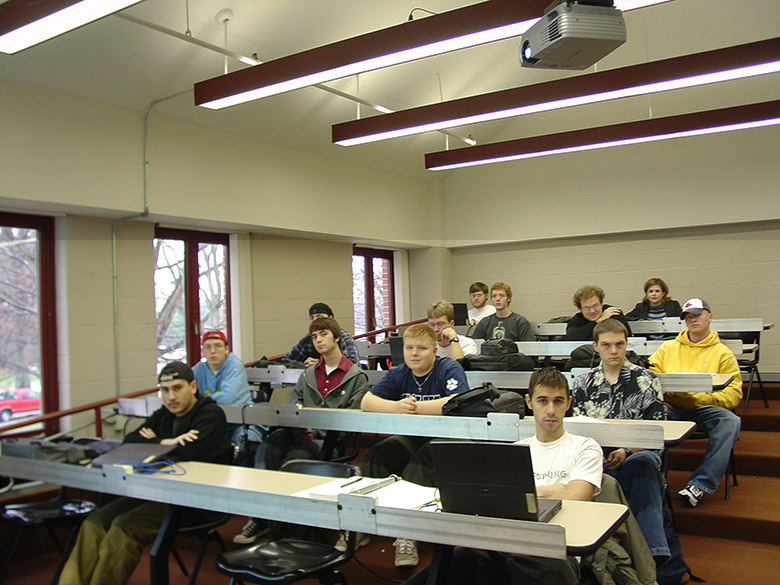
 |
Above — Lane splitting in Thailand. This is a recognizable example of positioning. If you are on one of the motorcylces, it seems totally fair and natural. If you are in one of the cars that just got passed while stuck at a red light, not so much. Can the cyclists ever "get it" from the car drivers' perspective? Maybe not at the time, because cutting in front feels like an achievement. But, if they also drive a car in the same traffic, then they have a chance to gain a taste of higher-level savvy, just from having both experiences. The cost? Probably passing stopped cars now has a slight negative edge, not quite as wonderful. |
- Positioning is a nasty game we all do: One truth he learned fast from the initiative, he's guilty of the same things he was thereby able to perceive in others. When you see it in them, from a new reference point, it ripples back on you. His own list of status-seeking ploys is lengthy. Most systematically egregious, treating students as students. Just because they don't know what all he does, doesn't demote them. It's like, having more money doesn't make you better than poor folks. Or even more interesting...
- Mostly we're stuck in compartments on that: He's pretty sure not everyone is going to accept women, minorities, or anyone else who's contrasting, now that he's seeing the same folks from the other side. There is no way to convince you that damning qualities you've always believed exist, in dissimilar people, aren't so. We can make a dent in our backlog of boiler plating; that's about all. Prior darts you've thrown at others become part of your justification; you are committed by your own history of actions. When we are told "truths" of others who are unlike us, at an early age, we do tend to believe these at a core level. Think of how many other neurons now fire around those prejudgments, when you are an adult! If people you know and respect agree on the group in question, that reinforcement clinches it. And, don't we hang out with the agreeable herd?
- You can tell if you're doing it: He now believes there are criteria for undeserved antipathy, which you can try, to check yourself on that count. How about —
- Negative: "Are you willing to mock some group, by emphasizing or exaggerating a trait you feel they have, which is at variance from you?" Steve thinks that's enough to know you are prejudiced against them. Since many of us do these acts on a regular basis, perhaps we have a lot of work to do??
A possible antidote, for such counterfeit connecting to others, is to imitate them as an honest extension of yourself, in an unpretentious way. That's what Steve's trying out, at any rate, for the sake of growth and understanding.
- Positive: "Are you willing to listen to what they say, as if they were you?" Steve guesses that's enough to know you have overcome being contemptuous of them.
This, Steve suggests, is aided by some token showing your acceptance. A further test is friendly compromise on your differences.
- The complexity: But, of course, the whole question has buried subtleties, as you can tell from sources like here. He just proffered that there were simple tests for typecasting. Now he admits that's a lie?
- Negative: "Are you willing to mock some group, by emphasizing or exaggerating a trait you feel they have, which is at variance from you?" Steve thinks that's enough to know you are prejudiced against them. Since many of us do these acts on a regular basis, perhaps we have a lot of work to do??
What did he miss, as tests that you try out, on yourself and others??
Possible benefits for you: From his background, Steve believes that self-effacing positions do enable you to lead a richer life of engagement with others — You are not busy protecting so much, as you do that. You are not committed to a single course of action on account of what you will get out of it personally, or because you have declared it so. Volunteering to be a member of a besmirched subgroup is the fast track to that situation.
This is Milton Bennett applied to gender, willing to cross borders yourself, to understand those who are not the same.
There must be personal exploration methods, beyond altering your façade, which effect reactions in students that tell more about them, and also reveal their impacts on strangers. If you've tried some, Steve would like hearing of them??
C.S. Lewis felt that "Humility is not thinking less of yourself, it is thinking of yourself less." Alcoholics Anonymous has an almost identical admonition. What do you think? Steve hopes that this advice doesn't remove the obligation to be self-reflective. He prefers Mormon leader Gordon B. Hinckley's "Being humble means recognizing that we are not on earth to see how important we can become, but to see how much difference we can make in the lives of others." That's a more operational definition, don't you think? "Remember your faults and not the flaws of others" isn't bad as a reminder when trouble brews, a place where it counts to be humble. Akin advice is found in GoodReads, the Bahá’í Reference Library, and Matthew 7:5.
Right — Mother Teresa's relevant quote stresses the internal strength gained by humility. A proud position, in contrast, requires constant tending to, distracting you from trying to do more important endeavors.
And for everyone else: At Rose, Steve senses a need to try for humility in as many ways as possible, since it is a necessary ingredient of good engineering, of teamwork on diverse teams, of customer relations, and of education itself. How do we work on this skill??
In Steve's section on "Philosophy in motion?", close to the top of this page, he suggested compromise as an example of a competency toward staying less pompous.
There are more, and likely we each have some we practice regularly. Where can we share these points of personal emphasis? What's the right forum? Since Rose is not a religious school, we are unlikely to reach a consensus for how to go about being more aware of others, through humility, Mindfullness, prayer, meditation, self-reflection, or doing our social discourse in certain ways. There are tips on the web for the latter. Things like:
|
|
The business-related sources like for the above advice are a bit wary of recommending outright meekness, Mother Teresa style, as part of the deal. That violates the drive and self-assurance needed to get work done in a snappy way. What vice-president would promote to manager a person who listed personal qualities of "lowliness or submissiveness," the opening description of humility from the Catholic Encyclopedia? Indeed, one should be aware of the context within which all the web advice is being given. Some goals, like Steve's, are to become more open to groups we have had trouble understanding, in his case, so as to help them learn. Others may be strictly for personal self-improvement, or for some other role like managing diverse groups toward a business end, or addressing a wide range of customer needs. Relatively few are going to have goals a lot like Mother Teresa or Gandhi.
Steve's firmly committed to the path of unveiling new realities to tribes, but letting them make up their own minds what these mean. This aligns with the existentialists' "authenticity" goal, described in the green text box, a ways above. Let them expand their own horizons, and tell us about that. The idea is that free choice beats "steerage." To achieve the mix, of stimulation without domination — that's where your humility comes in. If they react by attacking you, because the fresh thought threatens them, well, that's life.
It could be useful, Steve wonders aloud, to exchange notes.
As he writes this — Last night Steve dreamed he and his wife arrived on a city bus, to look at a much larger house they wanted to buy, an odd combination of circumstances. The house seemed to be created as the owner led them through it, rather like in computer games such as Minecraft. Touring the basement, Steve noticed the furnace was outside, which was immediately fixed by a wall appearing around it. Outdoors, a sidewalk rolled toward the neighbors, and Steve's wife went over to talk with them. Steve saw a sign on a balcony, saying "Poor Entrance," which reminded him of a past era when we in fact did give handouts to the homeless at our back doors. So the dream had a moment where Steve was trying to picture this happening today at a starter mansion. Symbolically, the homeowner could feel good for aiding the poor because the sign was there, even if they had to leap to the second story to receive the help. The argument that "we're doing everything we can," even when results strongly favor your own group, fits into this dream. And, like Minecraft, we can makeup realities to fit our needs, on the fly, without any self-awareness of it. |
Being the lesser: As just noted, a further example, which Steve pursues at Rose, is representing groups you believe may not be in the favor of the majority. So long as one is highfalutin faculty, representing the majority population groups, one cannot understand what students feel like who are at the bottom, either academically or socially. Those who have to struggle for friends on account of everyone preferring others, say. He thinks profs, in general, are far away from this plight. We share in the governance of the institution, hand out assignments and grades, and may have tenure. How can we possibly know how it feels to be on the other side of all that? Students call us "Doctor." It's much easier just to hone our attitudes.
Now let's flip the notion, that those at the top should discern better those falling far below them in status.
It is important also that the latter, lowly group know there are those at the pinnacle who like them, are like them, or want to be like them, who belong somehow to their powerless group. More identification is better. Saying a school is open to a posted variety is not the same as depicting them yourself, on a daily basis. How can we make that visible, so our compassion doesn't just come off as conjecture, unattached to reference points? Can we, oh, portray the student struggling with a problem, at the white board in class, without making fun of them? Or a student in a disliked minority, in a way they would agree is enabling, not problematic? Can we get beyond just gingerly trying the food of an antithetical culture, once a year? If we can't do those larger learnings, aren't we resisting understanding them?
Does this work at Rose? Keeping more sensors out suggests a different teaching style. Steve does not know how all the faculty feel, as to the traditional function of wielding power to stimulate learning, versus the alternative of staying open and not trying to write the script for what students think. Class sessions where you stop to assess how to proceed with different students — these can annoy the students who usually get everything crisply targeted to their particular way of thinking. If you give up on playing a dominating classroom role, so as to listen more, it's a bit scary, especially with students who are used to being told what to do under close supervision. We all see this in open-ended projects, for one. Their uncertainty as to how to proceed becomes your fault, quite likely. Where'd my boiled-down rubrics go?
He thinks the ploy has merit, of trying more to comprehend the students who aren't getting it, versus forming an intellectual phalanx with those who get it the best and are most academically sanctioned. In the same way, abiding with college outcasts and plebeians has an ethical basis. Should we add "tax collectors and sinners"?29
It's possible that our current system of rewarding academic merit and career qualities in students, with applause as well as grades, would be threatened by a change of pace. Everyone benefiting from the way this is done now might feel a loss, by even one person defecting from the academic pyramid program. It would be like stepping out of line in the graduation parade! Yet deviants play a vital role, as discussed in Steve's section, "Making Change," above. Durkheim said we affirm cultural norms and values by showing contrast, we clarify and sometimes change what is right an d wrong, and we give the rest new ways to unify. How can we attack goals everyone else overlooks, say, reducing the cost of education by having students help one another even more than they do now?? Maybe getting the great students to guide the weaker students, taking after us in finding them attractive to be around?
Left — Steve maintains that at least one misfit is needed wherever you go. Or, Robert Heinlein's "A society that gets rid of all its troublemakers goes downhill."
Our Rose grads can't be just a factory output of known quantities, when the world is changing at an accelerating rate. Those running the machinery, who are doing well with realities as they are, should be complemented by those willing to dive underneath the success stories, for a better look at the whole mechanism, unencumbered by a need to stick to the party line. The 2014 article, featuring the commencement picture behind me, was titled, "Rose-Hulman tops list of Indiana students who graduate with most debt."
Note Steve's books are in the shadows here, the students between them and me — likely not helping much to solve this problem. (You have to look through the students to see those books.) One graduating senior in the picture has three or four hands. He's going to need them.
Why not identify more with those in need, to discover ways they can be helped, on their terms? They are equally good people. In several spreadsheet studies Steve's produced, how well students do, in our CSSE classes, appears to correlate insignificantly with how well they do in general, like on their GPA. So, the successful ones are plausibly not, in general, smarter, better at studying, or anything else they might claim as a cause. But CSSE success does tend to be based on their prior experience — like our students who took CSSE 221 first, which was due to prior programming, did better in classes right after that, too. Success there predicted success in CSSE 132, more than other courses forecast results in the next. This outcome had little to do with "ability."
Both how they do in their GPA, and how they do in their major, could be partly self-fulfilling expectations, as much as it is because of their being more scholarly, since those two things disagree. Haven't you noticed those who see themselves as a "B student," and quit working when they get to that point?? Steve believes there is every possibility that students who don't achieve so much here will end up having just as successful a career. For example, going on to something else when you have reached a "good enough" level is how most of business operates. Herbert Simon got the Nobel Prize in Economics for pointing that out. So, don't these "satisficing" students deserve as much attention and esteem?
Steve shares all academics' thrill of having protégés who are super-fantastic, follow our every hint readily, and produce promising works early in their careers. However, our practical value could be like that of a high school coach. They all get a few stars, but the teams win due to the coach's ability to get the most out of the rest of the players. As with our business, the quality of practice is what makes it happen.
Is looking different a good thing or a bad thing?
Sound like a familiar media chant? It's remotely possible somebody can find somebody who can phrase Steve's implementation of a modesty initiative as detracting from good education somehow. So, Steve went ahead and thought of a few reasons why it's a good thing for his students, and a good thing to do while he's at Rose. There are 68 points to choose from here, in case you are dying for a disputation. Feel free to stop by his office ready to illuminate him. He'll be unpretentious in his own position, hoping you can outdo him on that.
Perhaps no attempt at gaining a grip on such relationships is going to be fully successful, but we can try.
Above, right — This is the flow Steve sketched around 2006, for the Active Humility program described in this section. The principal syllogism he anticipated students might derive, in their own reflections, is, "Here's a techie person who talks like me and such, but who obviously is playing a different role. In trying to imagine this, I suddenly realize that I, too, must be playing a role. I must be making a choice, after all. Therefore I am fundamentally like everyone else who is different, after all."
At the start, Steve wasn't sure what it would take, what "goofily" would imply, but he was game.
The top of the figure says symbolically what he wished would happen using the bottom parts. Both he and the students would learn, over time, from new and less tried angles.
The arrowheads were his guesses as to which way influence would move. The figure isn't meant to be precise, just suggest options.
Ten years later, he believes lots of students have tried to deal consciously with his presented conundrum. They might admit to thoughts complementing Steve's intended conclusion, of sharing their sphere more openly. Say, agreeing divergent voices improve engineering outcomes.
The left and right paths shown in the figure are (left) one for the students and (right) one for Steve. He wanted them to act like designers, be bolder and take more chances, looking to his prototype of challenging how work is done. The paths intersect where students would encounter Steve, as he epitomized that venturousness by repeatedly doing an act which was unavoidable to notice, and whose justification most had to struggle to fathom. As in Smalltalk inventor Alan Kay’s advice, that "The best way to predict the future is to invent it."
The two paths are tied at the bottom, too, students getting more out of it by dealing with more variety of interpersonals, and Steve likewise.
Does that sum it up?
As a student: In Steve's looks initiative, you get to see how it feels from the outside, when confronted by someone purposefully and substantially different on an issue you can't help caring about. In this case, an issue where times are changing — When you were a child, one thing was "right," and now the opposite is just as "right."
You will be on this objecting side of the table often, as well as being the proponent yourself. It will happen when others go off in their own authentic direction, and it doesn't see so authentic to you. Steve's configuration is an opportunity for you to see, more clearly than usual, all the reactions, as well as feeling your own, and including unconscious ones that spring out in you and in other people. And so, perhaps, you will have practice at understanding the complex responses everyone else has, to your own new directions.
Generalizing all this?
Steve believes that institutions and organizations he belongs to deserve to be seen from the outside. Like, actually check out what's going on in them, as if you were not a member. How does it look? What are the concerns? Students need to practice this, or they will never have the skill to apply it to the places where they will work. What is it the customers don't like, that we are doing? You can't fix it if you never try to put yourself in the position of a customer. You can't just back your clan all the time, and talk on the defects of your customers, if you want to keep them.
 |
| Above — Slogan of the Gadfly Society translates to, "I think, therefore I am dangerous." |
Being modest as to what you are, in your group, is a decent place to start on it. In contrast, trying to see yourself from the outside, while still defending yourself at every turn, doesn't give you much.
Pulling even more from dreams — We used to live in the upstairs of this house in Dayton, which, in the 1800's, was the farm house for the whole area, and now sits astride a cluster of smaller, post-WW II homes. Steve dreamed they were at a summer backyard party at this house, hosted by their old land lady, Harriet — something she used to do, to bring together her wide mixture of friends, tenants, and business associates.44 All such celebrations have a social purpose, though this is usually unstated, often unconsidered consciously. Indeed, that purpose may be to rise above the strictures of the roles you usually use to associate with the same group! In this way, celebrations can be a deep source of creativity. However, if the boss drives up to his reserved parking spot in his fancy sports car, like Division VP Bill Lumbergh in the movie "Office Space," all that growth potential will be defeated. The party will be mostly to kiss feet, then. So, your mileage can vary, but it is useful to try!
|
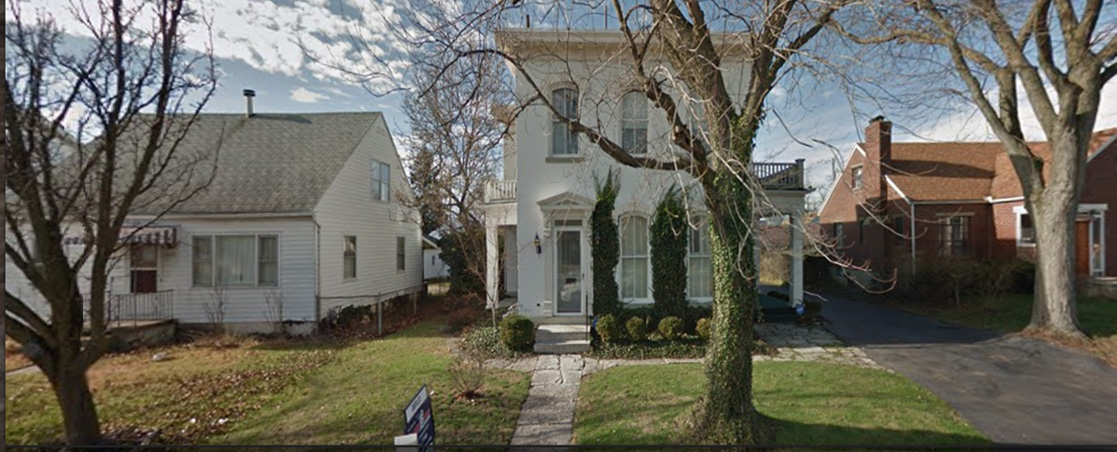
You will discover that most of the groups you're a part of are actually fairly brittle. As Edgar Schein said, organizations believe all that they do must be contributing somehow to their success, and resist change on that basis. Just to pick an example, being critical of the religious group you belong to tends to get you advised of your own shortcomings. It just can't be the institution. Companies notoriously make edgy decisions that don't change them enough, which seem like a good idea at the time, in their existing context. They have a lot of inertia and feel obliged to continue acknowledging outdated values that once helped.
Similarly, almost all groups hold tight to a sort of ethnocentrism as to their overall goodness. And we ignore the fact that everyone else does the same mistake.
Ask the for-profit prison industry, say. How about tobacco lobbyists? Diamond mining? Arms traders? So as not to pick on enterprise alone, how about governments? Is North Korea, say, a definition of insular thinking? You must have your own favorite.
You can see group-think in VW's decision to foil emissions tests while touting the merits of their diesels as a hybrid high-mileage alternative. Or Halliburton perhaps acting above international laws in a cohesive fashion. But, what if these examples fall closer to home, say, iPhones made in a factory with nets around the roof to catch suicide jumpers, a trick once used on slave ships? Product and coporate self-admiration is slippery stuff, even for the benefitting customers.
With academic institutions, one symptom of such unnecessary pride is reinventing the wheel on courses and other pieces of educational programs. For undergraduates, why should each school need their own customized versions with their logo on them? Is each one actually better than the next, as they say? At Rose, we sometimes get dinged by students, for using slides from another professor in the same department. Huh?
The gadfly may be appreciated as much as the whistle-blower, but they provide a service which prevents keeping up perpetual blinders.
We are social animals and we all feel the need to belong to clans. Well, aside from hermits, maybe. But we are now more closely connected, and we humans belong to this huge number of different groups, built back when that wasn't the case, and distance reduced the number of conflicts. Steve believes we need to practice looking at the ones we belong to, from the outside in, to understand how the rest of the world sees them. Humility gives you a window to see out of, toward that end.
How else can you see the paradox, ambiguity, irony, and tension of your own position? How can we learn from our own errors? As Barthes recommended, we need to demystify our own ideas. It's not a search for a single, superior position, ok? It's mostly being flexible on our current position by understanding it in many ways. Work from the plurality of meanings that come from many others and from our own underlying thoughts.
An Example
Google's vast, recent study of teamwork, already cited, listed five factors that made for good teams. "Psychological safety" was number 1: "Teams feel safe to take risks and be vulnerable in front of each other. As in, "Without feeling insecure or embarrassed." They added that:
Psychological safety was far and away the most important of the five dynamics we found -- it’s the underpinning of the other four. How could that be? Taking a risk around your team members seems simple. But remember the last time you were working on a project. Did you feel like you could ask what the goal was without the risk of sounding like you’re the only one out of the loop? Or did you opt for continuing without clarifying anything, in order to avoid being perceived as someone who is unaware?
Turns out, we’re all reluctant to engage in behaviors that could negatively influence how others perceive our competence, awareness, and positivity. Although this kind of self-protection is a natural strategy in the workplace, it is detrimental to effective teamwork. On the flip side, the safer team members feel with one another, the more likely they are to admit mistakes, to partner, and to take on new roles. And it affects pretty much every important dimension we look at for employees. Individuals on teams with higher psychological safety are less likely to leave Google, they’re more likely to harness the power of diverse ideas from their teammates, they bring in more revenue, and they’re rated as effective twice as often by executives.
Which implies that getting new ideas, and figuring out how to run with them, requires ego-flattening compared to the normal modus operandi of the business world. How bad would Donald Trump be on a Google team? The losses would be "huge." But how do you get folks to flip, from wanting to "Trump" others, to appreciating contrasting views so much that they fit on an optimal team? If you use this Presidential candidate as a model of what you'd be up against, in avoiding the pitfalls of personalties, you can see that it's not easy!
Right — Steve tried to picture the indominatable Donald on a Google team, and this was the best he could do, combining such a group in action, and an actual reaction of Mr Trump, taken from a site lauding his honesty regarding diversity. As I write, he's our President Elect. I hope he finds a better face, and facts, for our future.
The last section here explores fundamental ideas for clash-avoidance and the associated personal-delusion-avoidance, and how deep those problems run.
Endless variations
The idea isn't new, of being intentionally self-effacing, to the point that it's clear to everyone else you're serious about it. A couple quick examples from antiquity:
- The main point of Zen is to be nothing, which turns out to be harder than it seems. Having "Beginner Mind" defies intentionality.
- Jesus' call to be "poor in spirit" feels like a similar demand. This is the first group he identifies as "blessed."
The direction of giving up major riches in your life, especially sacrificing who you are, to learn more openly, somewhat goes against our cultural norms in the US, where "blessed" has been redefined to mean having good stuff, derived in the right ways. Yet, the reverse may be needed to overcome the biases that go with knowing you are doing well, especially knowing you are better in some ways than others — financially, emotionally, socially, or spiritually.
The benefit for you is what you gain from learning new directions. It's possible that you just have to change from where you are, regardless of what that represents, to get some of this action going. Steve's only tried this a few different ways, can't speak for all of them. If you've tried two approaches, which are kind of opposites, you gain also the view from above each of those. As in Steve's discussion of ethnographic studies, maintaining an understanding of two cultures can feel like a strong personal advantage. Accomplishing that requires giving up the provincialism of your existing, principle social group.
Above, right — This is Michelangelo's depiction of Saul's conversion to Christianity on the road to Damascus. It's the particular flavor of the story where God knocks him off his horse. If you are a born-again Christian, did you get knocked flat when you were converted? Did you hear the voice of God, like Saul? The horse is probably optional, but you get the idea.
Harvey Cox held that the way we join churches is nothing like Saul's experience. We tend to test the social waters of a given congregation first, to see if we fit in. The "conversion" comes some time later, as an entry ticket, often involving a whole family at the same time, for convenience. Which possibly confirms why churches are among the most socially stratified organizations in the US. It also explains why, in most churches, the number of people claiming to have had a Saul-like experience is pretty small, and the number who don't seem obviously unhinged is smaller still.
 What does "conversion" even mean, to those who've grown up in the same church? The New Testament doesn't deal with the problem that, for them, it's same song, second verse, a personal cost for having been brought up right.
Steve would maintain, out of this discussion, that the low expectations for personal experience go hand-in-hand with remaining very closely conformed to the life you are already leading, especially congruent to being afraid of giving things up, in order to take a chance on a new direction. Pretty sure Saul was taking a big chance, and he lost a lot in the process. Steve sides with the existentialists, on the "authenticity" of experience. It's personal, at the expense of conventionality.
Buddhism and Christianity are equally baffling; there are as many unsatisfying traps within each as there are rewarding positions to attain. Conceivably all religion has this problem? He's curious about yours...
Steve suggests we've reached a new spot when we are each willing to describe, to everyone of a different religion, the deficiencies of our own. The soft underbelly exposed, vs the hard, glittering shell of uniform threat and wonder we usually advertise to outsiders, and dare them to contest it. As in, why isn't syncretism a good idea? It's whole point is to overcome differences.
What's the opposite of killing or shunning apostates? Why are they a threat? Did God make our religions that fragile? Maybe fear of what's not the same as our beliefs, and our clergy who stir-up those feelings (and whose salaries we pay), are holding us back from a more peaceful world? Shouldn't they be the first to greet strangers?
Steve'll start — He knows his religious notions are half-crocked. Wait!,,, Here's a cookbook for that — check it out!
If you even awaken to the possibility of a perspective on your own beliefs, you will come face-to-face with the endless hope that replaces reality, at their core. We are driven by that personally, and we also are used because of that. Consider aspiration's role in our being controlled by both religion and politics. Our imaginations drive our behavior, at least if we are awake! Belief is not this rock it pretends to be, but a figment, varying from moment to moment. And therein lies its beauty. If you are not swallowed by pride, you can feel all that. Half-baked is a state of becoming.
Above — Here's your Fount now, courtesy of Norman Rockwell, in case you need a quick consult. He must be attractive, based on the attention, and there's no shortage of feel-good ammunition; he serves-up treats from the drug store soda fountain, giving the painting its nickname. His influence could be wide-ranging. Type 2 diabetes, maybe?
Guy on the left looks doubtful, or jealous, but drinks anyway. Black poodle could be a yapping protestor, Steve thinks. The thin straws, hairdos and glimpse of art deco pillar tag the scene as mid-century. Indeed, this was the Saturday Evening Post cover, Aug 22, 1953, starring Rockwell's youngest son, Peter, and based on his summer job as a soda jerk. Peter didn't care for it.
How can there be a framework around the one we are told, by scripture and by people we trust, that that cherished one takes ownership of everything? Well, you were able to understand this question, and it came from here; it did not come from those sources. If you are going to claim anything you can't tie directly and logically, to your favored grounding in verbiage, is thus false or evil, your life is kinda reduced to a set of Prolog logic assertions, which could be rather tense and uncreative for you. Most of our experience floats in and out of consciousness, as Steve noted in the related discussion under "Extrapolated Ethics." Trying to clamp down on that flow of reality so that you have more control, and can please those wordy founts you rely on, is as reductionist as it sounds. See metaphor at right.
Just saying. We in academia are here to open you up, beyond what you already thought was "it."
Any time we conclude we have much to feel good over, we break the principle of being driven to enlightenment and openness through not already being "full of it." And this can happen to those who claim to be on-board with a religion, as well as to those missing out on that. Jesus' "eye of a needle" statement seems to be overlooked by all the Prosperity theology in vogue. Zen, which is not firmly based in any scripture or teaching, takes this one step farther, as in the famous cup of tea story. Being up-to-here with religious ideas, wisdom or knowledge, is no good, either.
So, there are many means toward backing into a more childlike, receptive spirit, all of them impeachable.
Keep in mind it's all "real," our own version or society's version. Just going off the deep end in some way usually doesn't do much for you, whether that's on your own or with some group. Steve assumes you've experienced that with stupid party antics which felt "radical" at the time, and you regretted later.
As in Steve's example in the green box, above, we who feel threatened by any divergence will find as many ways as we can to keep you in line, regardless of what seems authentic to you. It's not to us.
Your unique trait doesn't have  to be looking or acting weird. As an engineer, the ways you seek to branch away can be as simple as championing a new technology or a new process. Or being the one who says the product won't meet customer needs. For any of it, you'll have to to decide how far to persist, along lines you believe in, and when you have to backtrack or simply cave-in, regardless of how right it feels to you.
Left — And here"s something fully crocked! In the 1980's Julian Schnabel became famous for doing paintings on smashed plates. Some people loved them and some people hated them. Schnabel came to have second thoughts, as folks demanded he do more in the same exact style. He has since branched-out into other media, including movies. But, imagine the rush when he first came up with this concept!
Likewise for firing-up a new business, or joining a startup you fancy. It could change your life, and it could be awful. Since it's risky, you'll have to fend off all kinds of doubters, regardless of how it ends up someday.
The same thought processes are a sound explanation of why we in software are perpetually optimistic, as to how grand our systems will be and how fast we can create them. We are following a star and, to a considerable extent, we're willing to sacrifice for it.
Is that enough of a list, of ways you can screw up / do what's wonderful?
There's no sure-fire formula for any of this humility stuff, but it's riveting to dwell on, huh!
And more
What else did Steve want to just throw out there for you?
(Besides split infinitives and crawling through the dirt, just covered.)
Let me know if you see anything in the musings, below, which fascinates you.
Some of it is themed, like tying illusion and motion to software — Does that fit? What do you think?
Some chat, with titles
|
One or more images,Optional aphoristic metaphor for education (Steve's timorous one-liner — please suggest better!) |
Some more chat, mostly |
||
|---|---|---|---|---|
Here's looking at you:
He loves self-referentials beyond just fun with Lisp and Scheme. At right, this is an impossible shot, of artwork here at RHIT... |
Consider how software yields flipped answers from flipped perspectives. |
Referring to that, a smaller version of the wood-sculpted hand reaches out to grasp it, while his own hand is poised behind those, as part of an incongruous, wispy image lying opposite to the direction from which he actually had to have been taking the shot. It must be a Sony Style thing...
Does love of self-referentials explain doing your whole page in the third person? Ask Steve!
In a normal world, objects seen in a mirror like this seem reversed left-to-right, but not top-to-bottom. Feynman had a good explanation, see here.
This is one of several illusions noted in this column, which Steve thinks shed light on software development. |
||
Long-term avocation — Photography: Here's a picture via which Steve made it into the school paper his first term at Rose. .. Roofers' shadows, seen projected on the chimney out Steve's office window. Steve loved the shadow motion of this event. And, he feels physical motion is a lot like running software. See the next 4 rows, below. How is photography motion? It captures that! Does this relate to Steve's "Philosophy in motion?" section, way above? Hmm... He hadn't thought of that. |
So often, we only see glimpses of what software does, even as developers. |
A college is fully Plato's Allegory of the Cave. Students and faculty can surmise what's going on in the outside world, but, unless you dip in and out of it while in the ivory tower, you are guessing. Are these two, seen from inside the tower, truly fighting, or not? Only a visit to the roof would clarify. |
||
Ready for Lift-off:
Left — Inside the office, this pic's more self-explanatory: Musician flies over flying pig over white board task list. Steve thinks this sheds light on the architectural process. Who knows for sure?
The mobiles don't move much, but they can, and they suggest it. |
Your precious processes will fly only for a too-brief period, then require change. |
Goodness changes fast in the software world. At right, this 2005 class studying requirements management learned to handle that with use cases, designing for a fictitious startup business, the professors (Mark Ardis and Steve) playing the entrepreneurs.
Ten years later, in the same room, Steve's class broke into teams starting their own businesses, perhaps for real, and their processes were now agile.
Of the students in the class shown, two went to Microsoft, and one ended up with a Ph.D. in CS. All are working in the software industry.
This particular section was even smaller than usual, thanks to its meeting at 8 AM!
Process change is motion, too, huh. |
||
Where it's at:
What matters here — students studying. Steve can see them in the lab, as he works on the next lesson in his office.
The motion here is their growth in learning. Much of it is by watching their programs run. |
The best learning happens in dedicated spurts — Steve thinks! |
Rose's open door policy guarantees an unpredictable work-flow, for us and for our students, but with lots closer interaction than if we sacrificed that. Musician passes the ostrich above the door, who's enamored of the strange glow given off by students thinking in the lab. Tinkly bell by the plaque serves as both door chime, when entering, and head knocker, when seated in chair underneath.
Once upon a time, "open door policy" was associated with diplomacy, and with keeping imperial powers from dominating trade with China. In business, having a manager keep their door open is an invitation, a sign of accessibility, notably for their employees. It suggests a fast and free flow of communication. Our students see this the same way regarding faculty, as a sign of students' priority in our lives and as an active means to promote their learning.
Steve's personal opinion — When students go looking for a job, they should observe whether this same policy holds true there. |
||
Bricks and mortar: The chimney out Steve's window is in fact in-between his office and the next one, which has been occupied successively by Salman Azhar, Lisa Kaczmarczyk, Curt Clifton, Matt Boutell, and Valerie Galluzzi, while he stayed put. To the casual observer, it looks the same from either office, leading to the logical conclusion that there are really two chimneys, but only this perspective reveals the faithful scoop. That 1/4 inch wall tile took forever to paste-up by hand, but it looks cool! |
Dedicated experimentation also pays off ... given time and accidental observations. |
Atop the shelving is one of his toy trains, part of the hobby noted at the end of the next chat block, below. It's a brass model of the original Rock Island Rocket, which was led by a very early, 1200 hp, Electromotive Division (General Motors) TA diesel. Here — In the full train package you can see that a couple of the cars are joined at a shared wheel set, just like the original. This lowered rolling resistance but prevented easy car replacement. The horse mobile directly in front is popular — the steed gallops as air To the right of it, against the window, is his Fresnel lens, also a hit. It shows a blur from here, but it reverses the image as you see it from the distance of visitors on the far side of Steve's desk. The penguin appears to be crowing over that. What's all the rest doing at Steve's window? Hah! Attempts to make features that sparkle in the light. A few were duds — Anything solar powered, like the silvery ribbons above the train car, refused to budge. The tall tube of glistening shapes turned yellow. Those stick-ons toward the top melted down the glass. The prism above them, however, shows rainbows across the room, late in the day. |
||
Planes, trains and automobiles: We trust what we can put a recognizable name on. In design work, successful contracting often has been associated with hyping the chief designer as if they had done everything. Thus Frank Lloyd Wright houses and Ralph Lauren shirts and Andy Warhol paintings. Steve believes we can learn from serious study of other fields of endeavor like this. Seen here with two of his famous creations, Raymond Loewy was known as "the father of industrial design." He supposedly did the paint layout for Air Force One, but he ran a big operation and it may well have been an assistant's inspiration. One of his specialties was logos: He did the Shell Oil insignia and the Lucky Strike pack. He was a force in making "streamlining" part of Art Deco and the Modern age. The Greyhound Scenicrusier was his. In this painting he's seen with two such creations, the Studebaker Commander and the Pennsylvania Railroad T-1.6 |
How it looks matters a lot. Styling draws attention to make sales, for one. |
Now, new design ideas have unexpected twists, and the two inventions shown here surely did. The T-1 was an effort by PRR to make a fast (100 mph+), more powerful steam engine to haul passenger traffic. Loewy's streamlining was for promotion. It had two sets of drive wheels, as you can see, but it was not articulated. The railroad found out, after building it, that it was prone to wheel slip, and some track improvements were needed so it could haul trains from NYC to Chicago. Loewy's original design included covers above the wheels, which had to be stripped off for ease of maintenance. Studebakers came out of South Bend, IN. A wagon maker in the 19th Century, they started delivering electric vehicles in 1902, but soon switched to gas. Their later ones, like this 1950 convertible, were termed "cars of the future" due to Loewy's styling. The radical, "bullet-nosed," airplane-inspired look sold well. Steve's wife's uncle drove the even more unconventional "Starlight Coupe" version which gave rear-seat passengers a panoramic view. Virgil Exner, soon to become another famous designer, assisted Loewy in turning these dreams into production cars. Having the fenders and body a continuous unit was still new, and those compound curves couldn't have been easy! Studebaker had quality control and labor problems in their manufacturing. In the end, they couldn't compete with the "Big 3" car manufacturers on price, and folded in 1963. The Avanti, last of Loewy's Studebaker designs, continued to be built by various small shops, up to 2006. Steve gets tickled by considering what made for success and failure in different kinds of designs. He collects models of these, especially trains, so he has artifacts to mull over, while doing his own designs. |
||
Dressed for success, 2011 and 2015:
At left, this is as informal as he could get for an official school portrait. Supposed to look professorial, he guesses. How do you model diversity, humor, complexity, right-brain values, and collecting and making good use of every imaginable thing. Oh, wait, that was supposed to have a question mark, right? Call it more fun with linguistics, or accidental discovery in action. |
The tenuous blur of the new ought not tempt us to ignore it. |
At right, remove the requirement to be a part of what's official, as in, assuming an impossibly fussy audience has to be pleased, as projected from a cumulative institutional superego, and you can combine instead multiple personal appearances, stimulating students to figure out the meaning. What is his intended kinship? The desired, preternatural impact is suggested by the use here of Photoshop's extrusion tool, "pixelating" the image into small, related cubes of meaning, while continuing to try representing the whole. Work is like family, a place to play. Intentionally violating norms is integral to creativity, not optional. As Plato put it, meaning comes from difference. Although, now that Steve dwells on that, his latest goal has been to vary from Plato. Too much drive to be right on all. Kinda leaves you empty from the combat, don't you think? Gotta agree, of course, that engineers should spend a bunch of energy being critical of the things we do, so that the bridge doesn't fall down. The twist is, we should spend a bunch of time not being harsh, too. The result we live with ought to play in our hearts like a Strauss waltz, not like a Strauss bascule bridge. |
||
The long view: Steve's ability to see Rose from a distance is due to more than lengthy industry practice. He's a Buckeye on the weekends, enmeshed in poles-apart town politics and amenities. |
Eventually your novice status will give way to the lessons of well-worn habits. |
His avocation has become known as traveling-across-I-70.
With two abodes, as marked, you can see why.
A view from Steve's drive, on the way to Terre Haute, is below all the boxes of this table. Along with what he thinks on as he does that drive!
|
||
Piecing together designs: Steve loves and respects his students, who will have a career like his. He observes how best they can learn. It's possible many are too scared of the unknown to hesitate from employing their hard-earned frame of reference. After all, it's only been a fraction of a decade since they were in middle school, checking Facebook 100 x a day to see if they'd been "dissed." Where he'd like them to be is willing to "deconstruct" their own position on solving a problem, technical or social. As in, abandon their own intent, so as to see it in a different frame of reference. Versus continuing to argue that they must be right. Only in this way will they understand people they need to make happy in their future lives, say, the users of their products and services.
|
Design is way subtler than the rest of engineering, and it includes reusing most of the content. |
The systems we build in software are roughly equivalent to these "upcycled" handmade styles from Etsy.com, with pieces taken from mismatched old garments and what-have-you, to fashion an artifact for a new purpose. Each piece had an original function, and was built by someone with a varying perspective. The best we can do, often, is pretend that the results go together, in an overall way that is pleasing to the customer. Or, in this Etsy case, also to the customer's onlookers. We are not so antithetic to the designers of these garments, in having discretion in the design and in sensing a compulsion to add our own originality. You can perceive the results better in someone else's domain, Steve thinks! How did they do? We see a lot of contradictions in design. Like clients who refuse to be pinned down regarding what they want, then insist what we produced isn't it. "Clarity" and "authenticity,"32 though popular for selling, because you want the customer to make a choice, aren't the most useful words for inventing. Meanings are unstable. Everything "depends." Even "responsibility" is blurred by the sharing of stakes and contributions. Ideas are paradoxical and conflicted. And you can't shout your way out of it. In reimagining Rose, we want to engage our full community in new ways. This could mean, say, more fully integrating the humanities in with technical learning. We should use that opportunity to move on, beyond the Hegelian dialectics that math and logic and the physical sciences and CS so often prefer, don't you think?? We want our students to participate in creating new forms, not forborne by violent, single-minded reductions at every turn. They need to step past traditional "critical thinking" and into that synthesis. Every bit of it is text, including meta-rules we have a habit of assuming. It's "in play" for discussion in alternative ways, by different heads. The more immediate access to broad meanings our students have, the more heads-up will be their designs. Students need the ability to read between the lines of what's declared to be so. If a client says they want it green, why is that? What influences this opinion. What might change in those influences? Not just why they say now it's gotta be green. What else can we look at besides opposition of ideas? Where does a team have traits in common? Where do our clients, with their competitors? How can we corrupt the dichotomies in play?? What partial solutions can we offer? Where can we find hints and angles? This is not a cookbook procedure to be learned, it's a general, humanistic approach to permeate the work. As in computing, undecidability rules. |
||
Reaching for the impossible: Deconstruction is actually a pretty tough trick for engineers. We are taught mostly to be analytical. But, contrarily, we need the softer skills of synthesis to build anything. There is only one best choice, or even a clear winner, under tightly constrained circumstances. When you look at someone else's design, however, it's much easier to come at it from discrepant directions — you are not invested in the particular one you've expended time on. So, what's this at right, for one, and why was it done this way? Would there have been a better design? In deconstructing artifacts, opinions matter. If you investigate the picture a little, you'll notice oddities like a beautiful woman named "Tobacco" above the left-hand door. And what appears to be a symbolic sun over the middle door to this building. Above these images, is that a big crack in the stone? Hmm... Steve's wife took the picture. She is fascinated by sculptures and other special effects that architects put over doors, or otherwise above the gaze of most passers-by. Often, they are specific symbols related to the purpose of the building, or representing clearly the era of its creation. 7 |
Keep staring up, once in a while. |
So, what's the deal with this one? What's your gut-level reaction, which likely, or possibly, is related to the intended effect of the piece's creator? 8 Sometimes when she points the camera up, the complexity frozen is pretty amazing. Regardless of this architect's concept, the result dazzled others we saw taking it in.9
Deconstruction is regarding sensing the intent, or the impact, of symbols like these, from new directions. Demurring, versus just asking the designer what it means. As with your take on these pieces, the "real meaning" is continually unfinished business. This also is true of our engineering works. "What it means" isn't just what we we designers think it means. Even more, it is what the users and others who encounter the artifact feel and believe it means. |
||
Smiling-down complexity:
Seeing matters from
dissimilar directions isn't easy — just ask Carl Jung about the unconscious,
which he insisted was unconscious. For complex systems with complex clients, you have to try!
|
Or, be up there, gazing down. |
Here's Steve in a natural
setting, 2007 — outside exploring, but holding a pen, so as to be scientific over
it. And here we also see the look of surprise that means you are learning
something new!
Starry pen? The Impressionist movement thrived on the fact they had oil paints more usable outdoors. Let's see, if van Gogh had done this picture, it might've looked a bit like this?
|
||
| What's up with this?? You have to have a long-term goal based on your ethics, to make contributions you can feel, Steve believes. He could be wrong. |
Know when your assumptions must be all wrong. |
The problem Steve would love to solve more than anything — the breadth of participation in CS in the US is moving inexorably in the wrong direction. | ||
Finding support and advice: Collaborating to achieve results is a specialty. |
Appreciate how we are all unique. |
Steve thrives on connecting with colleagues and their ideas at conferences. Here he's at ASEE 2014 with Timothy Wilson, Chair, Department of Electrical, Computer, Software and Systems Engineering, at Embry-Riddle. | ||
And mixing-in fun times: Conferences are even better if family goes along. Here Denise and Steve are outside Florence, 2015, ready for a drive in a 50-year-old Fiat. He was at CSEE&T and ICSE. You can see we also were ready for rain.
The quote in Steve's recommended aphorism below the picture refers to the management jargon which won't die, almost synonymous with "Let's forget how we got here." Usually it's an admonition given by a manager, to stick with discussing how to implement the plan they had in mind. "Moving forward" was voted 2010's most annoying phrase after the new Australian Prime Minister used it 20 times in her inaugural speech. To business workers, the phrase is as prickly as when we open a class with, "We might as well get started" to quash lively chit chat in the room. |
"Moving forward" requires continuing the past. |
The 1100 lb (499 kg) Fiat 500 of that era had 17 horsepower in the rear, and a 4-speed, non-synchronized transmission. We got some detailed instructions before starting out, on how to drive the relic without destroying it. Ever double-clutch on the way up? We stopped to snack, were passed by many other cars, and saw where Da Vinci got the background for the Mona Lisa. The ride was a Christmas present from Steve's two daughters. As an encore, they gave him a flying lesson in an equally aged military trainer, for his birthday.
|
||
Linking fascinations: His whole family finds travel to be a learning event because you can dive into a contrasting culture. Here, in 2012, are his two daughters, one in Paris, on a street named after her favorite ink slinger (and he mysteriously appears above her); and the other outside St. Petersburg, at a residence for Peter the Great, imitating the poet Pushkin, who stares out, overhead. |
Assume that what you don't know about other cultures must be important. |
Montaigne was a 16th Century author, influential in the development of the French language. He made the essay a standard literary form, and he merged casual commentary and autobiographical material with more serious stuff, just as we engineers do — gosh, Steve hopes he learned from him! He allowed doubt to enter into his writing, versus just being pompous. He had more hair than Steve. This street intersects the Champs Elysees, at a the same place as Avenue Franklin Delano Roosevelt. Definition of fashionable. Pushkin was a 19th Century romantic playwright and novelist, and often regarded as the greatest Russian poet and founder of modern Russian literature. At times Pushkin was unable to publish and was watched by the Tsar's political police — sound familiar? He fought a lot of duels and, predictably, didn't last the last one. We traveled to see the palace and gardens where this statue is, on a hydrofoil. Steve's daughter tried to talk us in at the Russian citizen admission rate. The woman in the ticket booth took one look and said, "Those aren't Russians." Perhaps we didn't have the right facial expression?
|
||
To de-Hoosierize or not de-Hoosierize... Steve tries to encourage his students to consider living in various places after they graduate, because they tend not to. If they are from Indiana, why not try someplace else for your first job? If you don't like it, you can always return. Or the reverse — If you came from elsewhere, why not stick around just a bit longer? |
We all have multiple paths we can follow. |
Here he is with his brother-in-law, Mike, walking a California trail that leads to a bay that leads to the ocean, a sequence you can't follow everywhere. Mike taught school in Indiana at the start of his career, but kept visiting friends on the West Coast and decided he liked it. Kids right out of high school aren't especially good a making life decisions, like the best home turf. It's a good practice not so many get married right away, as they used to. Figuring out where you want to live and work is equally huge. Trying a new domain out, after you graduate from college, but leaving your options open, like Steve's brother-in-law, is increasingly popular. Fortunately, for Steve's students, you can get a job as a software developer almost anywhere. Steve dons the same hip hop shirt as in the earlier split image, while he learns the current California haps and smells the water. |
||
Let's stretch yet another vacation canvas: Right – Here’s Steve's wife, Denise, enjoying our nation’s Capitol, spring, 2013, while awaiting cherry buds that were slow to blow. In the background, the National Gallery’s Lady Lilith, by Dante Gabriel Rossetti. He started painting it in 1866, finished it after two years, then changed the face at his client's request, so that it wasn't Rossetti's girlfriend. That’s an image Denise snapped, if you can figure out how. Not a selfie stick. Not a self-timer. Too close a resemblance, BTW?
|
Stay open to prodigal relationships everywhere. |
Lilith was of course Adam’s original wife, by Jewish tradition, of whom Goethe said, "She excels / All women in the magic of her locks; / And when she winds them round a young man’s neck / She will not ever set him free again." Thus were the values of the first first family, inspiring Rossetti to paint. There’s a lot to like in the unexpectedly thought-provoking twists of our societies! For non-fans of the concept that women's station is defined by Eve being formed from Adam's rib, Lilith was, in contrast, created at the same time as Adam, refused to mind him and left to live with archangael Samael. Who, himself gets around; among other references, in Gnosticism he's the third name of the demiurge, the guy who fashioned the physical universe. Who of course is not the behind-the-scenes God, in Gnostic and Platonic traditions where he's defined, just the one we're aware of, via this particular creation we live in. So, as she stood by for cherry blossoms, Steve's wife took a picture of Rossetti's impression of his amour as Lilith, altered to be more PC. With Lilith being an alternate origin story for women, who consorted with a possible maker of the universe, who isn't The One, after she dissed Adam. For Steve's money, in this whole story, the demiurge is the closest thing we've got to a holy engineer.
|
||
How do roots play a part? Top left — Young Steve investigates a strange golf club with transparent handle — will it even work? His parents encouraged curiosity. He took pride in knowing how to tell time on the watch. (And now collects them — see below.) Mom shows off his sister, who looks on dubiously. The cold-weather clothing styles were pretty standard for the era — "bundling up" was not to be questioned. The houses had front porches, on which to sit and view the world. The smaller building behind is a garage where we kept our car. Middle — A bit earlier, Steve's brother watches, entertained as Steve tries to help his dad wash the family's 1941 Chevy, at the first house he lived in, in New Castle, IN. Are we born to learn by doing, and to be engineers? Stories told by parents, after the fact, on their children's early predilections, may or may not be trustworthy, but the picture doesn't lie.16 What you see here is a toddler who really wanted to know how to do stuff. Bottom — This is a Sunday dinner at our house on 24th St in Indianapolis. Steve's grandparents, at left, lived in the other half of the double. His uncle, an artist, took the photo. With his back to the camera, Steve's doing his best to be amusing. Acceptance of those thinking differently came at an early age: Grandmother was a Christian Scientist, Grandfather was an atheist and socialist, named Steve's dad after Terre Haute's Eugene Debs, whom he knew. Uncle was an Existentialist, contradicting the fact what we see of him here is the reflected flash from his camera. Mother was a Mennonite. Father was a musician — as noted in the portrait of him on the violin, above, by his brother. Steve went with him to Jordan Conservatory, where he taught music theory. He conducted church choirs, but used to read books on Zen during the sermons. Both parents were early food faddists. Everyone at the table except Uncle is drinking just milk or water. Steve didn't try a Coke till he was a lot older, did eat a good amount of wheat germ. Most folks lived closer to relatives back then, so such get-togethers were not unusual. Before he started school, Steve would go next door to watch soap operas with his grandmother, giving Mom a rest. She raised canaries and African violets. She was part Cherokee — notice the black hair, despite her age. Unseen behind the camera, desks and tables where the two brothers worked on an endless array of projects and puzzles. This was their play room, most of the day. |
.
The experiences you had as a child continue to resonate. |
Top right — Some phenomena don't change so much. Steve's parents were as serious about education, as many of our students' parents were. Here, on the back porch of our house on 24th St, Mom reads to his sister as she views another book — probably wanting to do like Mom! She was two then. Note the prevalence of toys on the shelves behind the boxes, in all likelihood containing even more books or toys.
A little game to play: Got old family pictures like these? You should try the following exercise — picturing what is not the same now, even from when you were a small child. It is practice for acts such as imagining what is different for your customers, from your own world.
Many things do change pretty fast. A hundred years ago, a third of the labor force worked on farms, and being a live-in servant was a common occupation. The era shown here was roughly halfway between then and now, still a palpable contrast, to what today's Rose students grew up in. Steve's mother was a housewife, and had no servants. Grandmother had one, who came a couple days a week on the streetcar. She was black, and grandmother ate lunch with her — considered pretty radical by some neighbors. The single telephone sits next to grandfather in the bottom picture. The stew we're eating might be made from organ meat, recommended as even better for you than regular red meat. There's a casserole and a head of lettuce on the table. The salt shaker was used liberally. Our furnace was coal-fired; Dad went to the basement to stoke it, and to light the water heater when we needed hot water. The one bathroom was upstairs; its bath tub had curly feet. Our phonograph played 78 rpm records. Mom had just come into a Hot Point refrigerator, surpassing the ice box. You hung wet clothes on a clothes line. In the summer, we opened windows or sat out on the front porch and fanned ourselves, talking to passersby. We knew most of our neighbors. Cars sat in detached garages, in alleys, a carryover from having horses in barns. At this point, Dad drove a Hudson, soon to be replaced by a Nash. After another Chevy, he caught the import bug and bought a 2-cycle Saab 93. A group of neighbors paid us a visit to ask why we'd do that. In letters to the newspaper, he argued it was not un-American. Steve got mumps and chicken pox at the same time. When he started school, Miss Ott, his first grade teacher, distributed Scotch tape as a threat to anyone who talked as we practiced writing within the lines. We had ink wells with stick pens — you licked the pointed end to get it started. We memorized multiplication tables and did long division by hand. Classes walked en masse from the public school to a nearby church once a week for religious training. Those of us not participating had to do extra math problems. We took French classes in a cloak room on account of overcrowding. Steve can still sing Frère Jacques. We walked to school, including coming home for lunch. Got chased by the Jett boys but had a protector, Gene Hollander, whose family were among the many Jewish refugees from Europe who lived nearby. The Knox Pharmacy on the corner had a soda fountain where Gene worked; with the money he bought the first multi-speed, thin-tired bike we'd seen — a Schwinn World Traveler. We ran up and down the alley next to our house, pretending to be on a mission with Tom Corbett, Space Cadet. We role-played the action shows on TV with our best friend, Bruce Szathmary, whose dad played in the Indianapolis Symphony. We dug a hole to China. When we found a construction site, we played with the asbestos and junk. Steve's grandfather's baseball bat looked like one Honus Wagner used. Our TV set was a Muntz — at first, it got one channel and we settled for NBC's view of the world. Everyone was afraid of Commies and flying saucers. Uncle was named for Karl Marx, somehow lived through the McCarthy era. |
||
Watch out: Another of Steve's avocations is collecting cheap, analog watches. He enjoys the many creative ways you can answer the question, "What time is it?" He doesn't know why men are so fascinated with these anachronisms, but they are a significant use of discretionary income by a lot of us, and the # 1 item advertised in the front section of each week's Sunday New York Times. He enjoys explaining these little engineering exemplars to his students! |
 .png) Time is a an enemy and a friend — don't just let it chase you. |
Here we see two instances of displaying time using just a third of the watch face. It may not indeed be easier to read, but it's fun. The unique, 1990-ish Audemars Piguet Star Wheel, left, has 4 hours marked on each of the 3 sapphire wheels, which magically rotate up at the proper time, to point to the correct minutes using the correct hour! And the array of wheels rotates full-circle in 12 hours. It's 10:10 right now. They only made a few, and they still bring $ 12 - 24 k at auction. So, that's out, for Steve's collection! The Aeromatic 1912 Triple Regulator, right, solves a similar problem by having 3 hands, each pointing to a different band of minutes, on the left, or hours, on the right, with color coding to help overcome the visual confusion. Like, it's 9:25 right now. The "skeleton" areas reveal inner workings, ticking away. More in Steve's price range — €78 direct from the manufacturer. |
||
In a timely way: Combining the watch avocation with a habit brought by Mother Nature. And visually blending into the woodwork of his office. Here Stereo Steve sees himself as he would at night, after half a night's rest, awake to the alternate reality you get from segmented sleep. He's been doing that since high school, at least off and on. It's a good way to get a dissertation done, when you already have a full-time job and a family. Being awake in the middle of the night, actually rested vs tired, is a luxury most people deny themselves. You should go for it. It's a perfect time for reflection, depicted here with the starry night above, and Steve at the side, sporting a Bob Mackie jacket full of elephants and watching himself hold up a watch that has three sides, depicting the underlying gain: You now have the awake time of the day, sleep time, and this invented time in the wee hours. That won't work for me, you say? You haven't given it a good try, have you? The watch is a cheap "Winner," that's actually a loser, but still works. Originally it wouldn't wind. Now it does that, but you can't set it and the stem falls out. It's practical only if you start it at the exact right time, and mind that loose stem!
|
Literally, get on "The Watch" |
We've all been told by our parents that you need to get a good night's sleep, all in one, to stay healthy. It's a fairy tale, like starting the day with a good breakfast. A. Roger Ekirch wrote a book describing how, before the Industrial Revolution, we all did segmented sleep. It's just a practice, like, you only take a siesta mid-afternoon if you are Spanish. At Rose, you are dinged for falling asleep in class after lunch, as if it weren't natural. The wakeful time in between nightly sleep segments is called "The Watch" or dorveille, and the second of those terms also conveys a salient trait of the time, that it often blurs reality with the dreams you came out of and will return to in the "second sleep." How did our ancestors pass the time, in the middle of the night? Well, that's fun to consider. Apparently early Americans took lanterns and went to visit the neighbors, among other things. Probably not so much if they were pioneers in the wilderness!
If you enjoy working at night, the way a lot of scientists and engineers do, but don't like being tired as you do it, you should try this. For one thing, biphasic sleep gives you twice as many times to go through the transitions in and out of sleep, where many of us have revelations that were blocked by the focused way we were attempting to solve a problem. You get to feel the sky dripping down on you, like you see in Steve's picture here. If you do experiment with it, send Steve an email letting him know how it worked out!!
|
||
Teaching the impossible?? The only way to get a grip on ever more interwoven design work is to keep generalizing what you do. Ok, then, how do you teach undergrads how to do that well, when they have not wrestled with the lower levels? |
There's high value in knowing people you can rely on. |
This is at SEI in Pittsburgh, summer of 2015, at the Software Architecture Educator's Workshop. Shawn is fourth from right. Len Bass, first author of the book we use, is two over from Steve, on the left. |
||
Clinking and clanking: Many of Steve's students are "kinesthetic thinkers," who engage better in team discussions, in his office, if they have something interesting to do with their hands. He's that way, too! At top left is "Old Shackles" by Tucker Jones. At top right is the "Patience Puzzle," made by Amish people in Holmes County, OH, among others. Below, Steve's holding an Uncles puzzle that came with a difficulty warning on the box, despite the simple appearance. It's curved slightly because one student stood on it, trying to make the ring come out. The books behind this last puzzle obfuscate its shape, not the only moment a book has made perceptions less clear! Did you notice that the puzzle is moving? Now try to pretend it is not, after all... |
Distractions let the rest of your mind work on a serious problem. |
Some students just have to solve one of these puzzles, and Steve lets them borrow the offending item to work on more. They range a lot in difficulty. The goal of the one at top left is to get the ring off. It is widely considered to be "easy," but, initially, it looks impossible, like a lot of what we do in computer science. Does it help if you took topology? The objective for the Patience puzzle at top right is to get the "traveler" slide out from the row of nails. Only an occasional student gets it. Steve used it in classes at Bell Labs. One senior member of technical staff worked on it a whole morning without success, then went to lunch. When he walked in after, he "did it" almost in a single gesture. Steve asked him how, and he said, "I don't know." The Uncles puzzle is a metaphor for engineering problems which appear to be easy, but aren't. Like, how to sort a large file, quickly, or how to display results for a fuzzy search with the most likely answers first. |
||
Standing for something: Above — Wild horses couldn't drag him away from his new stand-up desk. It is infinitely adjustable down to sitting position, just by tugging on it. He predicts eventually it will catch on, if the health benefit reports continue. Below — Making do with available seating, at his Dayton home, Steve works on winter term course materials over Thanksgiving break, 2007. He was revising Software Architecture, adding a research paper assignment, of all craziness. Did the students end up getting it? Some have built new systems from scratch, including starting their own companies. One now has a Ph.D. in human interface design, a topic this course extended. He'd say more on what he stands for, or will sit for, but it's time to draw a ___________________________ and you'll never guess why! Ok, you might.
Just in case it's making you daft, check at the end.17 |
A creative venue is a house loaded with hints. |
Above — The puppet in the Anarkali dress is from Steve's former colleague, Abhishek Srivastava. He is now a tenure track prof and acting Dean of Student Affairs, at Indian Institute of Technology, Indore. The artsy double pendulum in front of Steve's glasses is by his younger daughter, Carly, when she was in grade school. The cartoon of him below that was done by Jon Pearson at the 1999 Creative Problem Solving Institute. The open gear clock above the imaged horses is a big hit with Rose students. His hand is on the mouse, clicking this picture, another self-referential — there's an image of this image, on the laptop's screen. Which surely has another one on that... He's lucky he didn't fall through a worm hole. The red and silver track ball reminds him there are alternatives everywhere. The attributed theme of engineering schools, that there is "one right answer," is itself dead wrong.19 The partly revealed "Man on Wire" poster is from the movie concerning Philippe Petit, who can just be seen in between Steve's monitors, illegally crossing from one World Trade Center tower to the other, in 1974. Some of Steve's students identify with this act, an exploit which turns out to be harmless, but still could get you in big trouble, proving, to them, that normal society's values are infirm. His watch is a Bulova that belonged to his late father-in-law. The sweater is an Ottoman weave. Since this picture was taken, he switched from PC's to Mac's. Those crazy, caricatured horses are also puppets, by the way. They're in the play "War Horse." Below — The dining table interloper makes best use of the bay window space at the end. Note pad doubles as mouse pad. It had to be cleared off every time we ate. Behind are Christmas dishes from Germany that've seen many years of use. Or, how dated is a china set which includes an ash tray? Inside that slightly ajar lower door, pasts we'll never look at again.21 Steve's older daughter took this pic, and he raised an eyebrow in response. The house was full, and the Scrabble game was in play. Steve's sweatshirt is from Gualala, in Northern CA, where the family sometimes spends time in summers. Think crashing Pacific waves and whales, as shown on the shirt. |
||
When giving up, to gain agreement, works: In his book, The World Until Yesterday, Jared Diamond describes how contrastive "justice" is in tribal societies. There are no prisons, and banishment is roughly a death sentence. When someone is wronged, they still have to live with the perpetrator. Unlike for us, it's mostly a question of compensation to the victims. If your pigs ate their crops, what's the right recourse? What if their fence was broken? And what if they killed one of your pigs? The parties are poles apart and emotional, for cause. The question is, what has to be done to restore peace? The goal of the tribe is that both sides end up with a resolution they can live with. The process for a Ugandan village is shown in the top image, from Diamond's book. This is a social, not technical problem. But it is a terrifically useful topic to read up on, a model for how to overcome the worst sorts of difference of opinion, and rejoin as an effective group.
|
Sometimes friends are only a compromise away. |
Here's another model for compromising on a chunk of what you believe must be absolute: There is a great tradition in labor negotiations, of giving up felt value in order to be able to continue a working relationship with co-workers who have fundamentally clashing interests. Each party goes into discussions with the other side, having considered what they really can or can't do without. Each tries, at least, to walk away with those encounters intact, though they would like more. There is gamesmanship, but plenty of sincerity as well. At bottom, check-out this 2015 reification close to home — from higher education. In the past, adjunct professors have not been given the same pay, benefits, duration of contracts, or even respect, as have full-time faculty. At Rutgers, this became an issue; adjuncts are now teaching approximately a third of the classes, but making only a fraction of what full-time faculty are being paid, per course taught, with the same quality expectations. One can find arguments for why lower pay has invariably been the case. Adjuncts were used to take care of "peaks" and other unanticipated needs, which full-time faculty couldn't manage. They usually had other careers, and they were not required to participate in research or service. Since they came and went, they didn't vote on school issues like full-time faculty did, which contributed to giving them lower status. What has changed now is that they are more often needed, but in the new role of keeping down the cost of higher education. For some of these qualified people, "adjunct professor" has become their main employment, just a low-paid and insecure one. And, because of their organizational position, they have no power to improve the situation. What you see, at Rutgers here, is their "Boston Tea Party." Under these changed conditions, if you were a college administrator, what might you be willing to make do with? And, if you are a student, what is your essential stake in it? |
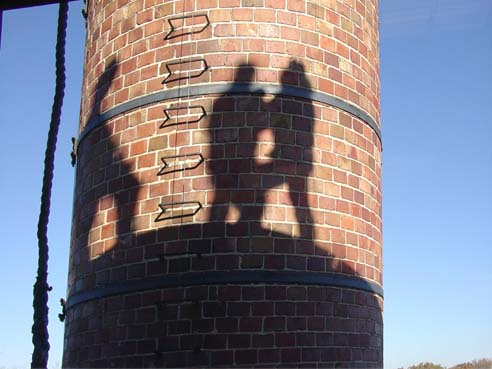
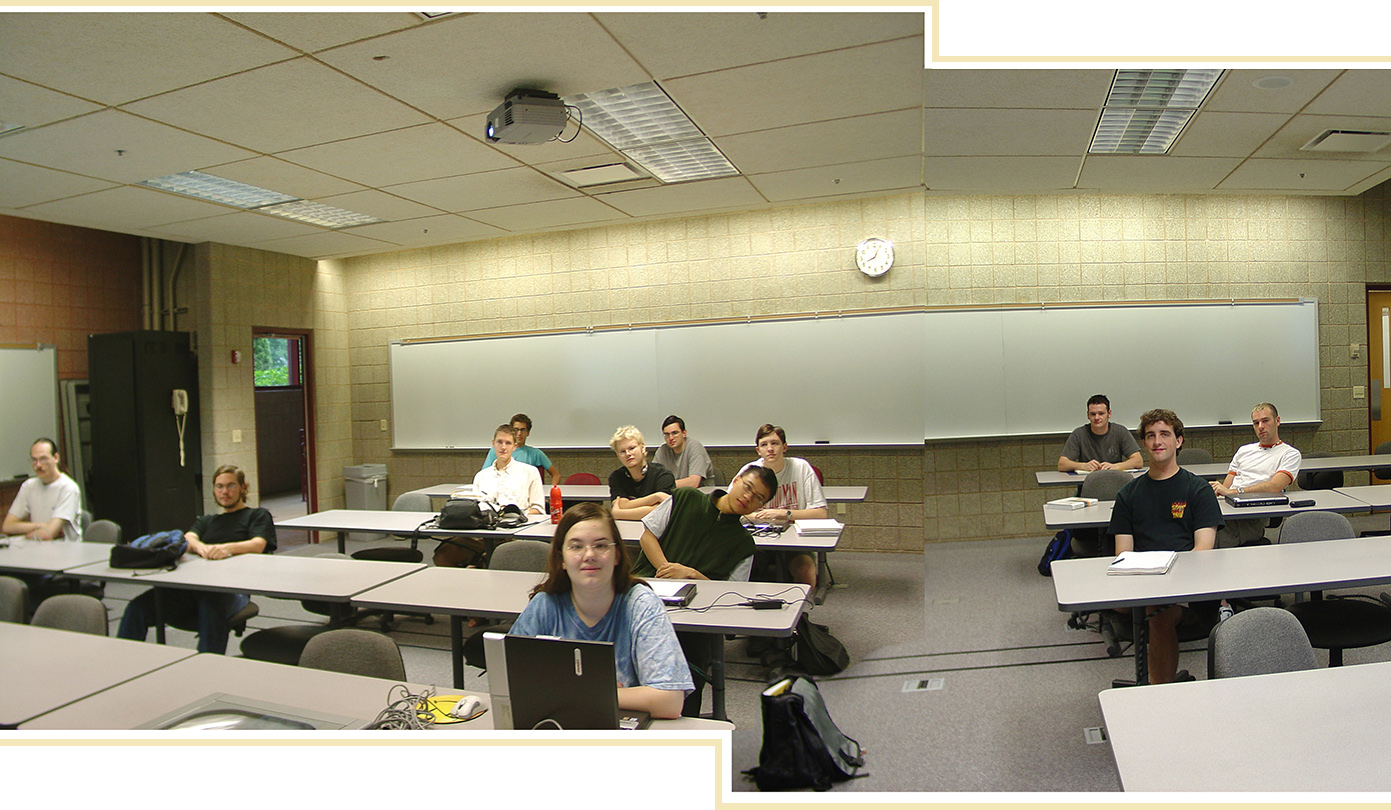
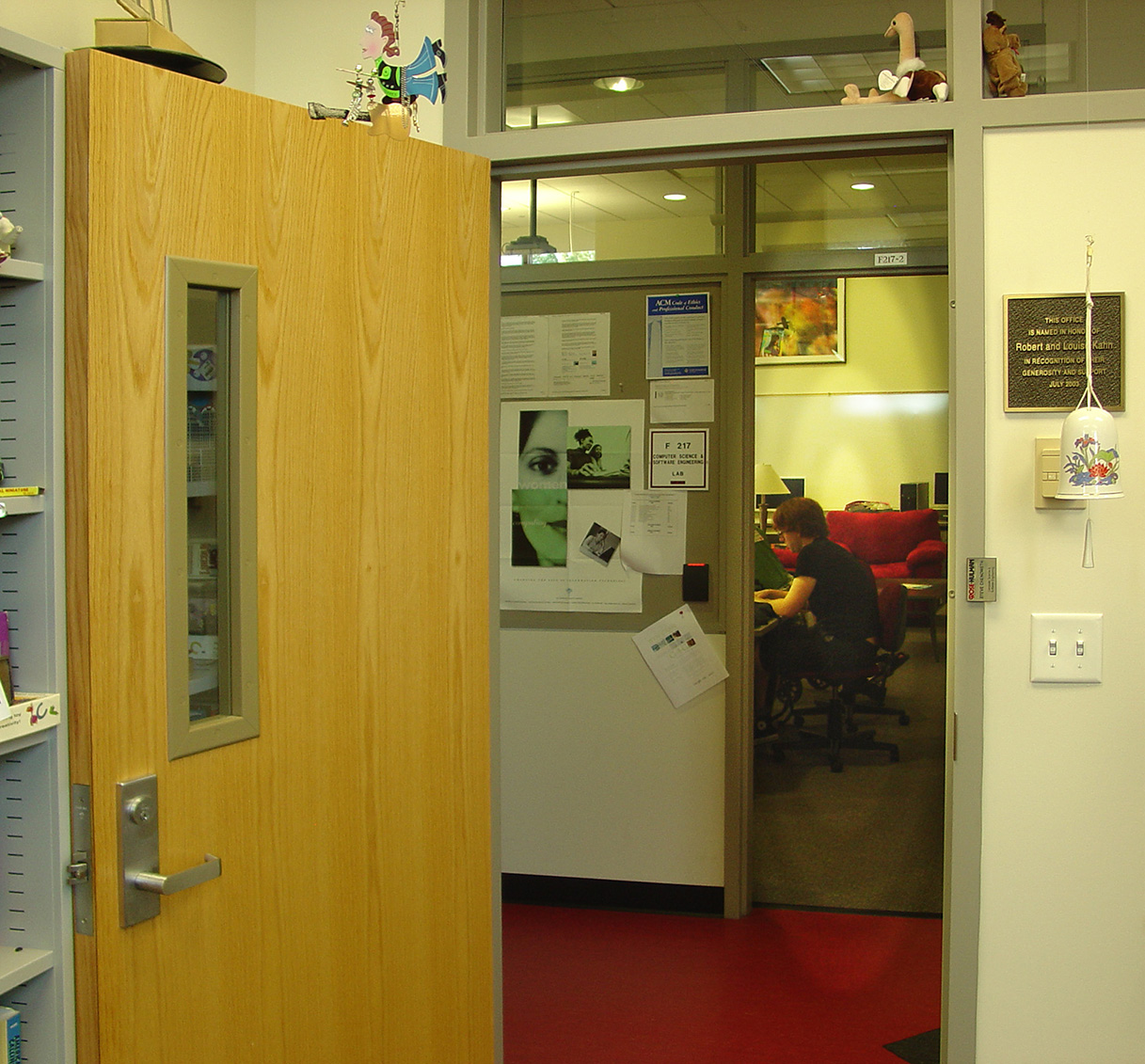
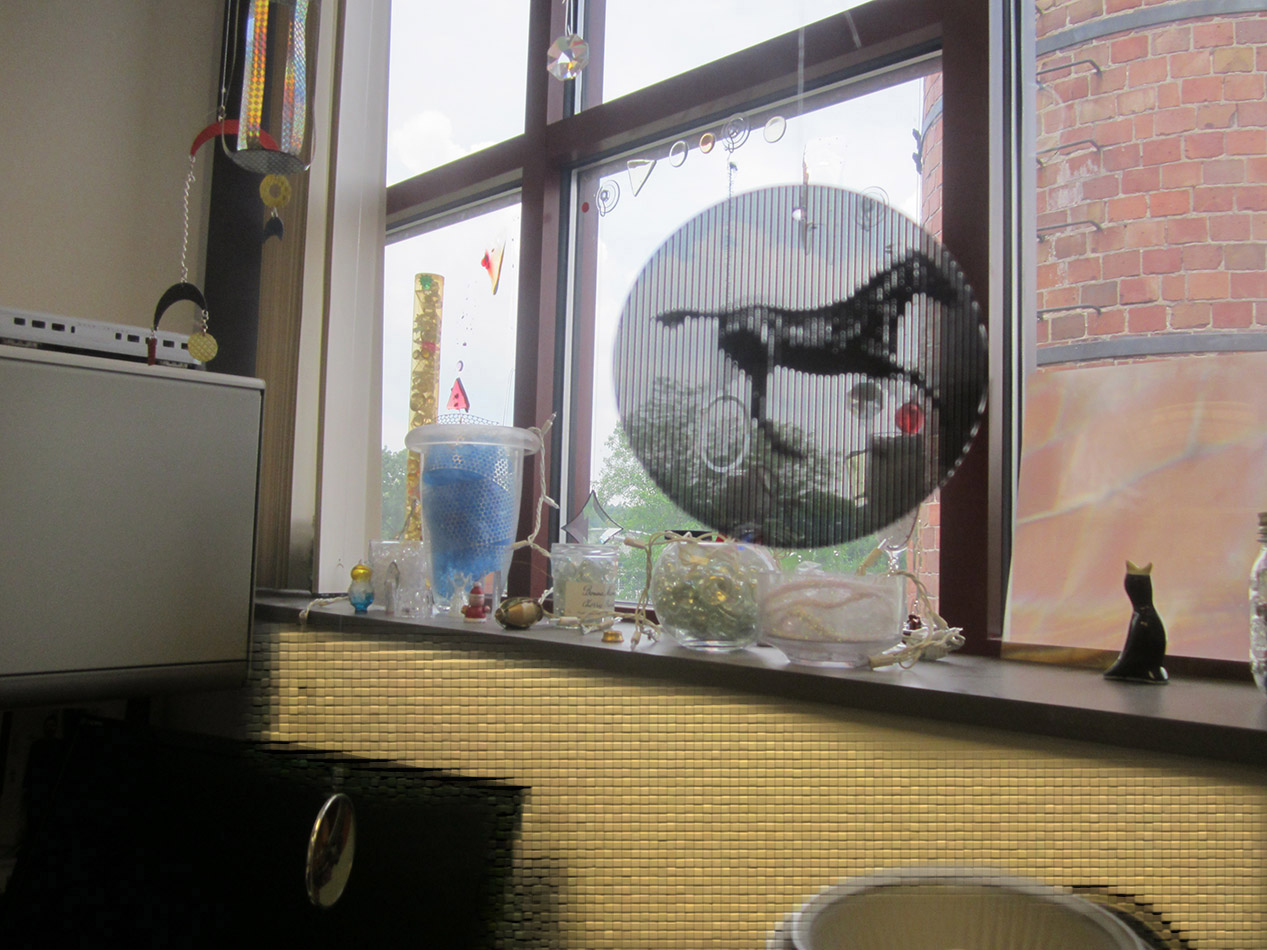
 conditioning rotates the piece. Which suggests to students, Steve daydreams, how an intriguing feature can make the difference.


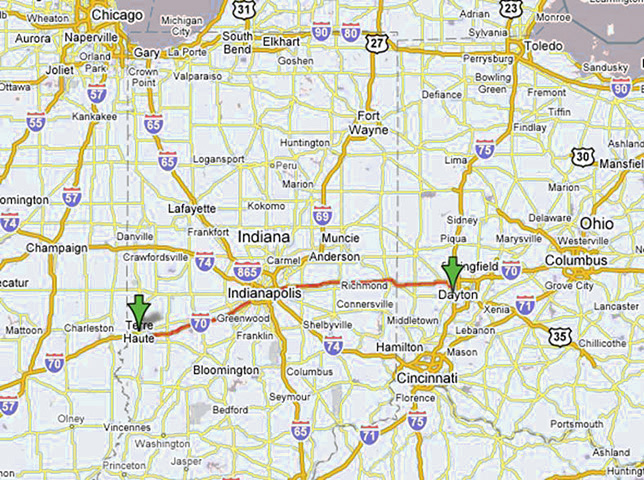
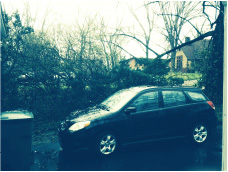


 Here's another instance, which his wife took on a different trip, again perched above the normal view on a building, head possibly perched on the body. It looks like it must be from Notre Dame Cathedral or whatever. But it's not a monster, it's a person, posed as what — Wondering? Is he like a second cousin to Rodin's "
 Emphasis on the overall craziness, turning sky and tree into a sense of sky and tree, along with a meatier Steve, while also highlighting the rolling role of the pen?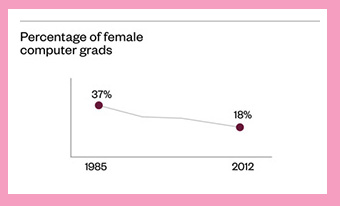
 For us, this tiny Fiat was almost a stroll down memory lane. We owned a similarly sized, yellow 1971 Honda 600 sedan like this, which had 10" wheels and a stroked 2-cylinder motorcycle engine. The doors were paper-thin, a little scary. Once a wheel rolled off of it, down the road in front of Steve. He logged the expenses, and one year's gas bill totaled under $ 60, much less than the repairs.. We'd bought it from Denise's brother, who was heading off to Indiana University, where freshmen couldn't have cars. When the local dealer started running out of parts, we sold it to a mechanic there, who promptly got fired for stealing those parts!

 What would you do, if you were wide awake but the lights weren't too good, like these folks, at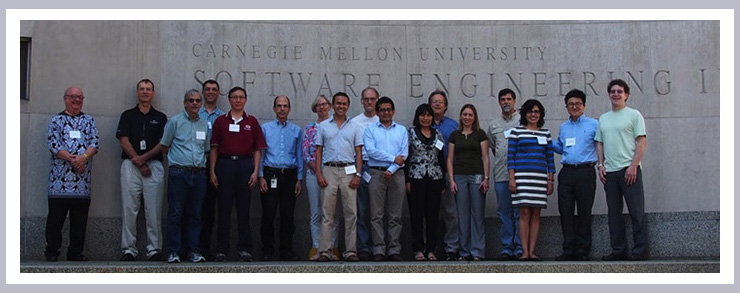

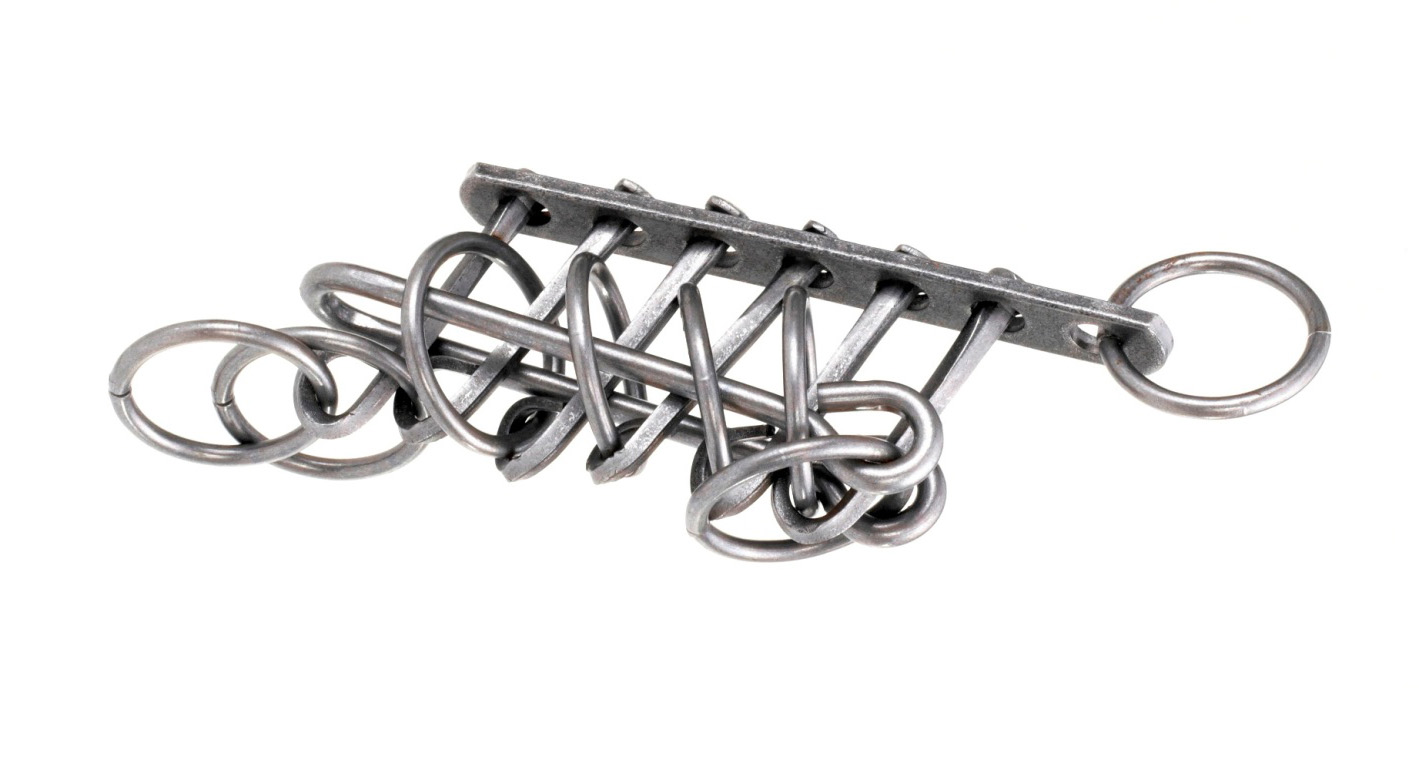

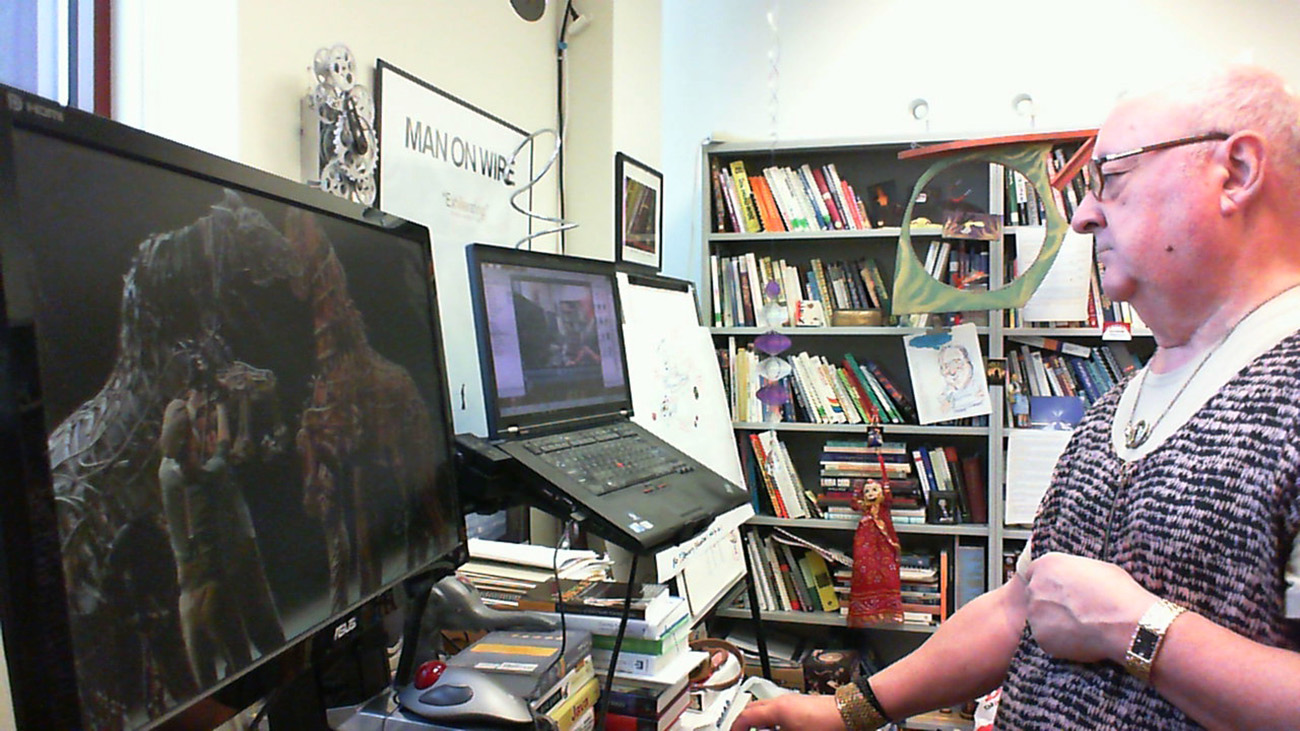

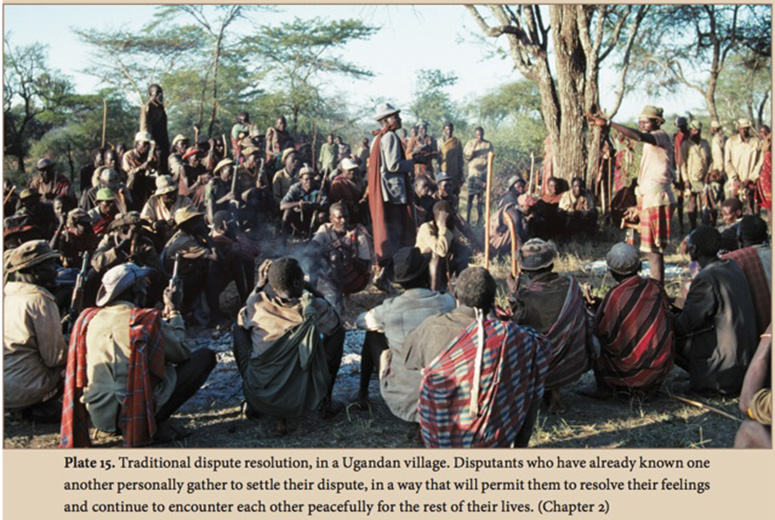
Epilogue

Above — On the way to Terre Haute from Dayton, March 6, 2016.
Thinking trucks and windshields — Among the amusements of this weekly trek have been identifying every type of semi tractor-unit coming the other way — the one you see is a Freightliner, the most popular brand in the US, now owned by Daimler Trucks. The car's nickname is "Crack," 42 and the crack in the windshield, not far from Steve's Rose parking sticker, is a theft-prevention device, a gift of such trucks. Blends in nicely with the crack in I-70 in front of him. We fear open, full gravel trucks with their self-serving warning signs; this is Steve's third windshield on the car, and it wasn't that. See the pickup overtaking the semi directly in front of him? When that happens, the trucks often move to the right, perhaps reflexively?, putting one set of wheels off the road, into rock territory. You likely recall that phenomenon because they hit the rumble strips, making a roaring noise as you pass. Now,if you are, instead, the car that's still not far behind that truck, watch out!
 And what the trucks haul — There's even more variety in the trailers the cabs are attached to. Don't you enjoy passing flatbeds, in that you can see what they're carrying? Essentially almost everything but software, that our Rose students will engineer, has to be designed with transportation as a passing thought, and Steve loves seeing the marginal cases roll by, like this monster with a heavy load seemingly attached by yellow plastic strips. The tractor is a Peterbilt 379 heavy-duty with 550 hp and an extra axle, plus there's an equivalent "steerable jeep" pusher in the rear. Ballpark 5% of the I-70 semi-truck traffic is more curious than a normal 18-wheeler. This one is much more rare and literally a traffic-stopper. You can't imagine the hassles of moving a rig like it across country! They need a state police escort — in each state. It only drives in daylight, so, where do you park it at night? And, they have to notify the railroads — If you get stuck going over some tracks, that's not too good for trains! Steve's seen such hauls negotiating Interstate off-ramps, with a separate pilot manning the rear cab for secondary steering.
Getting there in one piece — Speed: Useful to ponder while traveling, learning the safest speed, as measured by, "When do the fewest vehicles pass you or you pass them?" Most crashes involve two cars. Just over 70 in a 70 mph zone is the answer on this road.48 The traffic is light, here around mile marker 46, circa 10 cars per mile. Good weather for late winter, and no wind. Passed by another Rose car, also presumably on the way back from break, moving only slightly faster than me. Why do Rose folks have a reputation for speeding? Does that cred alone perpetuate bad driving? Engineers know safety is all-important. This is exactly where there was a 50-car pileup and 6-hour delay, not a month before.
Or two — Distance: So many ways exist to get in a crash, there's no easy set of safe-travel rules. Steve's driving more than 20 highway markers behind the two vehicles ahead, around 200 ft. Looks like a lot! But it could take 250 ft to brake to zero from 70 mph, plus maybe 100 ft of reaction time. Few of us observe this total following distance. Can you ever get into a situation where you need that full space?43 Truckers say you should go like 100 ft ahead of them before cutting-back, due to that time needed to hit the brakes; plus, they can't stop as fast as you. Do you observe that, even if an impatient driver has gotten on your bumper as you are overtaking the truck?
Or three — Surprise: Steve checks mirrors continually for "situations," like a pack coming up behind with someone even faster weaving through it. The adrenaline crowd speeds opportunistically between clumps of slower jalopies, then feels relative irritation approaching the next peloton, a visual impediment to continuing their 20-over or whatever. A crafty move makes them feel like a winning race driver. But the other pilots aren't Parnelli Jones, they're his grandma.
Accidents are caused by drivers doing unpredictable acts, which may be why new drivers pay high premiums. They don't know what most people would do, in some situation that's novel to them; it's not a built-in reflex yet, and logic doesn't help in quick encounters with the unfamiliar.
Say, on an expressway, trucks move left if there's a vehicle off the road to the right, and cars follow their lead, so reminded that someone may get out of it, right onto the road. Under these circumstances, the teenager wanting to pass you may try it down the middle, sensing an opportunity.
Steve's not sure how to do the age statistics, because, as shown here, you can't get a good look at passing drivers. But he'd bet that, for those impatiently going by a whole line on the right, the average age is below average.
Or four — Losing context: Steve's wife had a high school friend who died doing this; being a distracted driver multiplies the uncertainty for everyone in the vicinity. Steve thinks it could be a special problem with cell phone usage. If you are carrying on a conversation, you are less aware of the road.
Consider a car that goes by everyone else, then, while staying in the passing lane, slowly but surely eases off, to less than the speed of the cars on its right. If you are one of those just passed, what do you do — emulate the novice driver just described, riding by them on the right and hoping they see you in that large blind spot? We rarely used to see such incomplete-pass behavior on an expressway, like only if the passer suddenly saw a cruiser in the median, but now it's common. If you respond by changing to the left lane, behind them, usually you'll see them talking on their cell phone, oblivious to the fact they've created a questionable situation.
A bluetooth connection may prevent looking down at your dialing, but you still focus on that off-road conversation, putting traffic matters more on automatic, in your head.
Too safe? So, you're thinking Steve's way cautious, probably. He's being like communities Jared Diamond described in The World Until Yesterday, who camp under trees. Diamond wasn't afraid to stretch out close to a still-standing dried-up one, since the odds of it falling that night were remote. The people from the tribe wouldn't do it; they slept in the forest every night, and eventually this lack of foresight would get one of them.45 A famous evolution writer, Richard Dawkins, I think, similarly observed that, if we lived a million years, we wouldn't walk across the street; at some point we'd get smooshed by an unnoticed car. The long-term is a different perspective. Thus Steve's little chitchat, way above on this page (under Motivations), on teaching students to build durable systems, which we don't do. Doesn't fit in a 10-week term.
Crish-crash: In 13 years of weekly drives from Ohio, over 1000 such trips, he's never crunched anyone, and gone off I-70 only once. At night in blowing snow that was just starting to stick, and mediocre visibility, 20°F (-7°C), heading east at maybe 50 mph (almost all the traffic had slowed) around Ohio mile marker 8, a truck barely passing him lost track that Steve was there, probably focused on seeing the road, and started coming right. Steve hit the brakes just as his lane turned to black ice, did a 360 into a snow bank, then drove back out of it, up the embankment onto the road. The trucker didn't even slow down, out of curiosity. If he'd stopped to check, he might have incurred liability for any damage? Or lost his job? It's a jungle, disguised as the way home. Like in system crashes, the root cause fans out, usually an unlucky combination of things. Steve's mechanic, James Taylor, fixed the couple bent parts underneath, at no charge. No musical accompaniment.46
Perspective: How many dimensions can Steve use to understand the traffic safety side of 400 road miles each week? Here he tries it as a Muslim woman, selecting people he's known a few of and wants to model, as a personal challenge. Steve recognizes that a sketch of generalized values comes short of characterizing even one such person. In software development we at least try to personalize stakeholder descriptions, and knowing them or studying them at length is best. Yet there are accessible characterizations which define Muslim women as sufficiently different from the folks Steve knows better, that such ways to view the world can be used as a new direction to see what he is studying here.
Spiritual strength, harmony and peace, family, modesty, sincerity, social order, self-sacrifice, frugality, contentment and respectfulness come to mind almost immediately. These women also have roles that are very distinct from men, traditionally, and their social and economic positions are etched by that of their spouse. Following religious admonitions has high importance in itself, such as observing prayer times, giving alms and fasting. Picking from among these, and rolling them onto the highway:
- Other drivers notice such implied observance of morality — These matter; like when you ease up to let them pass first, rather than crowding in front of them, making them
slow down. How each of us drives becomes a model for everyone else. Surely, the temptation is strong, to just put your own progress first — you don't even know the other drivers competing to move at their own desired rate; they are encased actors. I-70 could be seen as an abstract moral playground rivaling holy books. Modesty, say, pays off.
- The Muslim complementarity of roles cannot be denied; on the road, commercial and personal traffic exist for different reasons, but hope to coexist.
- Property ownership is also a blend on I-70, for example — Only a minority of truck drivers own what they are marshalling, and the employees or contractors are held responsible for damage, late arrival and other well-known aspects of the job, rather like many Muslim women are charged with running the house and have privileges and responsibilities owing to their husbands' positions in society.
- Maintaining honor is a high value on the road, perhaps since the vehicles are slightly like weapons; or, why do you stop in the middle of the night till the light turns green? You are doing this mostly for yourself, demonstrating innate value.
- If we travel with families, others may be more cautious driving around us, even without a "Baby on board" affirmation. The evaluation of who the other travelers are, and treating them according to their presumed roles in society, is a part of the trip. Ask anyone in a Cadillac. Would they even want it if it weren't recognizable as one?
The abaya is a cape dress from Pakistan. Steve's chairs went to custom colors, in response, another "pure fabrication." Steve didn't do up the scarf as a hijab, partly out of a lack of skill. This one fact alone brought home how little he knows about most Muslim women. We learn a lot by listening to others. He'd love to know what metaphors they would apply here. Granted we're different, in what sense would they feel highway travel affirms who they are, and in what ways is it foreign territory?
Perspectiver: Steve hopes you find it startling to view some piece of your own regular life from a stranger's perspective. He does this a lot. If you don't surprise yourself in some quiet ways, you didn't do it. It's "walk a mile in their shoes," followed by an extra mile.
If their panorama helps you, then you possibly can help them.
In first considering whether to try seriously to look incongruously at work, as above, he strove to see that act from 22 points of view, detailing them all, over time, including the postures of many who would not favor it. The spread included understanding how CS students might take it, using the truth analysis of philosopher Edmund Gettier to extrapolate from their favored playland of video games. You have to grow serious on stepping out of your shell, to swim in the benefits.
His tangential decompositions, of the act of driving, as he motors along, are similarly plush. This one's an example.
"Find ways to be industrious, even in leisure." — Ben Franklin. For Islamic advice on leisure, see here.
Perspectivest: Here's the view a couple trips later, just a few meters down the road from where the bigger road-trip image, above, was taken.47 This one's a real "Sunset Drive" and an example of what Steve is inspired by on the way back to Terre Haute, many weeks. Usually, he also stops to have dinner in Indy with his older brother, who is retired, but builds computers and recumbent bikes, and also virtual hot rods on Second Life, as hobbies. So, Steve's carrying with him some of his brother's perspective, as he chugs toward the Haute. Like Steve, his Bro explores a wide range in each of his interests, including outrageous examples. On lay-down bikes, he used to ride a ZOX; it has the derailleur on the front wheel, which also steers since the chain twists.

How fast, really? — The Interstate mile markers give you a chance to check your speedometer's accuracy. For 1 mile, m = 60t / (60 - t), for m = your speed above 60 mph, and t = your time below 60 seconds. So, if 10 mi at 70, on cruise control, happens in a total of 500 seconds, that's t = 60 - 50 = 10, for 1 mile, and m = 60 * 10 / (60 - 10) = 12. You're in fact going 60 + m = 72 mph, and your odometer is reading 2 mph low.
How come rain knows you speeded up — Steve once figured, as it was raining, why, mathematically, you have to run your wipers while you are moving, but not at the next red light. It's true even if no other cars are splashing yours. There was a constant drizzle, I-70 had bad construction, and he had opted for US 40, which has some lights. Suppose, say, 10 raindrops a second hit the windshield while you're stopped, coming straight down. That's raining on a 2 ft deep windshield, front to back. Now, when Steve sped up to, say, 55 mph, then maybe 80 ft of windshield passes through the rain every second, so 40 times as many drops hit it. 400 a second? Time to turn-on the wipers! He bets there are other ways to figure this.
Jet trails — This particular evening had an unspectacular sunset, despite the wispy clouds. However, Steve was intrigued by the crisscrossing contrails. Supposedly these man-made cirrus clouds are only partly pollution, and also created the way your hot breath is visible on a cold day. A couple are moving this way — presumably headed by such jets! Most fly at 500-600 mph, so you might guess from that how high up they are, though the geometry is tricky — Most of their distance from you is horizontal. And, notice that, despite the fact you're looking at images following the earth's curvature, the trails are essentially straight! Even less accurately, decide where they are going?
What to do — When he started at Rose, Steve dreamed this 3-hours-each-way connection would be productive time, somehow, like grading online quizzes. Never happened. He has done books-on-tape, and heard interesting news, topical shows, and music. It's a quiet time, lots of alpha wave connections, even staying open-eyed. This trip, he listened to the Indy NPR station, which you can now get from New Castle all the way to Terre Haute — heard Steven Stolen's ad hoc presentation of the music world. Steve grocery-shopped off exit 11, then reached his apartment in time for the final episode of Downton Abbey.
A metaphor — What's symbolic here is that working at Rose is the final piece of Steve's career, after starting as a post-high-school teacher and cycling through the software industry for a very long time. Steve is obsessed with the question of how much he can contribute, and in what ways, before he and his wife "Rosily" ride off into such yonder sunsets together.
Ta da...
Ok, Word says that's more than 90 k words, 180 typed single-spaced pages of just the text, and Steve knows there are over 160 images punctuating, and 50 footnotes, below. Should be plenty for a single web page, Steve says!
The last word should be yours, so email me your thoughts!?
_____________________________________________________________________________________________________________________________________________________________

1 Image and commentary from http://www.oxfordstrat.com/ideas/pattern-recognition/. If you're having trouble turning around to picture the illusion, here's the postcard sideways, with a key. Maybe the extra villagers around the mouth are a mustache and beard?
2 1980's image of Columbus Works is from http://cqwe.cboh.org/lc_histories/CB-ColumbusWorks.html.
3 Mind map from https://www.mindtools.com/pages/article/newISS_01.htm.
4 There are of course 47 different ways to separate how the two bridges were designed. Moisseiff played a major role in the design of both bridges, but he worked with Strauss, Ellis, Ammann, Derleth, and others, as a team, on the Golden Gate project. He played a more dominant role on the Tacoma Narrows Bridge, and his design won out over an alternative, based primarily on its low cost. He argued, based on theory, that 8-foot-deep plate girders would provide sufficient stiffness for the bridge.
5 Image from http://www.ubiquitorium.com/woodcut2.htm,which also has some explanations.
6 Image from http://gonzai.com/raymond-loewy-the-self-made-man/.
7 This is the "Industries of the British Commonwealth" sculpture group by Carl Paul Jennewein (1933), over the doors of the British Empire Building, at Rockefeller Center, Midtown Manhattan, New York City. It's pretty typical Art Deco looking, huh! There's another view at http://travelphotobase.com/v/USNYC/NYE49186.HTM.
8 This is a "grotesque" (gargoyle) at Biltmore House, built in North Carolina in the late 1800's by the Vanderbilt family. It's on the back porch of the mansion. See, for example, http://www.wecallitjunkin.com/gargoyles-biltmore-estate/.
9 This is the Hermitage Museum, in St. Petersburg, Russia. It's like city blocks of rooms like this, filled with great art.
10 As of 12/17/2015, the US Bureau of Labor Statistics projects 186,600 new software jobs in the US, in 2014-2024, versus 56,500 for all the other major engineering areas (46,200 for those represented at Rose). This brings the projected total number of software development jobs to 46.3% of all engineering jobs in 2024 (55.2% for those represented at Rose). In 2014, it's already 43.4% of all engineering jobs. For more information, see http://www.bls.gov/ooh/architecture-and-engineering/home.htm and http://www.bls.gov/ooh/computer-and-information-technology/software-developers.htm,
11Garber is chair of Harvard’s Visual and Environmental Studies department and may not strictly see herself as a sociologist. But she writes influentially in regard to social phenomena.
12 See Interaction Design by Preece, Rogers, and Sharp, 4th Ed., pp 256+.
13 Steve doesn't wish to imply that knowing two points of view makes you a better person somehow, or, worse, that you'll agree with him on big issues in life. That's up to you to decide. It's likely to make you feel more fallible, rather like when a CEO hires two different consultants, instead of one, to tell her how to fix a business problem. Or, the way a person who speaks two languages occasionally has to expend energy switching gears when asked a question, because the answer comes to them in the other language.
14 For example, despite many faculty believing students from China are more likely to cheat, the evidence doesn't back it up, and there are associated phenomena that could be more of a cause of cheating than cultural background. Steve's younger daughter has friends from the Russian elite, and they are preoccupied, as are wealthy Chinese families, with having their children attend the best colleges, whether or not they are an academic match. The number of Chinese students expelled for cheating is actually a low percentage of those attending, according to a study just quoted in the Wall Street Journal.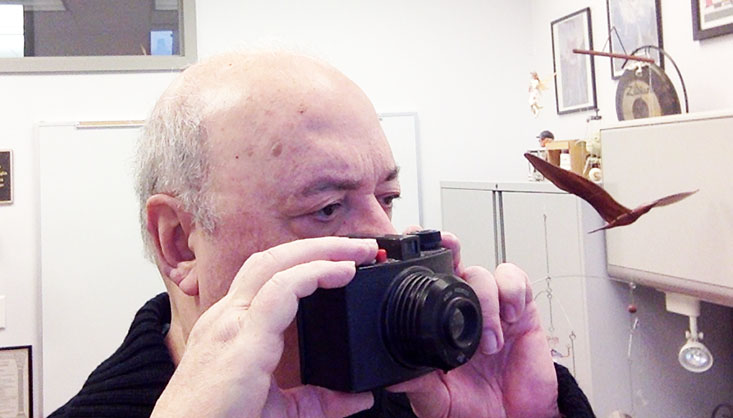
15 Cunningham describes the "technical debt" problem in terms of delayed design work, but it's clear that unanticipated places where the code required change and enhancement underlies the problem of growing design complexity. In Fowler's quadrants, the prudent decision to "ship now and deal with the consequences" may or may not be a fully informed decision.
16 Ok, Steve's mother almost surely took that image with this Agfa Pioneer, amateur-grade, 620 roll film camera that produced 6x9 cm negatives. The viewfinder makes you squint, and she was not comfortable taking pictures. You can argue that such images can be setup, posed, and framed. But, most likely, she didn't even say, "smile." The camera now sits on Steve's office shelf, next to other photo relics. It was styled by industrial designer Henry Dreyfuss, also famous for his work at Bell Telephone. Agfa-Gevaert, a 140-year-old Belgian company, now makes specialty imaging products. Like Kodak, they were onto the marketing ploy of offering cameras cheaply in order to stimulate film sales. Steve liked their 35mm slide film, which had deeper colors. See example on Wikipedia. He processed it himself, using the same chemicals as for Ektachrome. In this picture of Steve taking a picture, the wooden bird appears to be making a run for it. Or is it a fly for it? There's a gong in the background, below Communist propaganda posters. You'll have to guess why the small spotlight below the shelf.
17 This was Steve's solution to making the first table column fixed width, and it works on three different browsers.
18 An em dash is —, among other things. The line in "A visit from St. Nicholas" before that is "To the top of the porch! To the top of the wall!" You gotta believe it ends with "wall" only for the rhyme.
19 In engineering, this idea probably goes back, at least down one branch, to efficiency expert Frederick Taylor's notion that there was "one best way" to do factory work. He was very influential and one time president of ASME. He notoriously considered only improvement of production goals, a single perspective.
20 Rug designs from https://en.wikipedia.org/wiki/Persian_carpet and http://www.persiancarpetwarehouse.com/home.php?cat=256.
21 Ok, Steve looked, just on account of saying that. Everyone has a place for miscellaneous dishes and such. Among ours there, two beautiful Royal Worcester decorative square plates Steve won at a United Way pl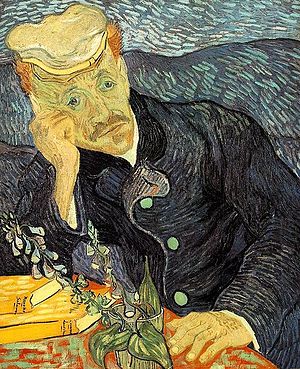 edge drive prize giveaway in 1974. We drew for order of selection andSteve was # 50. Guys before him were picking through mechanical gadgets, but Steve had brought his wife, who chose these. Looks like they're now going for more or less $ 100. You can see his reaction to that. Could be on Antiques Roadshow. Steve should revisit the cupboard occasionally. And maybe the one behind him? Your projects may also have buried treasure, like features you did long ago and forgot.
22 Steve knows it's unusual to serialize web content. And very old-timey in one way. Yet it also is novel to do it that way intentionally, when the content itself is not meant particularly to be read in any special order. This does give you a better chance to flip through it all, noticing curios by chance, than if most of it were just hot-linked and otherwise invisible..
23 The Far Side ® and the Larson ® signature are registered trademarks of FarWorks, Inc. Copyright © 2000, 2007 FarWorks, Inc. All Rights Reserved. Image from http://mikelynchcartoons.blogspot.com/2010/07/there-is-much-truth-in-old-far-side.html.
24 Not van Goghy enough? How about in contrast to his first and second 1890 portraits of Dr. Gachet, reproduced here. Steve played with the outlines more. The first version van Gogh did of this portrait has the more sketchy, brush-stroked sky, while the second one shows more of the same use of suggestion, expression, gesture, pose, image texture, and foreground objects that Steve employed.
 25 So, the question is, at what point do you say, "It works"? At left we see, a fraction of a second later, a better indication of how this particular flight would turn out — straight into the drink. If undergrad engineers are taught always to quit at the first sign of success and skip to the next entirely new, that's the wrong message with which to send them out into industry. Perhaps a part of the problem is that this is how academic researchers operate, themselves? If we can get a paper out of it, and picture how someday this might be useful, psychologically it's "almost done" and time to go on to s
 omething else. At AT&T, our heuristic was that, when anyone in research declared a new technology was ready to be used in products, more likely anywhere from 1 to 20 times as much work would be required to "productize" it.
Mixed into this training / mistraining issue is the question of "who" gets to announce it's successful. The newspapers observing Langley's flights didn't think this was it, and panned the effort and the public expense. One reported that the craft "slid into the water like a handful of wet mortar." The Boston Herald suggested Langley try submarines next. The Brooklyn Eagle said "the only thing he ever made fly was government money." The original wings were just too flimsy, but Langley insisted it was airworthy. The Smithsonian named a medal after him and awarded the first one to the Wrights. At the ceremony, Langley was lauded more than the Wrights, who then declined to give their original Flyer to the museum. In 1914, the Smithsonian reopened Langley's laboratory and finally cranked up a "proof of concept" flight, using a highly modified version of Langley's plane, not telling how much it was changed, then retroactively trying to pretend Langley's effort was the first bona fide human-carrying heavier-than-air craft. Orville Wright already had sued and won a court case over who was first, but the Smithsonian continued to say it for three more decades. There was a lot of pride at stake. And a lot of the action had taken place around Washington, D.C., where politics is king.
26 Ok, there are answers to that question. Doing this puts me out there with Flavor Flav. In current politics, as Steve writes this, Bernie Sanders talks about himself in the third person. He's just the latest person in the public eye to do so. Technically, it is called "illeism," and it has its own Wikipedia page. Like Julius Caesar, Steve does it here to gain a little objective impartiality. When he journals, he never does this. His favorite usage is in British Parliament, where the members refer to each other this way even when addressing the other person directly.
27 That's a pretty direct application of Gödel's incompleteness argument to epistemology, among other perspectives. See here.
28 Swearing is a more common way to cross the line into the taboo. And it dares the listener to react, much like altering your appearance does.
29 The people Jesus preferred to eat with. Mark 2:15-17.
30 An effort dating back a dozen years, to get students more in sync with the business world, by, once a week, having professors model the managers they will work for. The initiative kind of got perverted by its own name, to where, now, untenured faculty think males are supposed to wear neckties every Tuesday, though the actual rationale has been lost.
31 The wide variations in social roles we see, between men and women, may be partly biological and partly social (after all, they vary in contrasting cultures). The mechanism you should understand is how deeply parental and peer influences drive behavior of either sex, especially during childhood. We have to learn to do most without thinking about them, all the way from speaking language to belonging to the social groups our parents and others think we should fit into. Boys and girls are regularly told that they "don't really think that," when they say or do what's not fitting those roles, even though, obviously, they must have thought outside the role to garner this mental reminder.
After a couple decades of being cajoled to be a certain way, and reminded only to think of yourself in that way, our college students are going to believe they fit in those niche roles, for better or worse. "People conform to what is necessary," right down to not admitting they have other thoughts. Asking students whether they have ever considered crossing any role boundaries is going to yield some guarded responses. And the closely-watched sex role aspect plays havoc with developing deep teamwork learning, for one possibility. The men don't want to accept unflinchingly what the women represent. Being a visual cue, which dumps this suppression of role flexibility out the window, even momentarily, is very useful.
32 A great link on "authenticity," as a trendy behavioral goal for managers, is here. The goal of coming off as authentic, in a business environment, competes with other goals, like maintaining a style consistent with expectations for the position you are in. For college students, Steve believes having "authentic" experiences is easier — you are there to delve into life and you may only have an obligation to find yourself; it may be more forgivable if you don't please others at the same time.
33 Deuteronomy 22:5. Let’s be fair, the admonitions in Deuteronomy 22 tend to be read in a biased way by everyone. For example, nobody cares anymore of Verse 11, “Thou shalt not wear a garment of divers sorts, as of woolen and linen together.” Most churchgoers violate that without “sweating it.” This chapter also immediately follows the one infamously describing the proper way to take women you fancy from among captives, and cautioning you not to sell them as slaves if they don’t please you. Chapter 21 concludes by recommending stoning for a “stubborn and rebellious son.” It’s a judgment call for us, what of this, written around 1300 BCE, applies to our modern life. Christians cite the letter to the Hebrews (of debated authorship since early times – might be Paul, might be Priscilla, though it’s clearly polished), as evidence that we are now under a New Covenant which does not include the details of Old Testament regulations. 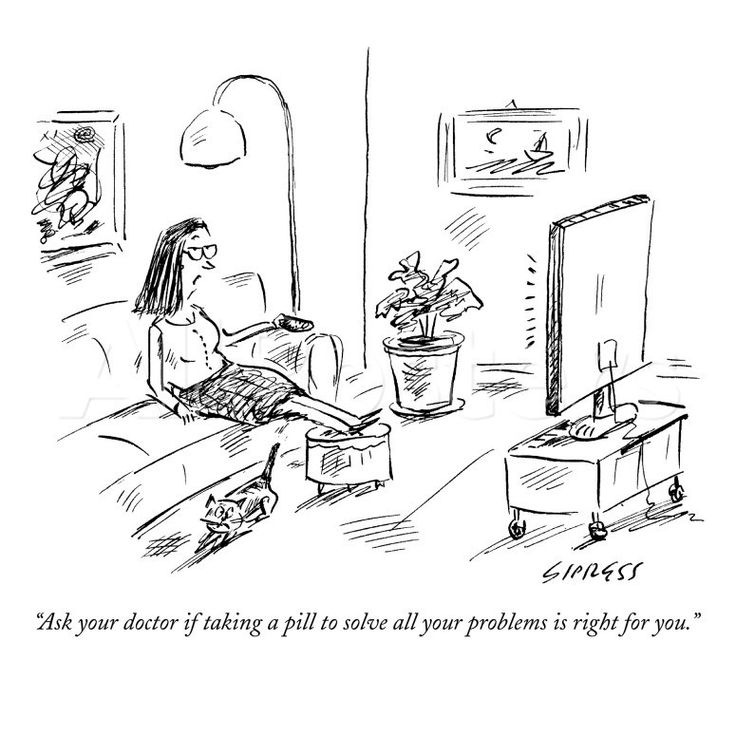
34 Steve doesn't pretend to know how to solve the opioid problem in the US. It does seem clear what we're doing now, which is based firmly on our morals and on sound business principles, isn't working. E.g., Opioid deaths in Massachusetts were up 57%, from 2012 to 2014. Harsher penalties haven't done it, nor has trying to stem the drug flow or stopping it at its source. Do addicts need tough love, like drug courts? Or maintenance therapy like methadone? Or just a more caring childhood? Are those business principles an actual causeof the problem, like Purdue Pharma making a killing off Oxycontin? Or, is there just more pain being felt in the US these days? The possibility our way of life has produced the plague remains a starter truth. Is it a coincidence, say, that the current rise of opioid usage roughly coincides with being blanketed by ads which sound like the New Yorker cartoon at right? In an age of commercially-induced instant gratification, aren't opioids the seemingly logical solution for those who can't get rid of physical or psychic pain? And with doctors standing by, willing to help them into a starter addiction?
35 What to do, to neutralize groups bent on terrorism, is surely more integral to the world than we want to believe. And Steve says this, having descended from humans who once were considered terrorists, and who became the losers of the Reformation. (See his short discussion of Mennonites, in the main text, under "Active Humility.") Religiously inspired groups seem the biggest problem, over time, though Anarchists and Communists, sporting their own self-righteous dogmas, give them a run for their money. Flipping your role to, say, being a part of the main group from whom the terrorists sprang, could be usef ul in understanding them. And, in fact, most of us are already a part of such a group — If you can't find your own equivalent, of being Muslim and wondering what to do about ISIS, Steve can help you find the closest semblance. One example, in his own case, was that, back in the day, he was a Hippie, and the sinister Weather Underground emerged from that movement. Isn't it harder to condemn terrorism as much as we should, when the terrorists claim to be on our side? Like, say, people in the Right to Life movement seem paralyzed to speak loudly enough, against those attacking abortion clinics, to have any effect in stopping them. Such control produces a mixed message as to who the good guys are, if you self-advertise your own group of criminals and denounce them. The current Catholic abuse scandal comes to mind, as well, as a close analogy, completewith a historically full denial of responsibility.
36 In A Mother's Reckoning:Living in the Aftermath of Tragedy. Crown Publishers, 2016.
37 Google for images of "Aztec pattern" and you'll see some dead ringers come right up, like here.
38 A closer view of the top and beads is here, and you can see the much smaller scale, contrasting geometries of the clunky beads and of the intricate paisley. The skirt pattern also picks-up the gold which dominates the top. Lisa Vanderpump is a leading character on two of Bravo network's reality shows. Her rich, Beverly Hills costars dress to impress.
 39 See also Richard Gere's analysis, of being regularly humiliated by daily encounters, earlier in this same section.
40 The proof is just slightly riveting: Informally, if length(b) = length(c), then a = bb, and we're done. WLOG, suppose length(a) > length(b) > length(c) > 0. Then a = bc = cb gives a = cxc from the first, for some subsequence x with length(x) > 0, because sequence a has to start with subsequence c from the second. And so b = cx and also b = xc. We can thus apply the same analysis to decompose b, as we did for a. And continue that process for a finite number of steps, until we arrive at all equally-length(ed) components (or length 1, where they will be equal), at which point we can rebuild a = dd ... d, from that smallest-length component. After writing of his theorem on this web site, Steve took an hour nap, woke up remembering how the proof was constructed, a gymnastic he did almost exactly 50 years ago. Isn't life wonderful?
41 See, for example, Davis, H.W. and Chenoweth, S., "The mathematical modeling of heuristics." Annals of Mathematics and Artificial Intelligence 5 (1992), 199-228; and Bramanti-Gregor, A., Davis, H.W., and Ganschow, F.G., "Strengthening heuristics for lower cost optimal and near optimal solutions in A* search," Proceedings of the 10th European Conference on Artificial Intelligence (1992), 6-10.
42 Steve drives his cars till they are ready for a ride to the junkyard, and they acquire nicknames based on their inevitable defects. Preceding "Crack" were "Spot," "Dent" and "Scratch." Here are a couple of them now, in their glory days, as Steve walked out into a double rainbow to go work at NCR, then ran back inside for a camera, to capture it on a Pentax full-frame fisheye lens. The 1974 Firebird eventually became "Spot," due to visible corrosion. The Honda 600 was too silly even for a nickname, but "Broke" would have fit its normal operating condition. One time the little conveyance went sour on the way home from being fixed, and Steve just turned around and limped back. It and its demise are already described on this page. Ever owned two cars, one of which had an engine 10x the size of the other's?
43 You betcha. Suppose that, just over that next rise, there's a a stalled vehicle in the right lane. The truck in front of you swerves around it, but you don't even see this situation until that truck changes lanes. If you can't go around, in that a line of vehicles has come up along side to pass you, your total 350 ft of stopping space will be needed, and may not exist.
44 Harriet lived downstairs. She knew a wide swath of folks because of her successful real estate investment business. She had been widowed in the 1940's, and built this herself while raising her daughter.
45 For more cool stuff from Diamond's book, see the last block of the big table just above this discussion.
46 James Taylor is also the name of a famous musician.
47 Same tree on the right, only closer.
48 It's interesting trying to do the math on passing, as you're cruising along. When there are around 50 vehicles / mile on I-70, which is more typical for Steve's weekly drive, at 72 mph he passes around 2 vehicles every 3 miles (mostly trucks), and gets passed by about 2. He thus thinks 72 could be taken as the average speed for travelers on this road. At 79 mph, he passes around 11 vehicles every 3 miles and doesn't often get passed. Over the whole 180 mile trip, that would mean encountering (180/3) * (11-4) = 420 more vehicles at close range. Not as safe. Similarly, if he goes 65, he infrequently passes anyone and gets passed by around 12 vehicles every 3 miles, including some trucks. Steve thinks this also is not as safe as 72, though the State Patrol may disagree.
The spread of speeds probably is nothing like a normal distribution. Trucks mostly tend to run at roughly the same slower rate, almost forming caravans. And clusters of speeders sometimes do that, too. But you can guestimate the math theory. Like if you're going 79 and everyone else 72, and they are evenly distributed over 3 miles of the road, 50 cars per mile, you'd pass about 13 cars in going that distance. Which is close to Steve's observed number of 11.
49 Steve has observed this phenomenon his whole life. If you believe it isn't so, try following a black or white person (at a respectful distance), walking down a street with many pedestrians of both races, and see if there is a difference in how they encounter others, based on race. For more detailed discussion of such chance encounters, see here. For another flavor of the casual encounter, see Steve's story from actor Richard Gere, above.
50 Just today, as he writes this, Steve interviewed a high school student and his family, from St. Louis. When he asked why the visitor was interested in studying CSSE, he said, "To build games, of course."
51 Having taken Latin, Steve insists that English word order stricter is needed than. If you get it, order can be varied for emphasis or color. Consider also the intent of the whole page, elaborated on under "Philosophy in Motion -- Rationale for home pages like this," that the entire document is intended to express some early / intermediate stage of thought development, ready for you to spring from, if you like. When we ponder in our own heads, we do not automatically self-correct our grammar, if we are trying to be creative.
52 That's a bit better than better but not as better as best. What would "best" be, in this case??
Background: Zen pipe courtesy of Magritte, though ocean-rippled diluted sideways web site background surely was not how he envisioned its presentation. After http://serendip.brynmawr.edu/local/collegesembio1.html. Steve's not the only one to mix semiotics and Magritte's famous pipes. See the handy definitions here.