PROBLEMS
1.1 The general solution of the differential equation (1.2) may be written in either as
x = C cos wot + D sin wot
or as
x = A cos (wot + f
)
Find A and f in terms of C and D.
1.2 A particle executing simple harmonic motion is observed to have a speed of 3 cm/s at the instant it passes the midpoint of its path. If the frequency of the oscillation is 10 Hz write an expression of the form (1.4) which will correctly describe the motion of this particle. Assume that the particle is moving along the x-axis with the origin at the midpoint of the path, and that one starts counting time at the instant the particle is passing the midpoint and moving to the right.
1.3 A large dicing machine is held a few inches off the floor by four identical springs. When the machine is set into vertical oscillation, the time required for 10 complete cycles is found to be 2 seconds. How much were the springs compressed when the machine was first placed on the springs and allowed to reach its equilibrium position?
1.4 When a piece of heavy machinery is placed on the floor of a shop, the floor sags 0.05 cm. With what frequency will the system (machine plus floor) oscillate, assuming it can be modeled as a mass spring combination?
1.5 To minimize the transmission of vibration, machinery is sometimes mounted on felt pads, which for small deflections behave as linear springs. Four felt pads are used to support a milling machine and each pad deflects 0.1 cm when the machine is loaded onto the pads. With what frequency will the machine oscillate if set into vertical oscillation?
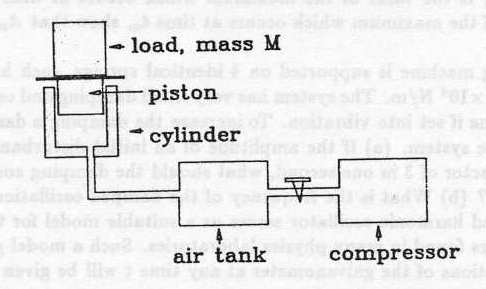
1.6 To achieve vibration isolation, heavy machinery is sometimes
mounted on air springs. An air spring consists of a cylinder with a closely
fitting piston and an air tank as indicated in the figure.
(a) If the cross sectional area, S, of the piston is 1750 square centimeters and the load is 4000 kg what is the pressure, P, in the tank and cylinder if the system is in equilibrium?
(b) If the piston is displaced downward an amount x, the volume of air in the cylinder and tank changes by an amount dV=Sx, the pressure increases by an amount dP, and the upward force on the piston increases by an amount (dP)S. If the downward displacement is sufficiently rapid, the compression will take place adiabatically, in which case dP and dV are related by
Vg dP + PVg-1 = 0
where g = 1.4 and V is the equilibrium volume
of the air in the tank and cylinder. Find the spring constant K of the
air spring in terms of g , S, P, and V.
(c) An optical bench with a mass of 1000 kg is supported by 4 air springs
connected to a common tank. Each piston has a cross sectional area of 70
square centimeters. When the system is in equilibrium, the volume of air
in the tank and the cylinders is 5000 cubic centimeters. Find the frequency
with which the table will vibrate if set into vertical oscillation.
1.7 Express the following complex numbers in exponential form:
(a) 1+i
(b) 1/(1+i)
(c) 1-iÖ 3
(d) (1-iÖ 3)/(1+iÖ
3)
1.8 Find the angle between the vectors representing the
complex numbers z1 and z2.
(a) z2 = (3-4i) z1
(b) z1 = 3 + 4i and z2 = i(3+4i)
(c) z1 = 1-iÖ 3 and z2=
Ö
3 - i
1.9 The real part of x(t) = 4exp(ip
t) describes a particle executing simple harmonic motion.
(a) What is the real part of this expression? (b) What is the frequency
of the oscillation?
(c) What is the amplitude? (d) Plot x(t) in the complex plane
at times t=0, t=1/4, t=1/2, t=1s. What is the angular velocity of the vector
representing x(t)?
1.10 The real parts of x(t) = 4 exp(ip t) and x1(t) = (3+4i) exp(ip t) and represent simple harmonic motions. Do they have the same frequency? The same amplitude? Represent x(t) and x1(t) in the complex plane at t=0. What is the phase difference between x(t) and x1(t)? Which leads?
1.11 If Pi = A1 exp(iwt), Pr = B1 exp(iwt), Pt = A2 exp(iwt), Pi + Pr + Pt, Pi - 2Pr = 2Pt, find the phase difference between Pi and Pr, and also the ratio of the amplitudes |Pr/Pi| .
1.12 The solution of the damped harmonic oscillator has the form
x(t) = A exp(-a t) cos(wdt
+ f ). This function of t has a series of maxima
and minima. The condition that x(t) have a maximum or minimum is that dx/dt=0,
i. e. , the maxima and minima occur at those times when the velocity is
zero.
(a) Show that the velocity is zero at times t which satisfy the condition
tan(wdt + f
)= -a /wd.
Since for any angle b, tan b=tan(b+kp )
where k is any integer, it follows that the values of t which satisfy the
above criterion are tk = to + kp
/wd , where to is the
first time either a maximum or minimum occurs and k is any integer.
(b) If An is the value of the maximum which occurs at time
tn and Am is the value of the maximum which occurs
at time tm show that Am/An = exp(a
(tn-tm)).
1.13 A 250 kg machine is supported on 4 identical springs, each having a force constant of 1 x10⁴ N/m. The system has very small damping and oscillates for a very long time if set into vibration. To increase the damping a dashpot is to be added to the system. (a) If the amplitude of an initial disturbance is to be reduced by a factor of 3 in one second, what should the damping coefficient of the dashpot be? (b) What is the frequency of the damped oscillation?
1.14 A damped harmonic oscillator serves as a suitable model for the wall type galvanometers. Such a model predicts the angular deflections of the galvanometer at any time t will be given by
q = A exp(-a t ) cos(wdt + f ),
where wd = 2p fd, fd being the frequency of the oscillation. From the following experimental data taken on one such galvanometer find the value of a . Time for 10 complete cycles 30.0 sec. Successive positive peak deflections 22.3, 20.l, 18.1, 16.3, 14.7, 13.3 degrees.
1.15 Show that it is possible to express the coefficients a2, a3, a4 ... in terms of ao and a1 so that the series
1.16 A damped harmonic oscillator is found to have a period Td of 1/2 second and an a =R/2m of 0.1 s-1. If this oscillator were driven by a force Fo cos w t, at what frequency would resonance occur?
1.17 A damped harmonic oscillator of mass m, damping constant R and force constant K is at rest in its equilibrium position when a driving force Fo sin w t is applied at t =0. With this set of initial conditions, will the steady state be achieved immediately or will some time elapse before the steady state is reached?
1.18 It is possible to apply a force of the form Fo
cos w t to a harmonic oscillator by means of
the arrangement shown in the figure (i).
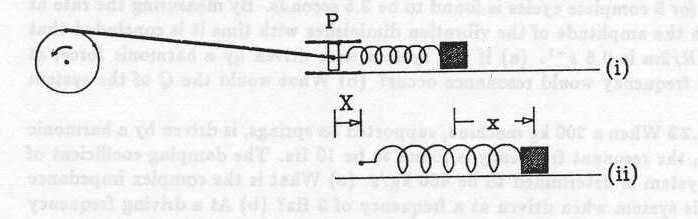
The end P of the spring is fastened by a light rod to a peg on a wheel
mounted on the shaft of a motor which rotates with an adjustable angular
velocity, w . Point P is forced to move (very
nearly) with simple harmonic motion, so that its motion is given by X=B
cos w t where B is a constant. In Figure (i)
the spring is unstretched and point P is at the midpoint of its motion.
Figure(ii) shows the system at a general time t.
(a) Isolate the mass m in this last figure, draw in the force exerted by the spring and assume an additional damping force R dx/dt Write the equation of motion and show that this has the form
1.19 One form of accelerometer consists of a mass m attached
to a piezoelectric crystal. The crystal is mounted on and moves with the
body whose acceleration is to be measured as suggested in the figure.
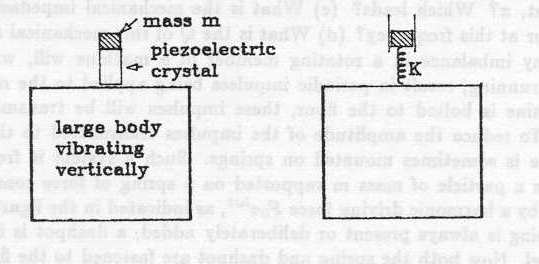
Assume that the crystal behaves as a spring of force constant K, that
the bottom end of the spring is forced by the vibrating body to move in
simple harmonic motion, and that, in addition to the spring force, a damping
force proportional to the velocity acts on the mass m. Show that the motion
of m is that of a driven harmonic oscillator. (See problem 1.18 ) The changes
in the length of the spring correspond to changes in the dimensions of
the piezoelectric crystal. Such changes generate electrical signals which
are a measure of the acceleration.
1.20 The steady state motion of a harmonic oscillator driven by a force Fo cos w t is described by equations (1.21) and (1.22). The quantity Fo/( w Z) is referred to as the displacement amplitude, while the quantity Fo/Z is referred to as the velocity amplitude or the peak value of the velocity. Both of these quantities depend on the frequency of the driving force. If the frequency, w , of the driving force is varied keeping Fo constant, (a) find in terms of m, K and R, the frequency for which the displacement amplitude is largest. (b) Find the frequency at which the velocity amplitude is largest.
1.21 A heavy machine is mounted on springs. When set in oscillation,
the time for 5 complete cycles is found to be 2.5 seconds. By measuring
the rate at which the amplitude of the vibration diminishes with time it
is concluded that a =R/2m is 0.8 s-1.
(a) If this system were driven by a harmonic force, at what frequency
would resonance occur?
(b) What would the Q of the system be?
1.22 When a 300 kg machine, supported on springs, is driven by
a harmonic force, the resonant frequency is found to be 10 Hz. The damping
coefficient of the system is determined to be 450 kg/s.
(a) What is the complex impedance of this system when driven at a frequency
of 5 Hz?
(b) At a driving frequency of 5 Hz, find the phase difference between
the driving force and the velocity. Which leads?
1.23 When an oscillator is driven at a frequency f=7.96 Hz, its
impedance is Z = 2500 + 6000i kg/s. When driven at a frequency of
1.59 Hz, its impedance is Z=2500-1800i kg/s.
(a) If the magnitude of the driving force is 1000 N, what is the peak
value of the displacement when the system is driven at 7.96 Hz? (b) What
is the Q of this system?
1.24 A harmonic oscillator is being driven by a driving force
Fo cos wt at a frequency such that w m=3 kg/s,
K/w =5 kg/s, R=2 kg/s.
(a) Is the driving frequency smaller than, equal to, or greater than
the resonant frequency?
(b) What is the phase difference between the driving force and the
displacement, x? Which leads?
(c) What is the mechanical impedance of the oscillator at this frequency?
(d) What is the Q of this mechanical system?
1.25 Any imbalance in a rotating member of a machine will, when the machine is running, result in periodic impulses being applied to the machine. If the machine is bolted to the floor, these impulses will be transmitted to the floor. To reduce the amplitude of the impulses transmitted to the floor, the machine is sometimes mounted on springs. Such a system is frequently modeled as a particle of mass m supported on a spring of force constant K and driven by a harmonic driving force Fo exp(iw t) as indicated in the figure.
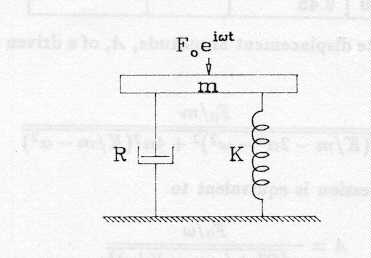
Since some damping is always present or deliberately added, a dashpot is included in the model. Now both the spring and dashpot are fastened to the floor and hence they both exert forces on the floor.
(a) Show that when the system is vibrating, the resultant force exerted on the floor by the dashpot and spring is of the form FT exp(iw t), where
FT = [(R-iK/w )Fo]/[R + i(w m-K/w )]
(b) The ratio FT/Fo is called the force transmissibility
of the spring dashpot arrangement. Show that this ratio will always be
greater than or equal to one for frequencies for which w
<woÖ2
, w o = Ö (K/m)
.
(c) Given that the damping constant R=Ö
(2Km) calculate the force transmissibility for a frequency w
= 5wo .
(d) For the system of Problem 1.22, find the force transmissibility
for a frequency of 30 Hz.
1.27 Show, in the steady state, that the total mechanical energy of a driven oscillator is not constant except in the special case when the driving frequency corresponds to the resonant frequency.
1.28 When a harmonic oscillator is being driven at different frequencies keeping the amplitude of the driving force constant, the steady state displacement amplitude is found to have its largest value when the driving frequency is equal to
wA = Ö [K/m - 1/2 (R/m)2]
This frequency is smaller than the resonant frequency w r =Ö (K/m). Show that if the Q of the system is 3.6 or larger, w A differs from w r by less than 2%.
1.29 If Ar is the steady state displacement amplitude when a harmonic oscillator is being driven at its resonant frequency and Ao is the value that the steady state amplitude approaches as w® 0 show that Q=Ar/Ao.
1.30 Show, for a driven harmonic oscillator, that the average rate at which energy is being dissipated is given by Rvmax2/2 where vmax is the peak value of the velocity.
1.31 Below are some experimental data showing the steady state
displacement amplitude of a driven oscillator as a function of the driving
frequency. The amplitude of the driving force was maintained constant throughout.
From this data find the Q of this oscillator. Find the value of a
=R/2m.
| f(Hz) | Ampl(cm) | f(Hz) | Ampl(cm) |
| 0.0100 | 2.90 | 0.0600 | 10.0 |
| 0.0200 | 3.10 | 0.0615 | 10.2 |
| 0.0300 | 3.60 | .0630 | 10.0 |
| 0.0400 | 4.55 | 0.0640 | 9.75 |
| 0.0500 | 6.60 | 0.0700 | 6.69 |
| 0.0550 | 8.45 | 0.0800 | 3.70 |
| 0.0580 | 9.45 |
1.32 The steady state displacement amplitude A of a driven oscillator may be expressed as
A = (Fo/m)/Ö [(K/m -2a2 - w2)2 + 4a2(K/m - a2)]
a) Show that this expression is equivalent to
A = (Fo/w )/Ö [R2 + (w m-K/w )2]
where a = R/(2m). If w is varied keeping Fo constant, A attains its largest value, Amax at a frequency wA = Ö [K/m - a2], and has a value equal to Amax/2 at some frequency w '. Show that if a << K/m, |w ' - wA| @aÖ 3 .
1.33 A damped harmonic oscillator with a mass m=0.05 kg, a damping
constant R = 2.5 kg/s and a force constant K = 3000 N/m is driven by the
force F(t) depicted in the figure below.
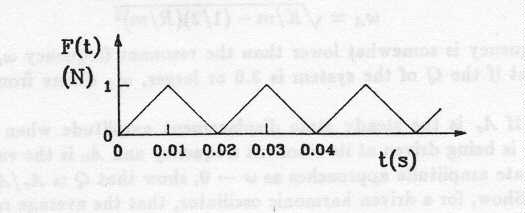
(a) Find the coefficients of the Fourier series representing the function
F(t).
(b) Write the first three terms of the series representing the function
x(t) which describes the steady state motion of the oscillator.