Name _________________________________ Box _____
SL 151
Bremmer
June 16, 2000
1st Exam - - Chapters 1 - 7
Part I. Multiple Choice (3 points each). Indicate the best
answer for each question in the space provided.
In Figure 1, S1 and D1 represent the original
supply and demand curves and S2 and D2 represent
the new curves. Answer the next three questions on the basis of this diagram.

- Referring to Figure 1, the indicated shift in supply from
S1 to S2 may have been caused by:
a decrease in the number of firms in the industry.
firms expecting the future price of the product
to increase.
an increase in the price of the product.
a decrease in the price of a key input used
in the manufacture of the good.
an increase in the price of a substitute in
production.
- Referring to Figure 1, the indicated shift in demand from
D1 to D2 may have been caused by:
a decrease in the price of the good.
a decrease in income, if the good is normal.
an increase in the price of a substitute good.
an increase in the price of a complement good.
None of the above.
- In the market depicted in Figure 1:
the shifts in demand and supply caused the
equilibrium to move from point J to point M.
there was an increase in demand and an increase
in supply.
the equilibrium price fell because the shift
in supply was greater than the shift in demand.
the shifts in demand and supply caused both
equilibrium price and quantity to decrease.
Both B and C.
- Referring to the production possibilities curve in Figure
2, which of the following statements is true?
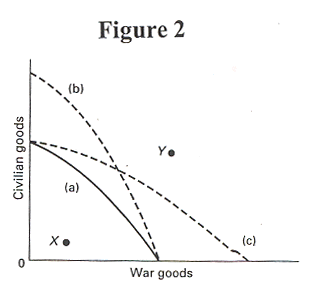
Resources in this economy aren't specialized
as they can be freely moved between the production of civilian goods and
the production of war goods.
Given production possibilities curve (a), point
Y indicates that society is failing to use available resources efficiently.
The movement from curve (a) to curve (b) implies
an improvement in civilian goods technology but not in war goods technology.
Given production possibilities curve (a), the
combination of civilian and war goods indicated by point X is unattainable
to this economy.
All of the above statements are false.
- If the production possibilities curve were a straight, downward
sloping line, this would suggest that:
the production possibilities curve exhibits
the law of increasing cost.
more and more of one good must be sacrificed
as the production of the other good increases.
opportunity costs of producing a given good
is constant regardless of how much is being produced.
resources are specialized.
All of the above except C.
- Which of the following will tend to shift the production possibilities
curve to the right?
A decrease in the unemployment rate towards
the full employment level.
A decrease in labor.
A decrease in natural resources.
A technological improvement which allows firms
to produce more output from given inputs.
A decrease in capital.
- If a nation has a comparative advantage in the production
of X, this means that the nation:
is not subject to the law of increasing opportunity
cost.
has a production possibilities curve identical
to those of other nations.
cannot benefit by producing and trading this
product.
must give up less of other goods than other
nations in producing a unit of X.
cannot consume a bundle of goods above its
production possibilities curve with free trade.
- If two nations have straight-line production possibilities
curves:
there will be basis for mutually advantageous
trade whether the slopes are equal or not.
there will be a basis for mutually advantageous
trade provided the slopes differ.
there will be no basis for mutually advantageous
trade.
then their after trade consumption possibilities
curves must lie inside their respective production possibilities curves.
- Consider the supply and demand curves depicted in Figure 3.
If the government established a price ceiling of $15, then the total revenue
received by suppliers would:
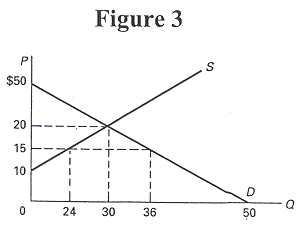
fall by $120.
fall by $240.
fall by $30.
remain unchanged.
- Other things being the same, the shortage associated with
an effective price ceiling will be greater the:
smaller the elasticity of both demand and supply.
greater the elasticity of supply and the smaller
the elasticity of demand.
the greater the elasticity of both demand and
supply.
greater the elasticity of demand and the smaller
the elasticity of supply.
- An inferior good is best defined as a product for which the:
cross price elasticity of demand is negative.
cross price elasticity of demand is positive.
income elasticity of demand is negative.
income elasticity of demand is positive.
income elasticity of demand is zero.
- Assume there is an increase in the demand for hand-held personal
digital assistants. The subsequent:
increase in price will be greater in the long
run than in the short run.
increase in price will be greater the less
elastic the supply.
increase in price will be greater the more
elastic the supply.
decline in price will be greater the more elastic
the supply.
Both A and C.
- Which of the following would not be true regarding
the price elasticity of demand?
The larger the portion of one's budget that
is spent on a good, the more elastic is the demand for the good.
The greater the availability of good substitutes,
the less elastic the demand.
The less time there is at hand, the less responsive
buyers can be in their purchases.
If demand is inelastic and price falls, total
revenue also declines.
If demand is unitary elastic, a change in price
results in no change in total revenue.
- Assuming a downward sloping, linear demand curve, lower prices
always corresponds to:
more elastic demand.
less elastic demand.
greater total revenue.
lower total revenue.
- If the demand curve is perfectly elastic, and supply is upward
sloping, giving every firm a $1 per unit subsidy will:
increase price exactly by $1.
decrease price exactly by $1.
decrease price by less than $1.
decrease price by more than $1.
not affect price at all.
Part II. Short answer (55 points). Give a concise, but complete
answer for each of the following questions. When appropriate, use graphs,
math, or equations to help explain your answers.
- When the price was $12, quantity demanded was 24 units. When price
increased to $14, quantity demanded was 16 units. Calculate the arc price
elasticity of demand associated with this price range. Is demand elastic,
inelastic, or unitary elastic? Confirm the previous answer by comparing
the total revenue associated with each price and explaining how changes
in price and total revenue are related to the price elasticity of demand.
Show your work for partial credit. (10 points)
- Using a production possibilities curve, describe three situations
where it is possible for society to consume more of both goods.
(10
points)
- The U.S. government administers two programs that affect the market
for cigarettes. Media campaigns and labeling requirements are aimed at
making the public aware of the health dangers of cigarettes. At the same
time, the Department of Agriculture maintains effective price floors for
tobacco, and the government limits the amount of land that can be devoted
to tobacco production. Are these programs at odds with respect to the goal
of reducing cigarette consumption? Explain. As part of you answer, illustrate
graphically the effects of both policies on the market for cigarettes.
(10 points)
- Before economic reforms were implemented in the countries of Eastern
Europe, regulation held the price of bread substantially below equilibrium.
Using a demand an supply diagram, describe what happened to the bread market
in these countries as prices were deregulated. (10 points)
- Figure 4 on the right shows the production possibilities curves
for two hypothetical nations, Orin and Pohl, both of which produce two
hypothetical products, jaxs and keps. Answer the following questions on
the basis of this figure. (15 points)
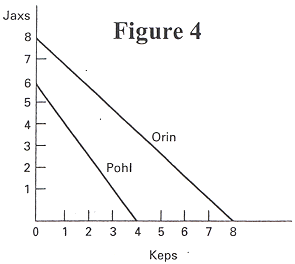
- Referring to the country of Orin, what is the opportunity cost
of producing 1 unit of jaxs? (2 points)
- Referring to the country of Orin, what is the opportunity cost
of producing 1 unit of keps? (2 points)
- Referring to the country of Pohl, what is the opportunity cost
of producing 1 unit of jaxs? (2 points)
- Referring to the country of Pohl, what is the opportunity cost
of producing 1 unit of keps? (2 points)
- In which product does each country have a comparative advantage?
Explain. (4 points)
- Suggest a terms of trade and explain why both countries would
find this terms of trade mutually beneficial. (3 points)