Name _____________________________________ CM ______
SL 151
Bremmer
September 19, 2000
1st In-Class Exam - - Chapters 1 - 6
Part I. Multiple-Choice (3 points each). Indicate the best
answer for each question in the space provided.
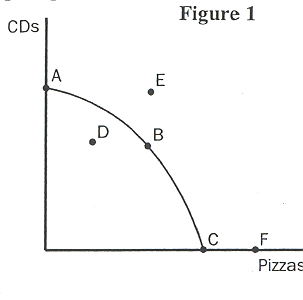
- How might a country consume a bundle of goods that lies above
its production possibilities curve?
The unemployment rate would have to fall toward
the current full-employment level.
The country could discover new supplies of
natural resources.
The country could engage in free trade with
other countries.
All of the above.
Both B and C.
- Referring to Figure 1, which of the following statements is
false?
Point D indicates an inefficient use of resources
and the presence of unemployment.
Point E is unobtainable because such a combination
of goods is beyond society's current productive capabilities.
The opportunity cost of producing one more
pizza increases as more pizzas are produced.
Resources in the economy are not specialized
and resources can be freely moved between the production of pizzas and CDs.
In drawing the production possibilities curve in Figure 1, the supply of resources is assumed to be constant and technology
is fixed.
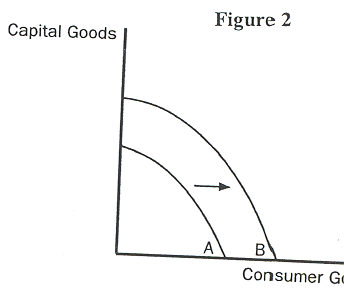
- According to Figure 2, the shift of the production possibilities
curve from curve A to curve B was most likely caused by which of the following?
A decrease in the unemployment rate towards
its current full-employment level.
A decrease in the supply of labor.
A decrease in capital.
An improvement in only the technology used
in producing capital goods.
A general improvement in overall technology.
- Assume a country has a straight-line, downward sloping production
possibilities curve, and it does not trade with any other country. You
can conclude that:
the country's production possibilities curve
is also the country's consumption possibilities curve.
as more of a good is produced, its opportunity
cost remains constant.
resources are not specialized.
All of the above.
None of the above.
- Which of the following would cause the demand curve for good
X to shift to the right?
An increase in income, if X is an inferior
good.
A decrease in the price of good S, a substitute
for good X.
An increase in the price of good C, a complement
to good X.
A decrease in the price of X.
None of the above.
- Which of the following would cause the supply curve of good
X to shift to the left?
A decrease in the price of X.
A decrease in the number of firms producing
good X.
Producers expect the price of X to fall in
the near future.
There is a cost-saving improvement in the technology
used to make X.
Workers who produce good X agree to take a
cut in wages.
- After a decrease in supply, consumer expenditures on the good
increased. In this price range, the price elasticity of demand:
is greater than 1.
is equal to 1.
is less than 1.
cannot be determined from the information given.
- Suppose there was a decrease in both demand and supply, but
the shift in supply was a larger magnitude. Therefore, you can correctly
conclude:
equilibrium quantity will fall but the change
in equilibrium price is indeterminate.
equilibrium price will increase but the change
in equilibrium quantity is indeterminate.
that both equilibrium price and quantity will
decrease.
equilibrium price will increase and equilibrium
quantity will fall.
equilibrium price will decrease and equilibrium
quantity will increase.
- If there is a surplus:
price would increase, causing the supply curve
to shift to the right, and the demand curve to shift to the left.
price would increase, causing producers to
move up along the supply curve and consumers to move up along the demand
curve.
price would decrease, causing the demand curve
to shift to the right, and the supply curve to shift to the left.
price would decrease, causing producers to
move down along the supply curve and consumers to move down along the demand
curve.
- Starting at the vertical intercept, as one moves down a straight-line,
downward sloping demand curve:
the price elasticity of demand increases, hits
a maximum, and then decreases.
the price elasticity of demand remains constant.
the price elasticity of demand decreases.
the price elasticity of demand increases.
the price elasticity of demand decreases, hits
a minimum, and then increases.
- Assume the supply curve is perfectly elastic. If the government
pays all firms a $2 per unit subsidy, then:
equilibrium price will decrease by less than
$2.
equilibrium price will decrease exactly by
$2.
equilibrium price will decrease by more than
$2.
equilibrium price will increase by exactly
$2.
equilibrium price will increase by less than
$2.
- Assume demand is perfectly inelastic and the equilibrium price
is $5. If the government sets a price ceiling at $4:
it would not be binding.
the resulting surplus will be larger the less
elastic the supply.
the resulting surplus will be larger the more
elastic the supply.
the resulting shortage will be larger the less
elastic the supply.
the resulting shortage will be larger the more
elastic the supply.
- The demand for a product will be less elastic:
if the good was a luxury good rather than a
necessity.
if the consumer spent a larger portion of his
or her income on the good.
if the product had a large number of available
substitutes.
in the short run rather than in the long run.
- If a positively sloped, linear supply curve cuts the vertical
axis above the origin, then:
at every price, supply is elastic.
at every price, supply is inelastic.
at every price, supply is unitary elastic.
the firm would be willing to sell output at
a zero price.
- Assume an increase in the price of Y results in an increase
in demand for good X. Therefore:
X and Y are complements and the cross price
elasticity of demand for X should be negative.
X and Y are substitutes and the cross price
elasticity of demand for X should be positive.
X and Y are complements and the cross price
elasticity of demand for X should be positive.
X and Y are substitutes and the cross price
elasticity of demand for X should be negative.
X is a normal good, and the income elasticity
of X is positive.
Part II. Short Answer Questions (55 points). Give a concise,
but complete answer for each of the following questions. When appropriate,
use math, graphs, or equations to help explain your answers.
- Define opportunity cost. Using a production possibilities curve,
explain how this diagram shows the concept of opportunity cost. (10
points)
- Suppose the price of product X is reduced from $1.45 to $1.25
and, as a result, the quantity of X demanded increases from 2,000 to 2,200.
Using the arc formula (the book calls it the midpoint formula), calculate
the price elasticity of demand. Is demand elastic or inelastic? (7 points)
- Other things being equal, use a demand and supply curves to show
the effect of each of the following on the equilibrium price and quantity
of corn. (18 points)
- Corn is now considered by doctors to be the most healthy vegetable.
- There is a decline in the amount of land used to grow
corn.
- The price of peas, a substitute for corn, goes up.
- Corn is a normal good and incomes fall.
- Producers expect the price of corn to fall in the future.
- The price of fertilizer increases.
- Answer the following questions using Figure 3, which shows the
production possibilities curves for George and Martha. (10 points)
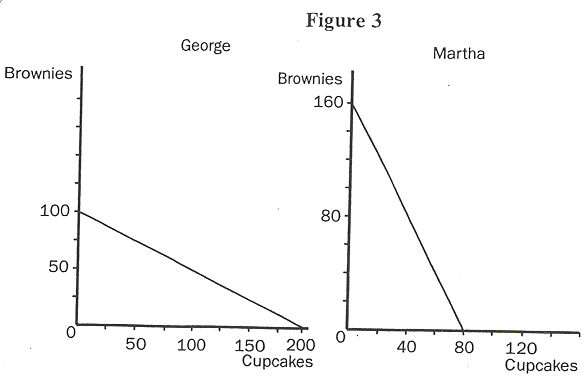
- What is George's opportunity cost of producing 1 more brownie?
(1
point)
- What is Martha's opportunity cost of producing 1 more cupcake?
(1
point)
- Define what is meant by comparative advantage. Where does George's
comparative advantage lie? In what product does Martha have a comparative
advantage? Explain. (6 points)
- Suggest a terms of trade that both George and Martha would find
mutually advantageous. (2 points)
- Suppose the government imposes a $5 per unit excise tax on sellers
of automobile tires. Using a demand and supply curves, carefully show and
explain the before-tax and after-tax situation. Indicate on your graph
the tax burden on consumers, the tax burden on sellers, and the government's
tax receipts. (10 points)