Syllabus

CSSE 490 - Robotics and Teamwork

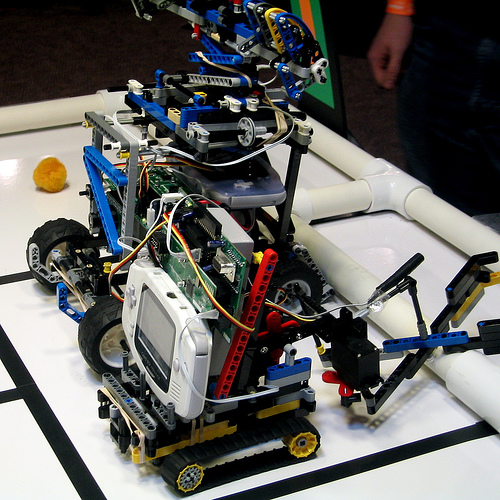
I'm not sure that the students who built this robot used the KISS principle -- what do you think?

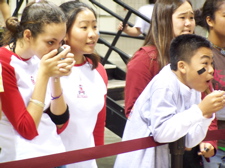
The team shown to the left used team tshirts as a team-building technique. What other techniques do you think helped them work effectively as a team?

This document contains:

General course information Instructors
Texts, Software and Other Resources Learning Objectives
Expectations Grading
Collaboration and Academic Honesty

Rose-Hulman Institute of Technology

Computer Science and Software Engineering Department

Spring term, 2005-2006

General course information

Prerequisites:

The only prerequiste is an interest in learning about robotics and teamwork by doing service. In particular, you must have an interest in helping middle and high school students learn about robotics and teamwork.

Meeting times and places:

  • Most weeks: Monday and Thursday, 7th period, in F-217 (CSSE lab)
  • Some weeks we will also meet on Tuesday. Some weeks we will not meet on Monday and/or Thursday.
  • In addition, you will meet frequently with your Rose-Hulman teammates during 7th period or other times that your team finds convenient.
  • In addition, you will meet regularly (once or twice a week, most weeks) with the middle/high school students whom you mentor, at times that you arrange with those students.

Course Description that might someday be in the online Undergraduate Bulletin:

The mission of this course is to use service learning to help students internalize and deepen their understanding of how to work effectively in teams, while at the same time helping students improve their communication skills, their problem-solving, and their technical knowledge of robotics.

Learning Objectives (aka Course Outcomes)

Students who successfully complete the course should be able to demonstrate:

  1. An understanding of how to work effectively in teams, including (but not limited to):
    1. The importance of creativity and how to combat blocks to creativity.
    2. The importance of specifications and how to express them.
    3. The roles of team members and how to conduct effective team meetings using those roles.
    4. How to reach consensus and how to handle conflicts.
    5. How to manage the progress of the team using task lists and other techniques.
    6. How to develop alternative designs and choose among them.
  2. The goals of written, oral and interactive communication and how to implement them effectively.
  3. An awareness of how professionalism impacts their career and how to maintain professional standards in their work.
  4. An increased understanding of one or more technical subareas of robotics, e.g. the design and use of sensors, software development of concurrent code, path planning, vision, or programming language design.
  5. An ability to help others understand what engineering is and why it is fun.
  6. The ability to integrate the above mentioned course goals in the successful completion of three course projects.

To accomplish these goals, students will complete 3 team projects:

  • Project 1: Design and implement a robot that could compete in the 2006 Beyond Botball competition described at www.botball.org/current-season/beyond_botball.php
    • Students will build the robots using Legos, HandyBoard and Mindstorms controllers, and many types of motors and sensors. Some teams may use other, even more sophisticated, robotics parts.
  • Project 2: Develop and deliver interactive exercises that teach middle-school and high-school students how to work effectively in teams.
    • In doing so, students will internalize their own understanding of how to work effectively in teams (per the goals listed above) and then deepen that understanding by developing effective ways to communicate that understanding to middle-school and high-school students.
    • The best design for such exercises would allow the exercises to be extended easily to other groups of people, e.g. first-year Rose-Hulman students.
    • The exercises will be delivered to middle-school and high-school students competing in the 2006 Botball competition described at www.botball.org. The Rose-Hulman students will deliver the exercises, help teach the exercises to any middle-school and high-school teachers involved, and mentor behavior implied by the exercises in working with the middle-school and high-school students.
  • Project 3: Investigate a technical area of robotics and present, orally or in writing, the technical ideas that the students learned from the investigation.
    • Each student team will choose their own area, but the ideas learned must extend (not repeat) ideas that the student team brings to this course.

Instructors

Steve Chenoweth

Associate Professor of Computer Science and Software Engineering

Email: chenowet@Rose-Hulman.edu
Office phone: (812) 877-8974
Office address: Moench F-220
Home page: http://www.rose-hulman.edu/~chenowet
Office hours: Stop by any time my door is open. I of course will not be there during my classes; during the spring term my regular classes meet:
  • MTRF 4th period - I'm teaching CSSE 474 in O-157.
  • MTR 7th period (this course), in F-217 (CSSE lab).
  • Tues 10th period and at two other times yet to be determined, I’ll be in Senior project in the CSSE conference room.
  • Wednesdays 9:55 -11:40 we have a department meeting.
Check the schedule on my door after the course begins for any additions. Or, feel free to make an appointment.

David Mutchler

Professor of Computer Science and Software Engineering

Email: David.Mutchler@Rose-Hulman.edu
Office phone: (812) 877-8426
Office address: Moench F-214
Home page: http://www.rose-hulman.edu/~mutchler
Office hours: Stop by any time my door is open. I of course will not be there during my classes; during the spring term my regular classes meet:
  • MTR 5th and 6th periods - I'm teaching CSSE 332 in D-219.
  • MTR 7th period (this course), in F-217 (CSSE lab).
  • Wednesday after 3 p.m. I usually help North Vigo's Botball team at their school.
  • Fridays from 12:30 p.m. to 2 p.m. I usually help Woodrow Wilson's Botball team at their school.
  • Wednesdays 9:55 -11:40 we have a department meeting.

My Microsoft Outlook calendar holds all my current appointments / committments. Use it, email or the telephone if you wish to schedule an appointment with me.

Stephen Pakbaz

Student assistant

Email: pakbazsc@Rose-Hulman.edu
Residence phone: (812) 877-1511
Residence address: 101 Dorm
Home page: http://www.rose-hulman.edu/~pakbazsc

Expectations

As a student in this course, you are expected to:

Attend class and participate actively in the learning experiences

Assist classmates with their learning

Do things that will enhance your (and everyone's) learning, for example:

  • Ask questions! In general, no question is too dumb. Other students will generally be grateful that you asked your question.
  • Volunteer answers to questions asked in whole-group session. Don't be afraid of answering incorrectly. Sometimes your incorrect guesses may lead to a more fruitful discussions than if you give a correct answer right away!
  • When you assist a classmate, help the classmate understand the concept, not merely "solve the problem."

Try to avoid things that will detract from your learning or that of people around you, for example:

  • Missing class
  • Showing up for class late
  • Talking to other people about things unrelated to the course
  • Chewing gum noisily
  • Using your computer for things unrelated to the course
  • Refusing to work with a partner on a group activity
  • Being disrespecful to a classmate, student assistant or instructor

Keep up with assigned work

Use Angel to record your work for this class, reflect upon it, and stay in touch outside of class

Every weekday, log into Angel to record what work you did that day for this class (even if you did no work for this class that day). At the same time, check Angel for announcements or other communication.

Take responsibility for your own learning

Jones, Valdez, Nowakowski, and Rasmussen (1995) describe indicators of engaged learning:

"In engaged learning settings, students are responsible for their own learning; they take charge and are self-regulated. They define learning goals and problems that are meaningful to them; have a big picture of how specific activities relate to those goals; develop standards of excellence; and evaluate how well they have achieved their goals. They have alternative routes or strategies for attaining goals—and some strategies for correcting errors and redirecting themselves when their plans do not work. They know their own strengths and weaknesses and know how to deal with them productively and constructively. Engaged learners are also able to shape and manage change."

Grading

The learning objectives for this course are listed above. Because this is a service-learning course, we will assess your effort rather than directly measuring your success at the learning objectives.

To that end, you will record your work in this course on a daily basis, by using Angel to complete a short survey each weekday. Your daily surveys will determine your grade as follows:

  • About 12 hours per week of work for this course (counting all your work, in class and out) earns you an A, assuming that:
    • You work steadily -- you should work about 12 hours or more most weeks, not merely average 12 hours of work per week.
    • You distribute your work reasonably among the three projects, thereby succeeding in all three projects.
    • You provide high-quality reflections with your daily surveys and you provide a high-quality report from your Project 3 research.
    • You attend class regularly.
  • About 8 hours per week of work for this course (counting all your work, in class and out) earns you a B, under the same assumptions as above.

Texts, Software and Other Resources

Required text: None

Required software:

TBA

Other resources include:

Collaboration and Academic Integrity

Collaboration is required in much of your work in this course. When you collaborate, you must:

Properly credit your collaborators.

Indicate clearly the extent of the collaboration.

Failure to properly acknowledge collaboration can be considered cheating.

Recall the Institute policy on academic misconduct:

"Rose-Hulman expects its students to be responsible adults and to behave at all times with honor and integrity."
The departmental statement on academic honesty has more detailed advice.

Dishonesty on any work in this course may result in a lowered course grade or a grade of an F in the course. More important, such dishonesty steals your own self-esteem. So don't cheat.

Syllabus developed by David Mutchler and Steve Chenoweth, Spring 2005–06, based on earlier work by Mike Wollowski, Claude Anderson, Andy Kinley, Salman Azhar, Curt Clifton, Matt Boutell and others.