CSSE 230
Data Structures and Algorithm Analysis
Written Assignment 7
- 80 points
To Be Turned In
Submit to the WA7 drop box on ANGEL. Late days may be used for written assignments.
-
Don’t forget: You should be keeping an individual log about your team project work so that you can write a performance evaluation for each of your teammates. You do not need to turn in this log, but I wanted to remind you while I had your attention.
-
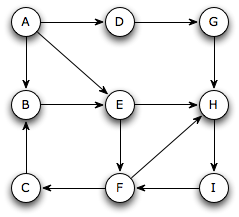
(30 points) Consider the following directed graph:
-
(5) Show the first three rows of an adjacency matrix for this graph. Label the rows and columns.
-
(5) Show an adjacency list representation of this graph.
-
(5) Show an edge list representation of this graph.
-
(15) Which of the above representation will use the least space? Support your answer with calculations. Be explicit about your assumptions concerning details of the representations.
- (15 points) Prove by mathematical induction that n! ≥ 2n for all integers n≥4.
(It can be proven other ways, but this is a good example for practicing induction, so that is what you should do).
-
(15 points) Weiss exercise 20.5 [20.5]. In this problem you will check your understanding of
collision resolution techniques in hash tables.
-
(20 points) Weiss Exercise 21.3[21.3]. The add and buildHeap algorithms are on pages 815 [753] and 819[757],
respectively. Do this one carefully.
It will be hard to know how to give partial credit for incorrect answers.
Optional practice problem
- not to be turned in.
This problem has been assigned in the past. Since you are actually implementing height-balanced trees, it seems redundant. But it could still be a very good practice problem for the next exam, so I did not remove it.
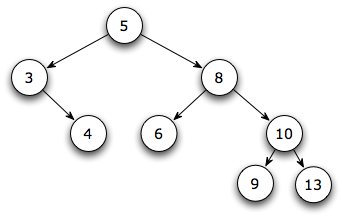
(xx points) Start with the following Binary Search Tree:
See the hint at the end!
-
Is this an AVL tree? ____ If not, rearrange it so that it is height-balanced.
-
Draw the tree after insertion of a node containing 11, using the usual BST insertion algorithm.
-
Is the new tree AVL? ______ If not, name the node where the rotation should be done, according to the algorithm from class. ______ Single or double rotation? ____________ If you need to do a rotation, draw the resulting tree.
-
Delete the element 5 from the original tree (not the one from part c), using the BST deletion algorithm described in class and in the textbook. Draw the new tree.
-
Is the new tree AVL? ______ If not, name the node where the rotation should be done, according to the algorithm from class. ______ Single or double rotation? ____________ If you need to do a rotation, draw the resulting tree.
-
Is your new tree (if any) AVL? ______ If not, name the node where the rotation should be done, according to the algorithm from class. ______ Single or double rotation? ____________ If you need to do a rotation, draw the resulting tree.
-
Add the element 5 to the tree from part (f) using the BST algorithm. Draw the new tree.
-
Is the new tree AVL? ______ If not, name the node where the rotation should be done, according to the algorithm from class. ______ Single or double rotation? ____________ If you need to do a rotation, draw the resulting tree.
-
Add the element 12 to the tree from part (h). Draw the new tree.
-
Is the new tree AVL? ______ If not, name the node where the rotation should be done, according to the algorithm from class. ______ Single or double rotation? ____________ If you need to do a rotation, draw the resulting tree.
-
Add the element 7 to the tree from part (j). Draw the new tree.
-
Is the new tree AVL? ______ If not, name the node where the rotation should be done, according to the algorithm from class. ______ Single or double rotation? ____________ If you need to do a rotation, draw the resulting tree.
Hint: In my solution, for all the sub-parts together, I did three single rotations and no double rotations. The first four leaf nodes in my final tree were 3, 5, 7, and 9. (In my first attempt, I misread part d) and deleted from the tree in part c) rather than the original tree. With that mistake, for all the sub-parts together, I did two single rotations and one double rotation and the first four leaf nodes in my final tree were also 3, 5, 7, and 9.)