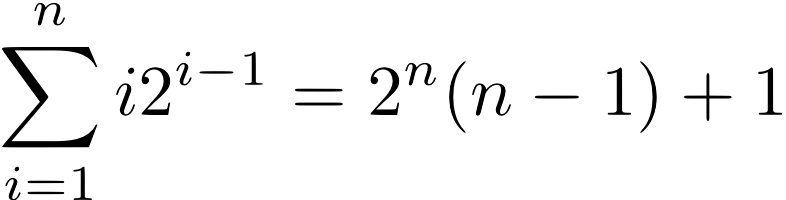
(20 points) Weiss Exercise 5.26 [5.20]. Calculate the average-case time complexity of the binary search algorithm. In order to make the calculations simpler, you may assume that N = 2k - 1 for some integer k ≥ 0, and that all elements are equally likely to be the one we are searching for. Note that the problem only deals with successful searches (where the item we are looking for is actually in the array).
Hint: For each i, count how many of the array elements will be found after binary search examines exactly i array elements. (For example, the middle element is the only one to be found after examining one array element, and there are two elements that can be found after two probes into the array.) Use a summation to help you find the average.
Potentially useful fact: Depending on how you work this problem, you may find the following useful: