- Some of you did the wordCount assignment in the Session07 project; in that case, simply copy your work from the Session07 project to the Session08a-Files project.
- For this and all the subsequent items, turn in your work by Team → Commit, as usual.
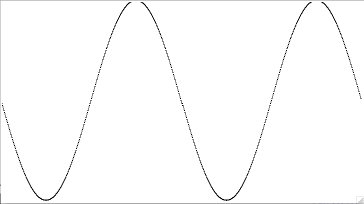
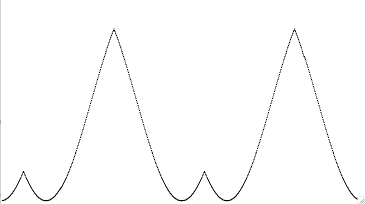
- Test your program using the sin.txt and maxSinCos files that we supplied in the Session08b-ObjectsAndGraphics folder. (The functions are "upside down" from that shown below because of the graphics coordinate system. You could fix that by using zellegraphics' win.setCoords() method if you so desire, but we won't require it.)
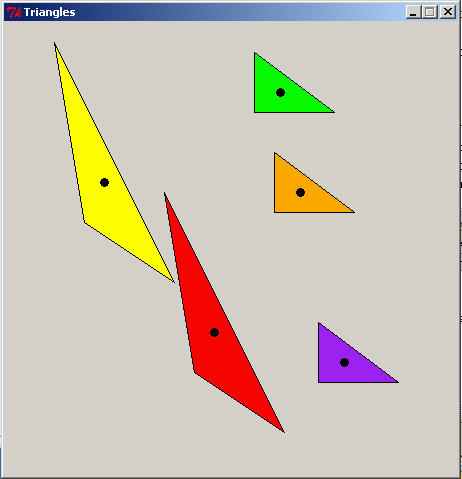 |
Correct output to the console from the completed
program::Centroid of t1 is (100, 160). Area of t1 is 7200.00. Now we'll move the triangle Centroid of t1 is (210, 310). Area of t1 is 7200.00. Centroid of t2 is (276, 70). Area of t2 is 2400.00. Now we'll move the triangle Centroid of t2 is (296, 170). Area of t2 is 2400.00. Centroid of t2 is (340, 340). |
(40 pts)
Mutable Parameters.
This exercise deals with the concepts in section 6.5 of Zelle. You may wish to re-read that section before doing this exercise.
You may do it alone or with your partner from class.
Background
In class we saw that functions can assign to their formal parameters:
def nextSquare(x):
    x = x + 1
    return x * x
But we also saw that the calling code cannot see the effect of this assignment:
y = 8
next = nextSquare(y)
print "y = %d, next = %d" % (y, next)
# prints:
# y = 8, next = 81
This is because the assignment to
x
in
nextSquare()
only changes the value referred to by
x. Informally, it just moves the post-it note for
x
onto the number 9, but the post-it note for
y
remains stuck to 8.
We've also seen that we can modify lists without using assignment:
squares = []
for n in range(10):
    squares.append(n**2)
print squares
# prints:
# [0, 1, 4, 9, 16, 25, 36, 49, 64, 81]
Here the
append()
method tells the
squares
list to add the given square to its "tail". Informally, the
squares
post-it note remains stuck to the same list throughout the code, but the list is being
mutated
by the
append()
method.
We can also mutate a list by assigning to its individual elements:
numbers = [2,3,5,7,11]
for i in range(len(numbers)):
    numbers[i] = numbers[i] ** 2
print numbers
# prints:
# [4, 9, 25, 49, 121]
In this example the
numbers
post-it note never moves once it is stuck to the original list. The assignment to
numbers[i]
in the body of the loop
mutates
the list by changing elements
inside it. It might help to think of the list like an egg carton. We put the numbers 2, 3, 5, 7, and 11 into the first five pockets of the egg carton, then we affix the
numbers
post-it note to the carton. In the loop we take out each number and replace it with its square, one pocket at a time. The carton and the post-it note never change.
We can use this idea of mutating a list to create a function that changes its parameters. Here's a function that does just that:
def factEach(nums):
    """Replaces each element of nums with its factorial."""
    for i in range(len(nums)):
        nums[i] = factorial(nums[i])  # factorial defined as in class
And some code demonstrating the function:
numbers = [2,3,5,7,11]
factEach(numbers)
print numbers
# prints:
# [2, 6, 120, 5040, 39916800]
To be turned in
Use the Session09 project that you checked out in class. Write and test functions in the module mutantFunctions.py that meet each of the following specifications.
(10 Points)
			squareEach(nums)
, wherenumsis a list of numbers. Modifies the list by squaring each entry.(10 Points) sumList(nums), wherenumsis a list of numbers. Returns the sum of the numbers in the list.(20 Points) toNumbers(strList), wherestrListis a list of strings, each of which represents a number. Modifies each entry in the list by converting it to a number. Here's an example use:numList = [10,20,30] print "sum = ", sumList(numList) squareEach(numList) print "squared: ", numList print "sum = ", sumList(numList) strList = ["17", "1.5", "2.718"] print "As strings: ", strList toNumbers(strList) print "As numbers: ", strList #prints the following output: #sum = 60 #squared: [100, 400, 900] #sum = 1400 #As strings: ['17', '1.5', '2.718'] #As numbers: [17, 1.5, 2.718]