(30 pts) File output and string formatting: Storing information in files is a very important exercise for engineers running experiments that generate a large quantity of useful data. The stored data can later be analyzed, categorized, and manipulated to allow engineers to draw useful conclusions.
Often, the generated data is formatted so that another
program can automate the process of analyzing, categorizing,
and manipulating the data. In this problem you are to write a program,
funcDump.py, that implements the following design:
- Prompt the user for a file name
- Open a file with the given name
-
Write 720 lines to the file. Each line should have the data:
n 200 + 200cos(nπ/180)
where n ranges from 0 to 719. Make sure the file is neatly formatted so numbers and decimal points line up. Below is a sample of the expected output. Your program's output should match this format exactly.
 98   172.165
 99   168.713
100   165.270
101   161.838
102   158.418
103   155.010
104   151.616
105   148.236
106   144.873
107   141.526
108   138.197
109   134.886
110   131.596
111   128.326
112   125.079
113   121.854
114   118.653
115   115.476
116   112.326
117   109.202
118   106.106
119   103.038
120   100.000
121    96.992
122    94.016
- Close the file
Submit your Python source file and the generated output to the funcDump Drop Box in the Homework 5 folder on ANGEL.
- Install Eclipse by following these instructions. (Upperclassmen need to update to Eclipse 3.4; freshmen can skip this.)
- Install and configure PyDev for Eclipse by following these instructions. (Upperclassmen need to do all of this; freshmen can skip the beginning and start at step 3 of Install the PyDev plug-in for Eclipse.)
- Install and configure Subclipse for Eclipse by following these instructions. (Everyone needs to do this.)
- You must show us in class next session (if you haven't
already):
- Launch Eclipse and show us your Hello World Python program running.
- In Eclipse, show us your modified "spam.py" file that you checked out using Subclipse. If you didn't get this working, instead choose Window > Open Perspective > Other..., and show us that "SVN Repository Exploring" appears in the list.
- Prompt the user for the file name and open the file with that name.
- Play your warning sound from the last robot homework.
- Read each line of the file. Each line will contain 4 values (
turn_angle_in_deg, turn_speed, fwd_distance_in_cm, fwd_velocity) - For each line, turn the robot based upon the turn angle and speed, then drive the robot forward based upon the forward distance and velocity.
For example (this is box.txt):
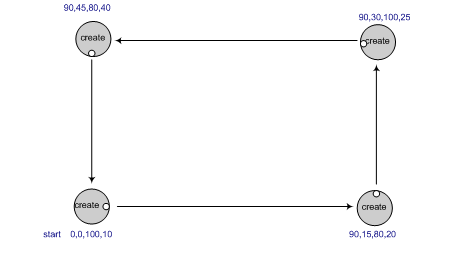
- You will likely use the go() and sleep() functions to move the robot, as you did last time. Another option instead of sleep is to use the wait_angle() and wait_dist() functions; see pycreate.pdf for details.
- Don't forget to close both the file and the connection to the robot at the end of your code!
- What you notice is that the more the robot moves the less accurate it will become in moving the prescribed distance or returning to the same point. This robot drifting is called odometry error. Odometery error means that the longer the robot travels, the sensor used to calculate the distance traveled (i.e. encoder) begins to accumulate error. This error is based upon wheel slippage, friction, uneven surfaces, wobbling wheels or sensor inaccuracy. In other words, the robot may “think” it is at a different place in the world than it actually is. This is a common problem in robotics research and it is necessary to add hardware or write control algorithms to combat this. For your homework, it is important to recognize the problem but you will not modify your program to compensate for it.
- Create a version of
funcDump.pythat prompts the user to enter the function for column 2 instead of hard-coding the function.