range.
Write a Python
range
expression for each of the following lists. You should write your expressions in a new file, rangeAndList.py, in IDLE, using
print
statements to print the answers. Answers to the first two are given as examples.
-
[0, 1, 2, 3, 4, 5]
Answer:print "3a.", range(6) -
[2, 3, 4, 5, 6, 7]
Answer:print "3b.", range(2, 8) -
[-2, -1, 0, 1, 2] -
[1, 3, 5, 7, 9] -
[1, 4] -
[0, 2, 4, 6, 8, 10, 12, 14, 16, 18] -
[2, 1, 0, -1, -2]
Manipulating Lists. Continuing with the file your created for the previous problem, add the following line of code:
myList = [3, 6, 8, 11, 7, 4, 5, 9, 10, 0, 2]
Now add statements to your program to print each of the following numbers or lists using expressions involving
myList. Again, a couple of examples are given.
-
3
Answer:print "4a.", myList[0] -
[3, 6, 8]
Answer:print "4b.", myList[:3] -
[8, 11, 7, 4] -
2 -
[0, 2] -
The position of
4inmyList. -
The length of
myList.
Upload the file containing your answers to problems 3 and 4 to the RangeAndList dropbox in the Homework 4 folder on ANGEL.
Some Geometry with Lists. For this problem you'll write three small, separate, but similar graphics programs: Pizza, Polygon, and Star.
Each program prompts the user to enter an odd integer, number. Then the programs draw pictures as follows:
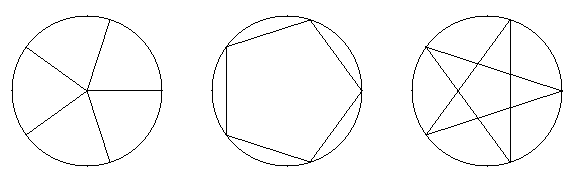
- The Pizza program draws a "pizza pie" with number slices.
- The Polygon program draws an inscribed regular polygon with number sides.
- The Star program draws the inscribed star generated by connecting every other vertex of the regular polygon.
The pictures below show what the display of your programs should look like for a couple of cases.
Examples when number is 5:
Examples when number is 7:
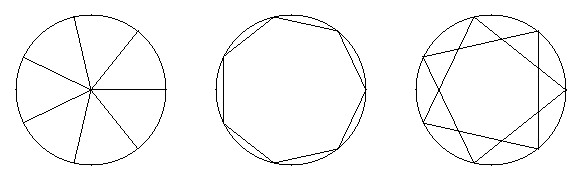
Copy and paste liberally during this assignment, but get Pizza right before moving on to Polygon and Star.
You may wish to use the following code, which generates an appropriate list of Points for any value of number:
    # Some constants
    radius = 150
    centerX = 200
    centerY = 200

    # Builds vertices list
    vertices = []
    for i in range(number):
        x = radius * cos(2 * pi * i / number) + centerX
        y = radius * sin(2 * pi * i / number) + centerY
        vertices.append(Point(x, y))
Do you see how you can iterate over the Points stored in the list vertices in order to find endpoints for the lines?
When you have finished and tested your programs, submit each Python source file to the corresponding drop box in the Homework 4 folder on ANGEL.