- Do its TODO's, in order.
- Commit your project when done.
Note: this problem, while good and challenging, is not as directly useful to your mastery of C as the previous C exercises have been. If you are behind, catch up on the previous exercises (including the one above) and skip this exercise if necessary.
Checkout the 25-Structures2 project. The rest of this assignment refers to that project.
(35 points) This problem involves defining and using some structs to model filled rectangles on the Cartesian (x, y) plane. A rectangle is represented by two points, point1 and point2, indicating opposite corners of the rectangle. The figure below illustrates the problem. The labels in the figure correspond to the variable names in the provided test code.
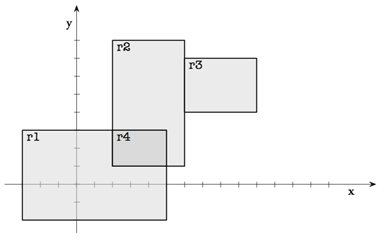
The parts of this problem must be completed in the order given; testing of the later steps depends on your implementation of the earlier steps. Part (b) should be completed in file rectangle.h and the remaining parts of the problem should be completed in rectangle.c. The file main.c should NOT be modified.
- (3 pts) Name and programming style
- (2 pts) We've provided an empty struct type Rectangle in file rectangle.h. Change this struct to store the necessary information (the points described above).
-
(2 pts) Now write a
function Rectangle makeRect(int x1, int y1, int x2, int
y2) in Rectangle.c that makes a Rectangle from the given coordinates,
where point1 has coordinates (x1, y1) and point2 has
coordinates (x2, y2). Any opposite corners may be given;
for example r1 in the figure could be generated using
any one of the following:
- r1 = makeRect(-3, 3, 5, -2) ,
- r1 = makeRect(-3, -2, 5, 3) ,
- r1 = makeRect(5, -2, -3, 3) , or
- r1 = makeRect(5, 3, -3, -2).
The function stub is already included, as is code in main() that tests your function.
-
(2 pts)
Write a function int getLeft(Rectangle r)
that returns the x-coordinate of the
left-most edge of the given rectangle. For example,
getLeft(r1) should return -3. The function stub is
already included, as is code in
main()that tests your function. -
(2 pts)
Write a function int getRight(Rectangle r)
that returns the x-coordinate of the right-most edge of
the given rectangle. For example, getRight(r1) should
return 5. The function stub is already included, as is
code in
main()that tests your function. -
(2 pts)
Write a function int getTop(Rectangle r)
that returns the y-coordinate of the top-most edge of
the given rectangle. For example, getTop(r1) should
return 3. (Note: y values increase as we move up, like
in mathematics.) The function stub is already included,
as is code in
main()that tests your function. -
(2 pts)
Write a function int getBottom(Rectangle r)
that returns the y-coordinate of the bottom-most edge of
the given rectangle. For example, getBottom(r1) should
return -2. The function stub is already included, as is
code in
main()that tests your function. -
(12 pts)
Write a function int areIntersecting(Rectangle
q, Rectangle r) that returns a "true"
value if the given rectangles touch and a "false" value
if they do not touch. For example, areIntersecting(r1,r3)
should return "false", but areIntersecting(r1,r2) and
areIntersecting(r2,r3) should both return "true". The
function stub is already included, as is code in
main()that tests your function. -
(8 pts)
Write a function Rectangle
intersect(Rectangle q, Rectangle r) that
returns a new rectangle representing the overlapping
area of the two given rectangles. You may assume that
the two rectangles do, in fact, overlap. The function
stub is already included, as is code in
main()that tests your function.
When your code is working, commit it to your repository.