34.15. Identify: Apply
Eq.(34.11), with  is the apparent depth.
Set Up The image and object are shown in Figure 34.15.
|
|
|
|
Figure 34.15 |
|


Execute: 
The apparent depth is 2.67 cm.
Evaluate: When the light goes from ice to air (larger to smaller n), it is bent away from the normal and the virtual image is closer to the surface than the object is.
34.19. Identify: The hemispherical glass surface forms an image by refraction. The location of this image depends on the curvature of the surface and the indices of refraction of the glass and oil.
Set Up: The image and object
distances are related to the indices of refraction and the radius of curvature
by the equation  .
.
Execute: 
Evaluate: The presence of the oil changes the location of the image.
34.23. Identify: Use
 to calculate f. The apply
  and
and  .
.
Set Up:  .
.  . If the lens is
reversed,
. If the lens is
reversed,  and
and  .
.
Execute: (a)  and
and  .
.  .
.  .
.  .
.  . The image is 107 cm
to the right of the lens and is 17.8 mm tall.
The image is real and inverted.
. The image is 107 cm
to the right of the lens and is 17.8 mm tall.
The image is real and inverted.
(b)  and . The image is the
same as in part (a).
and . The image is the
same as in part (a).
Evaluate: Reversing a lens does not change the focal length of the lens.
34.25. Identify: The liquid behaves like a lens, so the lensmaker’s equation applies.
Set Up: The lensmaker’s
equation is  , and the magnification of the lens is
  .
.
Execute: (a) 
 , to the right of the lens.
(b) 
Evaluate: Since the magnification is negative, the image is inverted.
34.27. Identify: The thin-lens equation applies in this case.
Set Up: The thin-lens equation
is , and the magnification is  .
.
Execute:  . The thin-lens equation gives
  .
.
Evaluate: Since the focal length is positive, this is a converging lens. The image distance is negative because the object is inside the focal point of the lens.
34.29. Identify: Apply
.
Set Up: For a distant object
the image is at the focal point of the lens.
Therefore,  . For the
double-convex lens,
. For the
double-convex lens,  and
and  , where
  .
.
Execute:  .
.  .
.
Evaluate:  and the lens is converging. A double-convex lens is always converging.
34.30. Identify and Set Up: Apply
Execute: We have a converging
lens if the focal length is positive, which requires  This can occur in one
of three ways:
This can occur in one
of three ways:
(i)  and
and both positive and
 .
.  (double convex and planoconvex).
(iii) and both negative and  (meniscus). The three lenses in Figure 35.32a in the textbook
fall into these categories.
(meniscus). The three lenses in Figure 35.32a in the textbook
fall into these categories.
We have a diverging lens if the focal length is negative, which
requires  This can occur in one
of three ways:
This can occur in one
of three ways:
(i)andboth positive and (meniscus). (ii) and both negative and
  . (iii)
 (planoconcave and double concave). The three lenses in Figure 34.32b in the
textbook fall into these categories.
(planoconcave and double concave). The three lenses in Figure 34.32b in the
textbook fall into these categories.
Evaluate: The converging lenses in Figure 34.32a are all thicker at the center than at the edges. The diverging lenses in Figure 34.32b are all thinner at the center than at the edges.
34.32. Identify: Apply
and .
Set Up:  and
and  .
.
Execute: 
 so the object is
  tall, erect, same side as the image. The principal-ray diagram is sketched in
Figure 34.32.
tall, erect, same side as the image. The principal-ray diagram is sketched in
Figure 34.32.
Evaluate: When the object is inside the focal point, a converging lens forms a virtual, enlarged image.
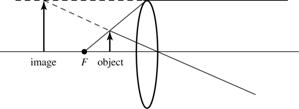
Figure 34.32
34.34. Identify: Apply .
Set Up: The sign of f
determines whether the lens is converging or diverging.  .
.  . Use to find the size and
orientation of the image.
. Use to find the size and
orientation of the image.
Execute: (a)  . and the lens is converging.
(b)  .
.  .
.  so the image is inverted.
(c) The principal-ray diagram is sketched in Figure 34.34.
Evaluate: The image is real so the lens must be converging.
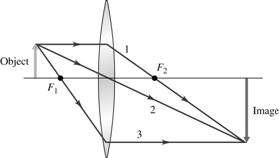
Figure 34.34