33.1. Identify: For reflection,  .
.
Set Up: The desired path of the ray is sketched in Figure 33.1.
Execute:  , so
, so  .
.  and
and  .
.
Evaluate: The angle of incidence is measured from the normal to the surface.
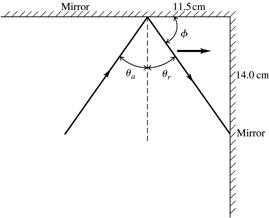
Figure 33.1
33.3. Identify and Set
Up: Use Eqs.(33.1)
and (33.5) to calculate v and 
Execute: (a) 
(b) 
Evaluate: Light
is slower in the liquid than in vacuum. By  when v is smaller,
  is smaller.
33.5. Identify:  .
.  , where
  is the wavelength in vacuum.
Set Up:  . n for
air is only slightly larger than unity.
. n for
air is only slightly larger than unity.
Execute: (a) 
(b) 
Evaluate: In quartz the speed is lower and the wavelength is smaller than in air.
33.7. Identify: Apply Eqs.(33.2) and (33.4) to
calculate  The angles in these
equations are measured with respect to the normal, not the surface.
The angles in these
equations are measured with respect to the normal, not the surface.
(a) Set Up: The incident, reflected and refracted rays are shown in Figure 33.7.
|
|
Execute: |
|
Figure 33.7 |
|


(b)  where the angles
are measured from the normal to the interface.
where the angles
are measured from the normal to the interface.


The refracted ray makes an angle of  with the surface of
the glass.
with the surface of
the glass.
Evaluate: The light is bent toward the normal when the light enters the material of larger refractive index.
33.17. Identify: The critical angle for total
internal reflection is  that gives
  in Snell's law.
Set Up: In
Figure 33.17 the angle of incidence  is related to angle
  by
by  .
.
Execute: (a) Calculate that gives  .
.  ,
,  so
so  gives
gives  .
.  and
and  .
.  .
.
(b) ,  .
.  .
.  and
and  .
.  .
.
Evaluate: The
critical angle increases when the ratio  increases.
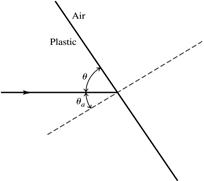
Figure 33.17
34.1. Identify and Set Up: Plane
mirror:  (Eq.34.1) and
  (Eq.34.2). We are
given s and y and are asked to find
(Eq.34.2). We are
given s and y and are asked to find 
Execute: The object and image are shown in Figure 34.1.
|
|
|
|
Figure 34.1 |
|


The image is 39.2 cm to the right of the mirror and is 4.85 cm tall.
Evaluate: For a plane mirror the image is always the same distance behind the mirror as the object is in front of the mirror. The image always has the same height as the object.
34.2. Identify: Similar triangles say  .
.
Set Up: 
 and
and 
Execute: 
Evaluate: The image of the tree formed by the mirror is 28.0 m behind the mirror and is 3.24 m tall.
34.3. Identify: Apply the law of reflection.
Set Up: If up is the +y-direction
and right is the +x-direction, then the object is at  and
and  is at
is at  .
.
Execute: Mirror 1 flips the y-values,
so the image is at  which is
Evaluate: Mirror 2 uses  as an object and forms an image at
  .
.
34.4. Identify: 
Set Up: For a concave mirror 
Execute: (a) 
Evaluate: (b) The image formation by the mirror is determined by the law of reflection and that is unaffected by the medium in which the light is traveling. The focal length remains 17.0 cm.
34.5. Identify and Set Up: Use Eq.(34.6) to
calculate  and use Eq.(34.7) to
calculate
and use Eq.(34.7) to
calculate  The image is real if is positive and is
erect if
The image is real if is positive and is
erect if  Concave means R and f
are positive,
Concave means R and f
are positive, 
Execute: (a)
|
|
Three principal rays, numbered as in Sect. 34.2, are shown in Figure 34.5. The principal ray diagram shows that the image is real, inverted, and enlarged. |
|
Figure 34.5 |
|

(b) 

 so real image, 33.0 cm
to left of mirror vertex
so real image, 33.0 cm
to left of mirror vertex
 (m < 0 means
inverted image)
(m < 0 means
inverted image) 
Evaluate: The image is 33.0 cm to the left of the mirror vertex. It is real, inverted, and is 1.20 cm tall (enlarged). The calculation agrees with the image characterization from the principal ray diagram. A concave mirror used alone always forms a real, inverted image if s > f and the image is enlarged if f < s < 2f.
34.6. Identify: Apply and  .
.
Set Up: For a convex mirror,  .
.  and
and  .
.
Execute: (a) The principal-ray diagram is sketched in Figure 34.6.
(b) .  .
.  .
.  . The image is 6.6 cm to the right of the mirror. It is 0.240
cm tall.
. The image is 6.6 cm to the right of the mirror. It is 0.240
cm tall.  , so the image is virtual.
 , so the image is erect.
Evaluate: The calculated image
properties agree with the image characterization from the principal-ray
diagram.
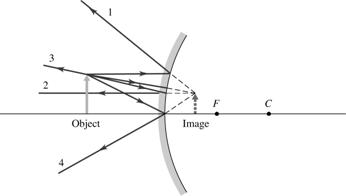
Figure 34.6
34.7. Identify:  .
.  .
.  . Find m and calculate
 .
.
Set Up:  .
.
Execute:  so
so  .
. 
 .
.
Evaluate: The image is real and is 1.75 m in front of the mirror.