27.43. Identify: The period is  , the current is
  and the magnetic moment is
Set Up: The
electron has charge  . The area enclosed by the orbit is
  .
.
Execute: (a)

(b) Charge passes a point on the orbit once during each period, so  .
.
(c) 
Evaluate: Since the electron has negative charge, the direction of the current is opposite to the direction of motion of the electron.
27.45. Identify: The magnetic field exerts a torque on the
current-carrying coil, which causes it to turn. We can use the rotational form
of
Set Up: The
magnetic torque is given by  , and the rotational form of
  . The magnetic field is parallel to the plane of the loop.
Execute: (a) The coil rotates about axis A2 because the only torque is along top and bottom sides of the coil.
(b) To find the moment of inertia of the coil, treat the two 1.00-m segments as point-masses (since all the points in them are 0.250 m from the rotation axis) and the two 0.500-m segments as thin uniform bars rotated about their centers. Since the coil is uniform, the mass of each segment is proportional to its fraction of the total perimeter of the coil. Each 1.00-m segment is 1/3 of the total perimeter, so its mass is (1/3)(210 g) = 70 g = 0.070 kg. The mass of each 0.500-m segment is half this amount, or 0.035 kg. The result is

The torque is

Using the above values, the rotational form of

Evaluate: This angular acceleration will not continue because the torque changes as the coil turns.
28.25. Identify: Apply Eq.(28.11).
Set Up: Two parallel conductors carrying current in the same direction attract each other. Parallel conductors carrying currents in opposite directions repel each other.
Execute: (a)
 and the force is
repulsive since the currents are in opposite directions.
and the force is
repulsive since the currents are in opposite directions.
(b) Doubling the currents
makes the force increase by a factor of four to 
Evaluate: Doubling the current in a wire doubles the magnetic field of that wire. For fixed magnetic field, doubling the current in a wire doubles the force that the magnetic field exerts on the wire.
28.28. Identify: Apply Eq.(28.11) for the force from each wire.
Set Up: Two parallel conductors carrying current in the same direction attract each other. Parallel conductors carrying currents in opposite directions repel each other.
Execute: On
the top wire  upward. On the middle
wire, the magnetic forces cancel so the net force is zero. On the bottom wire
upward. On the middle
wire, the magnetic forces cancel so the net force is zero. On the bottom wire 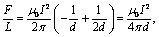 downward.
Evaluate: The net force on the middle wire is zero because at the location of the middle wire the net magnetic field due to the other two wires is zero.
28.31. Identify: Calculate the magnetic field vector produced by each wire and add these fields to get the total field.
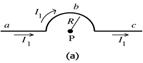
Set Up: First
consider the field at P produced by the current  in the upper
semicircle of wire. See Figure 28.31a.
in the upper
semicircle of wire. See Figure 28.31a.
|
|
Consider the three parts of this wire a: long straight section, b: semicircle c: long, straight section |
|
Figure 28.31a |
|
Apply the Biot-Savart law 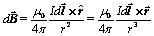 to each piece.
Execute: part a See Figure 28.31b.
|
|
so |
|
Figure 28.31b |
|
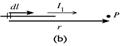


The same is true for all the infinitesimal segments that make up this piece of the wire, so B = 0 for this piece.
part c See Figure 28.31c.
|
|
so |
|
Figure 28.31c |
|
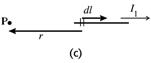

part b See Figure 28.31d.
|
|
|
|
Figure 28.31d |
|
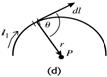


 The angle
  between
  the radius of the
semicircle. Thus
the radius of the
semicircle. Thus 


(We used that  is equal to
  the length of wire in
the semicircle.) We have shown that the two straight sections make zero contribution
to
the length of wire in
the semicircle.) We have shown that the two straight sections make zero contribution
to  so
so  and is directed into
the page.
and is directed into
the page.
|
|
For current in the direction shown in Figure 28.31e, a similar
analysis gives |
|
Figure 28.31e |
|
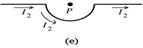

 are in opposite
directions, so the magnitude of the net field at P is
are in opposite
directions, so the magnitude of the net field at P is 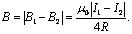
Evaluate: When 
28.33. Identify: Apply Eq.(28.16).
Set Up: At the center of the coil,  . a is the
radius of the coil, 0.020 m.
. a is the
radius of the coil, 0.020 m.
Execute: (a)

(b) 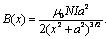

Evaluate: As shown in Figure 28.41 in the textbook, the field has its largest magnitude at the center of the coil and decreases with distance along the axis from the center.
28.35. Identify: Apply Ampere’s law.
Set Up: 
Execute: (a)
 and
and 
(b)  since at each point on the curve the direction of
  is reversed.
Evaluate: The line integral  around a closed path is proportional to the net current that
is enclosed by the path.
around a closed path is proportional to the net current that
is enclosed by the path.
28.43. Identify and Set Up: Use the appropriate expression for the magnetic field produced by each current configuration.
Execute: (a)
 so
so  .
.
(b)  so
so  .
.
(c)  so
so  .
.
Evaluate: Much less current is needed for the solenoid, because of its large number of turns per unit length.