27.3. Identify: The force
 on the particle is in the direction of the deflection of the
particle. Apply the right-hand rule to the directions of
on the particle is in the direction of the deflection of the
particle. Apply the right-hand rule to the directions of  and
and  . See if your thumb is in the direction of , or opposite to that direction. Use
  with
with  to calculate F.
Set Up: The
directions of , and are shown in Figure
27.3.
Execute: (a) When
you apply the right-hand rule to and , your thumb points east. is in this direction,
so the charge is positive.
(b) 
Evaluate: If
the particle had negative charge and and are unchanged, the particle would be deflected toward the
west.
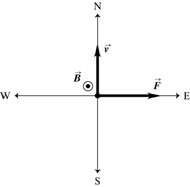
Figure 27.3
27.5. Identify: Apply and solve for v.
Set Up: An
electron has  .
.
Execute: 
Evaluate: Only
the component  of the magnetic field
perpendicular to the velocity contributes to the force.
of the magnetic field
perpendicular to the velocity contributes to the force.
27.7. Identify: Apply  .
.
Set Up:  , with
  .
.  and
and  .
.
Execute: (a)  .
.

 which is consistent
with as given in the problem. There is no force component along
the direction of the velocity.
which is consistent
with as given in the problem. There is no force component along
the direction of the velocity.
 .
.  .
.
(b)  is not determined. No force due to this component of along ; measurement of the force tells us nothing about
(c) 
 . and are perpendicular (angle is
  .
.
Evaluate: The
force is perpendicular to both and , so  is also zero.
27.9. Identify: Apply  to the force on the proton and to the force on the electron. Solve
for the components of .
to the force on the proton and to the force on the electron. Solve
for the components of .
Set Up: is perpendicular to both and . Since the force on the proton is in the +y-direction,  and
and  . For the proton,
  .
.
Execute: (a) For the proton, 
 so
so  . The force on the proton is independent of
  . For the electron,
  .
.  .
.
The magnitude of the force is  . Since
  ,
,  .
.  . The sign of is not determined by measuring
the magnitude of the force on the electron.  .
.  .
.  . is in the xz-plane
and is either at
. is in the xz-plane
and is either at  from the +x-direction toward the
  or from the
  toward the .
(b) .  .
.  .
. 
 .
.  .
.  . The force is in the xz-plane
and is directed at
. The force is in the xz-plane
and is directed at  from the
  toward either the +z or
  axis, depending on the
sign of .
axis, depending on the
sign of .
Evaluate: If the direction of the force on the first
electron were measured, then the sign of would be determined.
27.53. (a)
Identify: Use Eq.(27.2) to relate 
Set Up: The directions of  are shown in Figure
27.53a.
are shown in Figure
27.53a.
|
|
|
|
Figure 27.53a |
|


The directions of  are shown in Figure
27.53b.
are shown in Figure
27.53b.
|
|
|
|
Figure 27.53b |
|


Both pieces of information
taken together say that  is in the y-direction;

Execute: Use the information given about  to calculate


(b) 
Evaluate:  is perpendicular
to whereas only the
component of
is perpendicular
to whereas only the
component of  perpendicular to contributes to the
force, so it is expected that
perpendicular to contributes to the
force, so it is expected that  as we found.
27.55. Identify: The sum of the magnetic, electrical, and gravitational forces must be zero to aim at and hit the target.
Set Up: The
magnetic field must point to the left when viewed in the direction of the
target for no net force. The net force is zero, so  and qvB – qE – mg = 0.
Execute: Solving for B gives

The direction should be perpendicular to the initial velocity of the coin.
Evaluate: This is a very strong magnetic field, but achievable in some labs.