The answer is "image compression." Modern mathematics (some developed
in the last 20 to 30 years), electrical engineering (DSP) and computer science
have been responsible for the development of good image compression algorithms that have
application in many areas of mathematics.
The course will cover the mathematical basis of many of the ideas behind
image processing such as filtering, filter banks, the discrete Fourier
and cosine transforms and the discrete wavelet transform. All of this will
be balanced by applications of these ideas to various types of
problems in applied mathematics,
with a special emphasis on image compression. The images
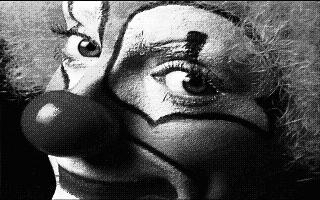
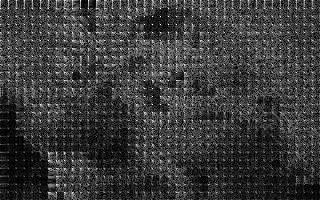
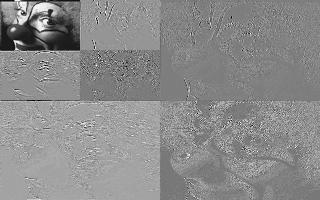
help make the mathematics more concrete, as the two pictorial illustrations of
Discrete Cosine Transform (DCT) based JPEG compression and Discrete
Wavelet Transform (DWT) based JPEG compression below show.
The course is aimed at juniors and seniors, though anyone who has a good grasp of basic matrix algebra will benefit. The essential mathematical ideas can be built upon matrix algebra and some Fourier series, that is, what you learned in MA212. The course work will consist of homework assignments, a couple exams and one or two projects. The primary computational tool will be Matlab. It is not necessary to know Matlab beforehand, though some computational experience is helpful (e.g. Matlab, Java, Python, anything really). Our main goal will be to understand the mathematics behind the current DCT-based JPEG (see picture above) compression method and new wavelet-based compression methods (see picture above). By learning the mathematical foundations as well as their application, we expect that students will gain background to further their learning of image processing methods and other areas of applied mathematics.
I particularly welcome any student who wants to do a related Imaging Certificate project after taking the course.
Any questions? Send me email: kurt.bryan@rose-hulman.edu
Return to the The MA 439 Page.